
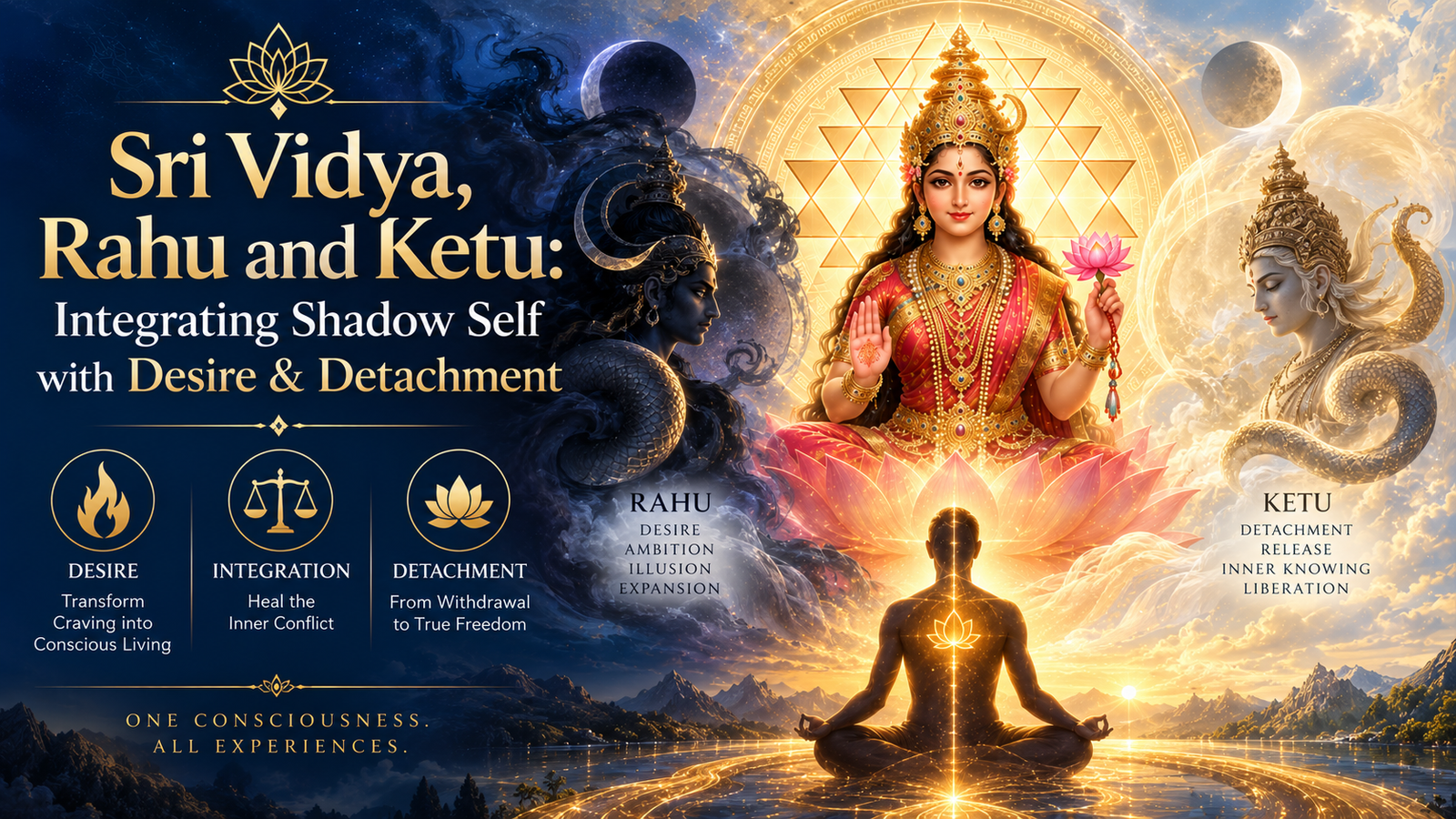
How the Divine Mother’s Symbolism Holds the Tension Between Wanting and Withdrawing
Rahu shows where a person wants more. Ketu shows where a person has already lost interest. Many people experience both tendencies at different points in life, sometimes within a short period. Vedic astrology describes these tendencies through Rahu and Ketu, the lunar nodes. Sri Vidya provides a spiritual framework for understanding both movements through awareness, without allowing either desire or withdrawal to define the whole of one’s experience.
What Rahu and Ketu Actually Represent
Rahu and Ketu are the two points where the Moon’s path crosses the Sun’s path, known as the lunar nodes. Vedic astrology treats them as a single axis because they always occupy opposite positions in a birth chart. Rahu is associated with expansion, ambition, craving, comparison, and attraction toward experiences that have not yet been fulfilled. Ketu is associated with withdrawal, detachment, disinterest, and the loss of attachment to experiences that once held importance.
Classical Vedic astrology understands this axis in karmic terms. Rahu and Ketu are not simply categories of good and bad. They indicate areas of imbalance, attachment, and separation within a person’s experience. The tension between them can create movement and development. Sri Vidya approaches this movement through awareness, allowing a person to recognise both tendencies without becoming completely identified with either one.
The Rahu Pattern: Desire Without Awareness
Rahu can be recognised in the tendency to want, compare, achieve, and continue seeking fulfilment. It can appear through ambition, attraction to status, repeated comparison with others, difficulty recognising when enough has been reached, or the belief that fulfilment will come through a future achievement.
Sri Vidya makes an important distinction here. Desire itself is part of worldly experience. Lalita Tripura Sundari is associated with beauty, abundance, enjoyment and the fullness of manifestation. The deeper question concerns identification with the object of desire and the expectation that achieving it will establish a lasting sense of completeness.
A promotion may provide recognition. A relationship may provide companionship. A possession may provide comfort or status. These experiences can be meaningful, while the deeper desire may concern security, recognition, belonging or rest. Recognising this distinction changes the way desire is understood.
The spiritual movement associated with Rahu therefore concerns awareness of desire. Desire can remain present while its object loses the authority to define one’s sense of self.
The Ketu Pattern: Detachment Without Integration
Ketu expresses a different tendency. Where Rahu is associated with movement toward experience, Ketu is associated with withdrawal from experience. This can appear as disinterest, emotional distance, loss of attachment, or a sense that previous goals have lost their importance.
Detachment can have spiritual value, but withdrawal can also become a way of avoiding experience. Sri Vidya provides an important distinction here. Its vision of liberation includes life within Shakti, the manifesting power of consciousness. Spiritual freedom therefore concerns the relationship with experience itself, rather than simple absence from worldly responsibilities.
A person can remain fully engaged with a relationship, career or responsibility while becoming less dependent on that experience for a sense of wholeness. This gives detachment a different meaning from disengagement.
Why Neither Pole Is the Goal
Rahu and Ketu describe two different movements of experience. Desire moves toward acquisition, recognition, and further experience. Detachment moves toward separation, disinterest and reduced involvement. Each can become limiting when identification with that movement becomes dominant.
Spiritual development concerns the awareness in which both tendencies can be recognised. Desire can be observed without automatically determining action. Detachment can be recognised without automatically becoming withdrawal. Sri Vidya places both within a larger understanding of consciousness, where neither tendency has to become the basis of identity.
Understanding the Shadow in Rahu and Ketu
The idea of the shadow adds another dimension to this teaching. In spiritual reflection, the shadow can refer to aspects of experience that a person has rejected, denied, exaggerated, or left unexamined.
The Rahu shadow can appear in desires that become difficult to acknowledge clearly. A person may strongly seek recognition, possession, influence or approval while believing that the object itself will provide lasting fulfilment. The desire becomes stronger when its deeper basis remains unexamined.
The Ketu shadow can appear through rejection. A person may distance themselves from relationships, responsibilities or emotions because engagement feels uncomfortable or unnecessary. Detachment can then become a fixed position instead of a conscious freedom.
Shadow integration in this context means recognising both tendencies with greater clarity. It does not require rejecting desire or abandoning detachment. It requires understanding the attachment, avoidance, or identification that can accompany them.
This gives the Rahu-Ketu axis a useful spiritual interpretation:
Rahu asks what continues to be desired.
Ketu asks what has been rejected or left behind.
Awareness allows both to be recognised clearly.
Sri Vidya places both within the larger understanding of consciousness.
Lalita Tripura Sundari and the Integration of Desire and Detachment
This teaching becomes more complete when considered through Lalita Tripura Sundari, the central form of the Divine Mother in Sri Vidya.
Her significance in this context lies in the relationship between consciousness, manifestation, and liberation. Sri Vidya does not require worldly experience and spiritual realisation to be treated as mutually exclusive. Beauty, abundance, relationship, responsibility and spiritual knowledge can all be understood within the manifestation of Shakti.
This provides a deeper context for the Rahu-Ketu tension. Desire does not have to be treated as spiritual failure, and detachment does not automatically establish spiritual maturity. Both can become objects of awareness.
Lalita Tripura Sundari is also described through the name Nirguna, indicating the reality beyond the qualities that characterise manifest experience. The teaching therefore moves beyond identification with any single state. Desire can be known. Detachment can be known. Attachment and aversion can be known. Awareness remains present through all of them.
This is the significance of Lalita in the context of shadow integration. The aim is not to create a personality that is permanently desirous or permanently detached. The deeper aim is recognition of the consciousness in which both experiences arise.
The Sri Chakra and the Movement Toward the Bindu
The Sri Chakra provides a central visual representation within Sri Vidya. Its nine interlocking triangles form a complex structure associated with the many dimensions of manifestation, while the bindu at the centre represents the most subtle centre of the yantra.
The outer structure can be contemplated in relation to the complexity of human experience: desire, fear, relationship, responsibility, achievement and attachment. The bindu represents the central principle toward which Sri Vidya directs contemplation.
Rahu can be interpreted here as attention becoming increasingly involved with desired objects and experiences. Ketu can be interpreted as attention becoming increasingly disengaged from objects and experiences. Both movements remain connected with the changing contents of experience.
The movement from the outer structure toward the bindu therefore provides a useful way to understand the spiritual principle of returning attention to its source. This connection between Rahu-Ketu and the Sri Chakra is an interpretive framework for reflection. Traditional Jyotish and Sri Vidya developed as distinct bodies of teaching, so the connection should be understood at the level of interpretation rather than presented as a historical claim that both systems were originally taught together.
Recognising Rahu-Ketu Patterns in Daily Life
These patterns can be recognised through ordinary experience without requiring a birth chart. The important point is the quality of awareness brought to the experience.
A strong desire may become clearer when its deeper expectation is examined. The desired object may concern security, recognition, belonging, pleasure or achievement.
A period of detachment may also require careful observation. Reduced interest can represent genuine freedom, while it can also indicate avoidance of an experience that remains difficult to engage with.
The distinction between detachment and disengagement becomes especially important here. Detachment allows a person to remain present while reducing dependence on a particular outcome. Disengagement removes involvement from the experience itself.
Similarly, awareness changes the relationship with desire. A desire can be understood clearly without allowing its urgency to determine every decision. This is one practical meaning of observing Rahu and Ketu within daily life.
Conclusion
Rahu represents the tendency toward further experience. Ketu represents the tendency toward withdrawal from experience. Both can influence thought, desire, action, and identity.
Sri Vidya provides a different basis for understanding this tension. Desire can be recognised without becoming the measure of fulfilment. Detachment can be understood without becoming withdrawal from life. Shadow integration begins when these tendencies are seen clearly, and their deeper basis is understood.
Within the vision of Lalita Tripura Sundari, worldly experience and spiritual awareness belong to the same reality of Shakti. The movement toward fulfilment therefore becomes a movement toward greater awareness of consciousness itself.
Rahu and Ketu remain meaningful as movements within experience. The deeper spiritual question is the awareness in which those movements are known.
Frequently Asked Questions
- Are Rahu and Ketu considered malefic planets that need to be fixed?
Classical Vedic astrology treats Rahu and Ketu as karmic indicators rather than simply negative forces. They indicate areas associated with attachment, separation, imbalance and karmic development. Their significance depends on the wider birth chart and the traditional interpretive framework being used. - Does Sri Vidya say desire is spiritually wrong?
No. Sri Vidya includes worldly experience, beauty, abundance and enjoyment within the manifestation of Shakti. The deeper concern is identification with desire and the expectation that an external object will provide lasting completeness.
Related posts:
Lalita Tripura Sundari: Introduction and Meaning of the Name
Sri Vidya: The blessing of Magnetism, Creativity, and Beauty
Lalita Tripura Sundari: The Divine Union of Mahasaraswati, Mahalakshmi and Mahakali
Sri Vidya: Pure Devotion as the First Blessing
Sri Vidya: The Blessing of Abundance: Prosperity, Success and the Fulfillment of Life

Rohit Ray Sharma is a spiritual awakening coach in India helping conscious professionals and seekers find greater clarity, purpose, and self-awareness. His work draws on the wisdom of India’s Shakta and Shiva traditions, with a focus on Sri Vidya, spiritual awakening, consciousness, self-realisation, and inner transformation. Book a one-to-one spiritual awakening session to begin your journey toward greater clarity and purposeful living.
- Rohit Ray Sharma
- Rohit Ray Sharma
- Rohit Ray Sharma
- Rohit Ray Sharma