
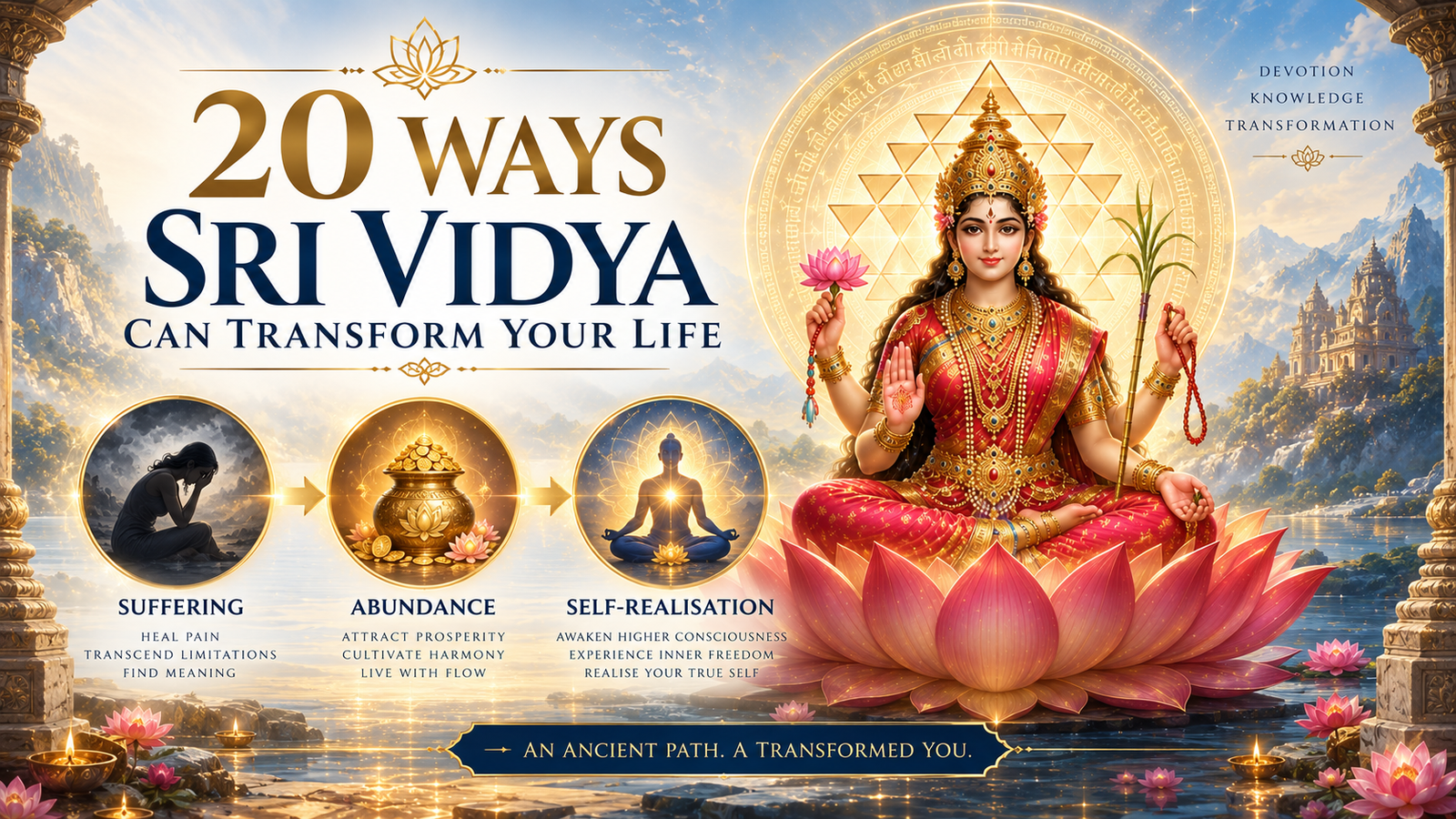
A Practical Guide to Sri Vidya’s Teaching on Suffering, Abundance and Self-Realisation
Sri Vidya is a Shakta tradition within Indian spiritual life, centred on the worship of the Divine Mother as the source of wisdom, abundance and transformation. It holds worldly life and spiritual freedom together rather than treating them as opposites, which is part of what makes its teaching so directly applicable to an ordinary life full of work, relationships and responsibility. Its deeper purpose is a way to understand suffering, desire, abundance, success, and purpose differently, arriving at a closer relationship with the Divine Mother and with your own deepest nature.
Lalita Tripura Sundari: The Center of Sri Vidya
Every shift described in this article is understood, within Sri Vidya, as arising through relationship with Lalita Tripura Sundari, the Divine Mother at the centre of this tradition. Her three aspects, Mahakali, Mahasaraswati and Mahalakshmi, are her own functions: the release, the wisdom and the abundance she brings as one continuous grace. They are what happens in an ordinary life as a relationship with her grows more real.
What follows are twenty ways that relationship shows up, grouped by the part of life each one touches.
How Your Relationship With Suffering and Desire Changes
The first shift Sri Vidya brings is not the removal of difficulty. It is a change in what difficulty is for.
- Suffering becomes something you can work with. Fear, attachment, confusion, and desire left unfulfilled stop feeling like separate problems that need separate solutions. Sri Vidya reads them as one connected territory, and offers a way to meet that territory directly instead of only managing its symptoms.
- A deeper stillness becomes available. As the mind spends less energy on constant wanting and resisting, peace stops depending on external conditions lining up. It becomes something closer to your ordinary state, available through the distractions of a given day.
- Satisfaction stops depending on the next acquisition. Fulfilment shifts from something chased through the next purchase, promotion, or achievement toward something recognised in what is already present. This is a genuine change in where satisfaction is looked for, and it works without denying yourself things.
- Desire matures. Instead of treating every desire as something that must be fulfilled immediately, you start noticing what a given want is actually about. Often it is not the object itself but a need for security, recognition, or rest, and naming that changes how you pursue it.
Once suffering and desire are understood this way, the next question becomes what to do with the energy that used to go into managing them.
How the Three Shaktis Show Up as Inner Change
Sri Vidya’s teaching identifies three specific powers at work in a life, each connected to a different Devi. Recognising these shifts as they happen only takes attention, without needing deep study of the theology first.
- Old patterns start to loosen. This is Mahakali’s dimension: the power to release fear, outdated identities and habits of thought that have outgrown their usefulness. It rarely arrives as a dramatic break. Usually it looks like one assumption, carried for years, quietly stopping being true.
- Discernment sharpens. Mahasaraswati’s dimension moves you from reacting to appearances toward recognising what is actually true, not just what appears true. Decisions that once felt confusing start to have a clearer shape, not because the situation changed, but because your ability to see it did.
- Creativity opens on its own. The same discernment that sharpens also connects you to expression, learning and beauty, the parts of Saraswati’s domain that do not announce themselves as spiritual but change how you work and make things.
- Prosperity and harmony. Mahalakshmi’s dimension brings attention to nourishment, generosity, and the conditions that let a life actually flourish, prosperity understood as something received and shared instead of endlessly accumulated.
- Will, knowledge and action start moving in one direction. When what a person wants, understands and does begin to line up, a life stops feeling fragmented across competing priorities. Effort starts to feel less scattered because it is no longer working against itself.
These five shifts describe the inner mechanics. The next set describes what changes once they take hold.
How Sri Vidya Redefines Success and Prosperity
Sri Vidya holds a meaningful life and a prosperous one together, instead of asking you to choose between them.
- Purpose becomes clear in what your goals actually serve. Life moves from simply pursuing targets toward understanding what those targets are actually serving. The goals themselves may stay the same. What changes is your relationship to why you are chasing them.
- Success stops being measured by one number. Money, status, and achievement remain real, but they stop being the whole picture. Wisdom, harmony, meaningful relationships, and contribution start counting as success in their own right.
- Abundance is received rather than hoarded. Prosperity becomes something to enjoy and share, instead of something to endlessly accumulate as protection against an imagined future. The shift is less about how much a person has and more about how tightly it is held.
- Spiritual life and material life stop competing. Sri Vidya’s own teaching holds worldly fulfilment and liberation together, so ambition and practice can develop together instead of working against each other.
- Peace and prosperity stop being traded off against each other. The goal is neither external success without inner peace, nor inner peace bought through rejecting the world. Sri Vidya points toward both moving together, each one making the other more complete.
What starts as a private shift in how you see success eventually changes what you do with what you build.
How Sri Vidya Changes What You Do With What You Receive
A quieter set of shifts happens once the earlier ones settle: attention starts moving outward, toward what your growth can offer beyond yourself.
- A natural presence develops. Lalita’s symbolism of beauty and radiance describes the presence that emerges when a person’s values and actions move in the same direction. People notice this kind of alignment even when they cannot name what they are noticing.
- Challenges start to mean something different. A difficulty stops being purely an obstacle to escape and starts becoming material for release and deeper awareness. The event itself may not change. What it is asking of you does.
- Life moves from self-centred toward service. As wisdom and abundance mature, what you receive stops staying only yours. Seva, service offered without expecting something back, becomes a natural extension of growth as it deepens.
- Achievement connects to something larger than the individual. Accomplishments feel richer once they are tied to contribution and compassion, and thinner when they stay purely personal. This is less a moral rule than an observation about what actually satisfies over time.
Devotion Within This Journey
Devotion within Sri Vidya tends to move through its own progression. It often begins with approaching the Divine Mother for something specific- clarity, relief, a change in fortune, and there is no dishonesty in starting there. As the relationship continues, seeking her blessings can grow into trusting her and simply loving her, apart from what she gives in return. Further still, her presence can be recognised inside ordinary life itself, sensed as already present in the work, the relationships and the decisions that fill a day.
The Larger Shift: From Self-Development to Self-Realisation
The last two shifts describe something bigger than a change in habits or outlook. They describe a change in what a life is understood to be for.
- Growth moves beyond improving circumstances. Early practice tends to focus on fixing what feels wrong, more peace, more clarity, more stability. Over time, the focus moves toward recognising the deeper nature of consciousness itself, the awareness in which all that fixing was happening.
- The basic question a life is asking changes. It moves from what a person can get from life toward what life is revealing, what you are here to realise, and how what you receive can become an expression of wisdom and service in turn.
Suffering leads to understanding. Confusion gives way to wisdom. Desire, once matured, becomes contentment. Attachment, once released, becomes freedom. Scarcity, once questioned, turns into abundance. Success, once examined, points toward purpose. Self-development, taken far enough, becomes self-realisation. Receiving, once it grows, turns into giving. None of these arrive all at once, and none of them require abandoning the life you already have. They describe a life understood differently from the inside, one where peace, prosperity and purpose stop competing for the same limited space and start working together, the way Sri Vidya has always taught they were meant to.
A life touched by Sri Vidya does not look dramatically different from the outside. The same work continues, the same relationships, the same daily decisions. What changes is what all of it is understood to be in service of, and who it is ultimately offered to.
Frequently Asked Questions
- Can these shifts happen without formal initiation or ritual?
Learning about Sri Vidya and undertaking Sri Vidya sadhana are two different things. The philosophical teachings in this article, how suffering, desire, success and generosity are understood, can be studied and reflected upon by anyone. Traditional Sri Vidya practice, with its specific mantras, yantras and initiatory disciplines, belongs within an established guru-parampara, a lineage of teacher and student, and is not something these pages can substitute for. - What place does devotion have in this teaching?
Devotion typically moves from approaching the Divine Mother for something specific toward trusting and loving her for her own sake, and eventually toward recognising her presence already inside ordinary life. This progression is what keeps the twenty shifts from becoming self-improvement in spiritual language.
Related posts:
Who Is Lalita Tripura Sundari: The Divine Mother of Sri Vidya
Lalita Tripura Sundari: Introduction and Meaning of the Name
Sri Vidya, Rahu and Ketu: Integrating Shadow Self with Desire & Detachment
Sri Vidya: The blessing of Magnetism, Creativity, and Beauty
Lalita Tripura Sundari: The Divine Union of Mahasaraswati, Mahalakshmi and Mahakali

Rohit Ray Sharma is a spiritual awakening coach in India helping conscious professionals and seekers find greater clarity, purpose, and self-awareness. His work draws on the wisdom of India’s Shakta and Shiva traditions, with a focus on Sri Vidya, spiritual awakening, consciousness, self-realisation, and inner transformation. Book a one-to-one spiritual awakening session to begin your journey toward greater clarity and purposeful living.
- Rohit Ray Sharma

- Rohit Ray Sharma
- Rohit Ray Sharma
- Rohit Ray Sharma