
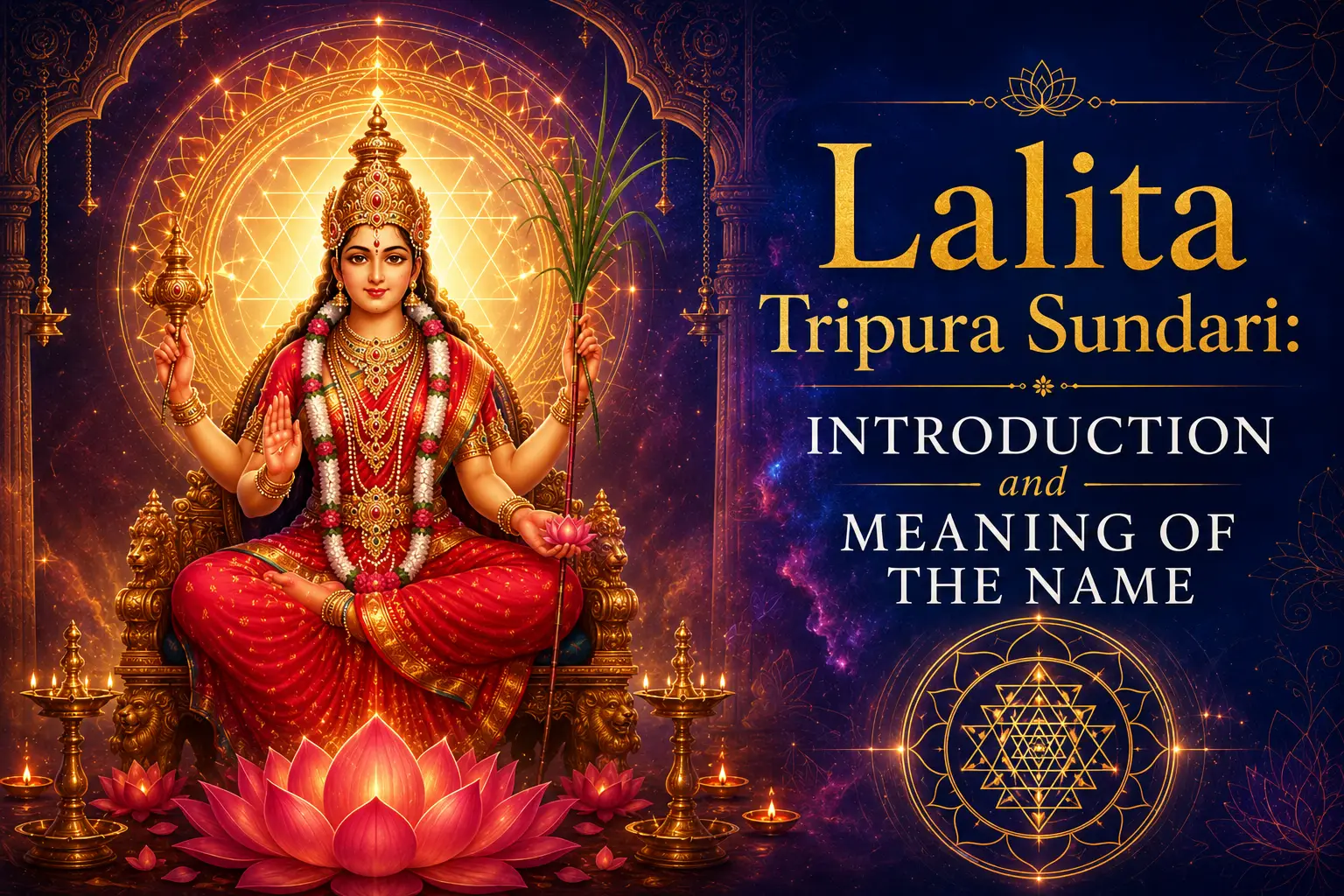
A Name That Is Also a Teaching
In the Vedic tradition, a name carries the full weight of the reality it describes. Every name given to a deity is a compressed teaching, a precise description of that reality’s nature, function, and relationship to existence. The name Lalita Tripura Sundari is deeply meaningful. Each of its three parts expresses a complete philosophical truth. Together they describe the nature of the supreme goddess, the structure of creation, and the relationship between consciousness and the universe.
Lalita: The Spontaneous Nature of Creation
The word Lalita comes from the Sanskrit root meaning to play, to move freely, to express with effortless completeness. This single word carries the Shakta understanding of creation in its most distilled form.
Creation, in this tradition, arises from fullness rather than effort. It flows from the Divine Mother the way expression naturally moves through a being who is complete within themselves, freely, joyfully, without strain. The universe is her lila, her divine play, her natural expression of inner fullness moving outward into form.
This understanding has a profound effect on how a sincere seeker reads existence. If creation is Lalita’s spontaneous expression, then every arising within that creation, every season of life, every experience of beauty and difficulty alike, belongs to an intelligent, conscious unfolding guided by living intelligence. The word Lalita places the whole of existence within the field of her awareness and her natural creative outpouring.
Tripura: Three Worlds, Three States, Three Times
The word Tripura carries three distinct and simultaneous layers of meaning. Each layer operates at a different level of understanding, and all three are true at once.
The cosmological level refers to the three worlds: the gross world of physical matter, the subtle world of the mind and vital energy, and the causal world of pure consciousness from which the other two arise. Lalita presides over all three. She is the supreme reality that holds the entire structure of manifest and unmanifest existence within herself simultaneously.
The experiential level points to the three states of consciousness that every human being moves through in every cycle of a day: waking, dreaming, and deep sleep. In the waking state, the mind engages with the outer world through the senses. In dreaming, consciousness creates its own inner world from impressions. In deep sleep, both the outer and inner worlds dissolve, and awareness rests in its own unobstructed ground. Lalita presides over all three. She is the continuous presence behind every shifting state, the awareness that remains when its objects change completely.
Tripura represents the conscious, subconscious, and superconscious mind. – Tripura can also be understood as the Divine Mother who governs the three levels of the human mind. She illumines the conscious mind, through which we think, speak, and act in the world. She also pervades the subconscious mind, where memories, emotions, impressions (samskaras), and latent tendencies are stored. Beyond both shines the superconscious, the state of pure awareness where the individual self awakens to its unity with the Divine.
As Tripura Sundari, she harmonizes these three dimensions of the mind, transforming ordinary awareness into spiritual wisdom. When the conscious mind becomes pure, the subconscious is healed, and the superconscious awakens, the seeker begins to recognize the ever-present Divine Mother within. Thus, Tripura is not merely the ruler of three worlds but the goddess of the entire inner landscape of human consciousness.
The metaphysical level points to the three aspects of time: past, present, and future. Time itself is her creation. All three phases of time arise within her, move within her, and dissolve back into her. She is beyond containment within time. Time exists within her. At dissolution, she is the abode of all tattvas, all principles of existence, still remaining herself, unchanged. She gave birth to the three worlds and receives them back at the end of each cycle, remaining exactly what she was before any of it began.
Understanding Tripura at all three levels simultaneously begins to reveal why the tradition places her as the foremost of the Mahavidyas and the supreme reality of the Srikula lineage.
Sundari: Beauty as the Signature of Wholeness
The word Sundari means the beautiful one. This is beyond the ordinary perception of physical beauty.
When consciousness is whole, undivided, and fully present to itself, Beauty, at this level, is the natural signature of a reality that lacks nothing, that holds no inner conflict or division, that is entirely aligned with its own deepest nature.
Lalita is Sundari because she is the most complete form of reality. Her beauty is the visible expression of absolute wholeness. The seeker who approaches her with genuine sincerity begins to recognise this quality in her form, in the living world, and in the nature of existence itself. When the inner life becomes more whole, more aligned, more awake, the world begins to carry a quality of beauty that was always present but had been obscured by the divided condition of the perceiving mind. This is Sundari’s teaching working within the seeker’s own direct experience.
Her Names as Precise Descriptions of Cosmic Function
Each of her major names describes a specific dimension of her nature with the precision of a working definition rather than a poetic title.
Tripura Sundari is also known as Lalita, Shodashi, Kamakshi, and Rajarajeshvari. She is recognised as one of the ten Mahavidyas and is described as the foremost of the Mahavidyas in the Srikula tradition.
Shodashi – Śoḍaśī means “the Sixteenth One.” She is the youthful form of Śrī Lalitā Tripura Sundarī, traditionally described as a radiant Goddess of sixteen years of age. Just as the full moon shines with all sixteen kalās (digits or rays), Śoḍaśī embodies the complete manifestation of Divine Śakti. She is the living symbol of complete consciousness, complete power, complete bliss, and complete realization. Like the full moon shining with all sixteen kalās, she reveals the highest state in which nothing remains incomplete, and the individual soul awakens to its identity with the Divine. She also corresponds to the sixteenth-syllable mantra, the Shodashi mantra.
Rajarajeshwari means the queen who rules over all rulers. Every deity, every cosmic force, every principle of creation operates under her sovereignty. All gods and goddesses worship her. All letters and their sound originate from her. Hence, she is called the embodiment of mantras. The queen of queens is the tradition’s way of placing her above every other divine function in the hierarchy of cosmic governance.
Kamakshi means the one whose eyes hold the power of desire and fulfilment simultaneously. Kama is desire, and akshi is eye. Her gaze generates desire within creation and simultaneously fulfils it. She both creates longing and satisfies it. This is a precise description of how creation works: consciousness generates the pull toward experience, and that same consciousness is the fulfilment of every experience that arises within it.
The Complete Name as a Living Teaching
Lalita Tripura Sundari is the supreme power who expresses creation freely, who presides over the three worlds, the three states of consciousness, and the three dimensions of time, and whose absolute wholeness radiates as the beauty at the root of all existence.
Each part of the name points to a different dimension of her nature. Lalita points to the quality of her expression: free, alive, complete. Tripura points to the scope of her sovereignty: the whole of creation in all its levels and all its time. Sundari points to the nature of what she is: whole, undivided, radiant with the beauty that belongs to a consciousness that lacks nothing.
Held together, the name describes the complete Absolute in feminine form. The entire teaching of the Shakta tradition about the nature of reality, the nature of consciousness, and the nature of creation is present in these three words.
Benefits of worship of Lalita Tripura Sundari
In the Sri Vidya tradition, the worship of Lalita Tripura Sundari is regarded as one of the highest paths to both worldly fulfillment and ultimate liberation. As the Supreme Divine Mother, she blesses the devotee with health, prosperity, harmonious relationships, wisdom, protection, inner peace, and success in righteous worldly pursuits (bhoga), while simultaneously awakening higher consciousness, purifying the mind, dissolving ignorance, and guiding the seeker toward Self-realization (Atma Jnana) and liberation (moksha). Unlike many spiritual paths that emphasize either worldly life or renunciation, Lalita’s grace harmonizes both, teaching that spiritual realization can unfold while living a complete and balanced life. This truth is beautifully expressed in the traditional verse:
A famous verse states:
यत्रास्ति मोक्षो नहि तत्र भोगो
यात्रास्ति भोगो नहि तत्र मोक्ष:।
श्रीसुन्दरीसेवनतत् पराणां
भोगश्च मोक्षश्च करस्थ एव।।
Yatrāsti bhogo na ca tatra mokṣaḥ,
Yatrāsti mokṣo na ca tatra bhogaḥ,
Śrī-Sundarī-sevana-tatparāṇām,
Bhogaś ca mokṣaś ca karastha eva.
Meaning
“Where there is worldly enjoyment alone, liberation is absent. Where there is liberation alone, worldly enjoyment is absent. But for those devoted to the worship of Sri Sundari, both worldly enjoyment and liberation rest in the palm of their hand.”
Another important verse says: from Lalitopākhyāna (Brahmāṇḍa Purāṇa)
तस्मादशेषलोकानां
त्रिपुराराधनं विना ।
नास्ति भोगापवर्गौ तु
यौगपद्येन कुत्रचित् ॥
Tasmād aśeṣa-lokānāṁ
Tripurārādhanaṁ vinā,
Nāsti bhogāpavargau tu
Yaugapadyena kutracit.
Meaning
“Therefore, without the worship of Goddess Tripura, nowhere in all the worlds can one attain both worldly enjoyment (bhoga) and liberation (apavarga or moksha) simultaneously.”
Related posts:
Sri Vidya : The Awakening of Purpose with Desire to Serve
Sri Vidya : From Personal Desire to Divine Purpose
Sri Vidya: Awakening and Liberation - Recognizing the Divine Mother Within
Spiritual Awakening: Understanding Why Life Starts Falling Apart
Sri Vidya: The blessing of Magnetism, Creativity, and Beauty

Rohit Ray Sharma is a spiritual awakening coach in India helping conscious professionals and seekers find greater clarity, purpose, and self-awareness. His work draws on the wisdom of India’s Shakta and Shiva traditions, with a focus on Sri Vidya, spiritual awakening, consciousness, self-realisation, and inner transformation. Book a one-to-one spiritual awakening session to begin your journey toward greater clarity and purposeful living.
- Rohit Ray Sharma
- Rohit Ray Sharma
- Rohit Ray Sharma
- Rohit Ray Sharma