
Understanding the Three Powers of Wisdom, Abundance and Transformation in Sri Vidya
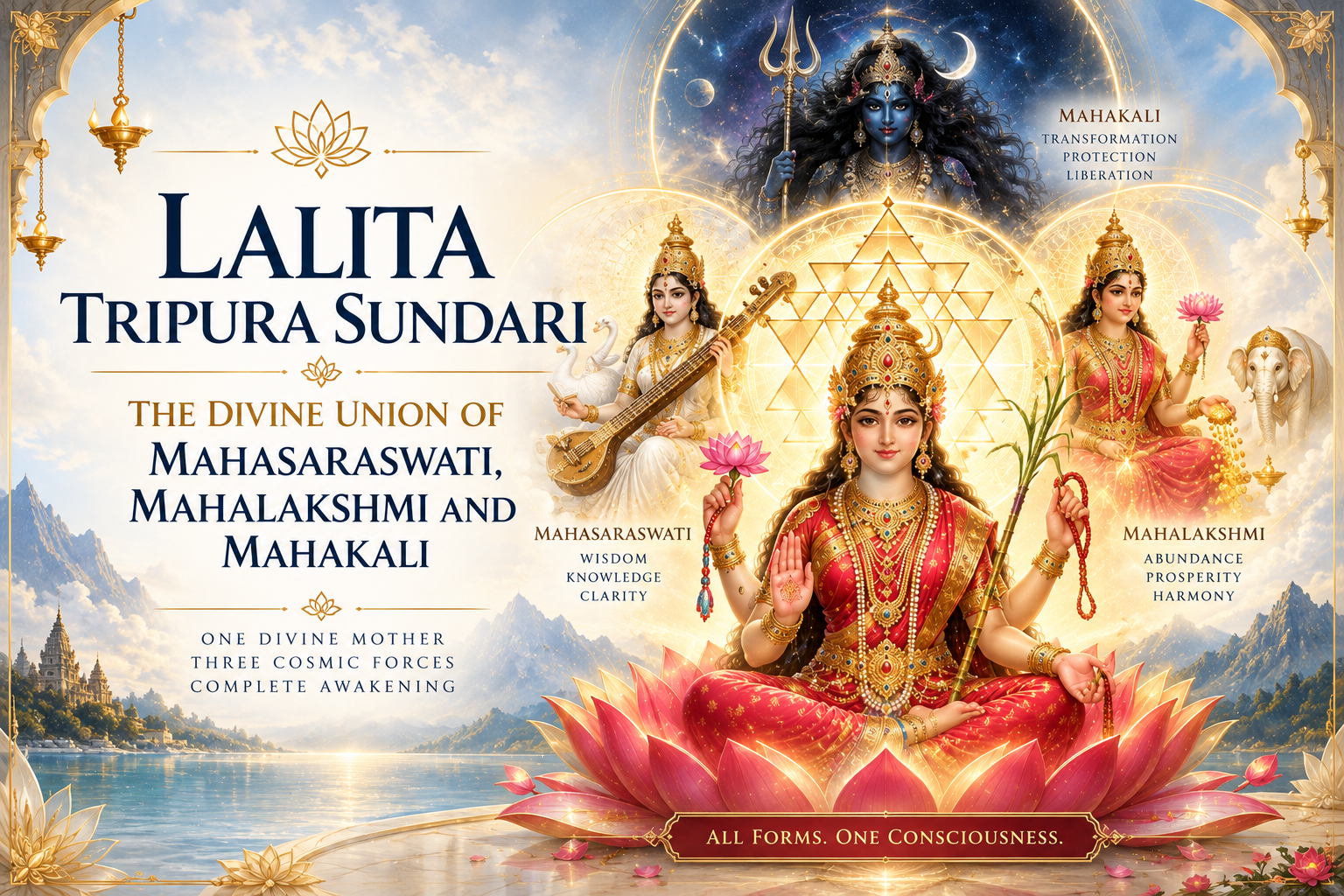
Lalita Tripura Sundari is worshipped in Sri Vidya as the goddess in whom knowledge, abundance and transformation meet as a single power. Anyone who first comes across her name also comes across three other goddesses: Mahasaraswati, Mahalakshmi and Mahakali, worshipped widely during Navaratri. A question follows naturally. Are these three the same as Lalita, separate expressions of one power, or unrelated forms that simply share a family resemblance?
There is a precise answer, and it goes deeper than a simple yes or no. Lalita Tripura Sundari is taught as the supreme unity from which the three powers of knowledge, abundance, and transformation arise, and into which they are gathered back as one continuous grace. At the same time, her own thousand sacred names call her Nirguna, the one beyond these very qualities. She takes the form of the three, expresses herself through them, and, according to her own thousand names, remains beyond every one of them. That is the central teaching this article decodes, section by section, connecting cosmic symbolism to the way these three powers already move through your own life.
Who Is Lalita Tripura Sundari in Sri Vidya
Lalita Tripura Sundari stands at the center of Sri Vidya, one of the great Shakta paths within Indian spiritual tradition. She is counted among the ten Mahavidyas, the great wisdom forms of the Divine Feminine. Her name carries its own decoding. Lalita means the one who plays, reframing all of creation as something that arises freely and out of abundance, carried by joy rather than strain.
Tripura Sundari means the beauty of the three worlds. The number three repeats through her symbolism at several levels. It points to the three realms of experience that make up a human life. It points to the three states every person moves through daily: waking, dreaming, and deep sleep. It also points to the three gunas, sattva, rajas, and tamas, the qualities said to weave every experience, object, and personality trait in the material world. She carries the name Sundari, beautiful, because the three worlds, the three states of consciousness, and the three gunas are all present within her at the same time, one single nature described from three angles. You already live inside all three at once, whether or not you have named them before.
Why Mahasaraswati, Mahalakshmi and Mahakali Are Connected With Her
A related teaching within the wider Shakta tradition describes the Goddess appearing across three great forms, each connected to one of the three gunas that shape human nature. In one well-known Shakta presentation, Mahakali is linked with tamas, Mahalakshmi with rajas, and Mahasaraswati with sattva. This particular mapping is common, but it is not the only one taught across Shakta tradition, and different lineages sometimes emphasise the three forms differently. The mapping matters less than the deeper point underneath it: Shakti expresses herself through three functions, gathered under one source.
The stronger understanding holds three ideas together. The three goddesses reveal different dimensions of one Divine Shakti. Lalita Tripura Sundari represents the supreme unity from which those powers arise. And she remains the source in which they are reconciled, held as one continuous power instead of three separate blessings a devotee collects one at a time.
Mahasaraswati: The Power of Knowledge and Creative Intelligence
Sattva belongs to Mahasaraswati, carried as knowledge, discernment, and creative clarity. This is understanding that changes how you actually see a situation, the difference between knowing a fact and recognising a pattern in your own life for the first time.
This differs from ordinary intellectual accumulation. A person can hold a great deal of information and still act from confusion. Mahasaraswati’s gift moves toward discernment, the capacity to see what is true underneath what only appears true. It also moves toward creative intelligence, the ability to shape new understanding instead of repeating old conclusions.
Mahalakshmi: The Power of Abundance and Prosperity
Prosperity, beauty, and the drive toward flourishing move through Mahalakshmi as rajas. The word Sri itself, closely associated with Lakshmi and present in Lalita Tripura Sundari’s own epithets, carries this same meaning of auspiciousness and abundance.
Sri Vidya welcomes prosperity as a legitimate part of spiritual life. This abundance finds its fullest expression when it grows alongside dharma, right conduct. Chased for its own sake, prosperity turns into grasping. Held alongside dharma, it turns into flourishing that has room for generosity in it.
Mahakali: The Power of Transformation and Liberation
Tamas is Mahakali’s domain, and here the symbolism needs careful reading, since tamas is usually mistaken for simple inertia. Her tamas is understood specifically as the power to dissolve what has become fixed, including old fear, ego-bound identity, and thought patterns that have hardened past their usefulness.
Her fierce iconography expresses compassion through severity. Some patterns in a life only loosen when something in you finally becomes willing to let them dissolve. This is why, at the individual level, she is connected to the same movement that liberation itself requires: the dissolving of what the self has mistakenly held onto as permanent.
The Story of Bhandasura: Ego Dissolved by Grace
Her own arising gives this teaching a story to stand alongside the philosophy. When a demon named Bhandasura, born from the ashes of Kamadeva, desire itself, grew powerful enough to threaten the balance of the worlds, the gods had no way to stop him on their own. They turned to the Divine Mother. She arose from a sacred fire in her full radiant form, seated upon the Sri Chakra, and after a great battle, dissolved Bhandasura and restored balance.
Bhandasura stands for what the article has already been describing in abstract terms: ego, ignorance, and desire that has grown unmastered instead of understood. His birth from Kamadeva’s ashes is a precise detail. It places the origin of the problem inside desire itself, the same territory the article returns to later when it discusses how Lalita’s grace transforms your relationship with wanting. Her victory is wisdom and grace dissolving what force alone cannot remove, and the same movement is available to you every time an old fear or a fixed way of seeing yourself finally loosens its grip, not through force, but through a clarity that simply stops feeding it.
In her classical form, she carries a sugarcane bow, five flower arrows, a noose and a goad. Each is read literally. The bow, made of sugarcane, represents the mind, sweet and pliable, capable of being shaped. The five arrows, made of flowers, represent the five senses through which the mind meets the world. The noose represents attachment, and the goad represents aversion, the two motions of pulling toward and pushing away that keep a person bound to what they desire and afraid of what they resist. She is shown holding these, not destroying them: mastery of the mind and senses means directing them with a steady hand, the same steadiness you are asked to bring to your own mind and senses long after the story ends.
Lalita Tripura Sundari as the Unity of the Three Shaktis
Lalita Tripura Sundari is the point where these three powers gather and from which they arise. Knowledge, abundance, and transformation stop being three separate blessings you must chase down one at a time. They become three expressions of a single grace, present together, all at once.
A complete spiritual life needs all three, working together. Wisdom without transformation can remain understood in the mind but untested in life. Abundance without wisdom can turn into attachment. Transformation without wisdom can turn into disruption that has no direction. Lalita represents integration itself, the state in which knowing, flourishing and releasing support each other instead of pulling a life in three directions.
The Deeper Meaning of Tripura: Goddess of the Threefold Reality
Tripura is often translated only as “the three worlds,” but the symbolism reaches further. She is the Divine Mother who encompasses the threefold structure of existence itself. This pattern of three appears again and again once you start looking for it: three worlds, three states of consciousness, three gunas, three great powers.
This threefold structure is the shape existence itself takes. Lalita Tripura Sundari is named for standing at the center of that structure, present within it instead of watching it from outside.
Her Sacred Form: The Sri Chakra and the Point Beyond It
Sri Vidya gives this threefold structure a visible form, the Sri Chakra, also called the Sri Yantra. It is built from nine interlocking triangles, some pointing upward and some downward, layered together and surrounded by circles of lotus petals. The upward triangles represent Shiva, consciousness. The downward triangles represent Shakti, the active power of creation. Their overlapping is read as the same union already described in her name Lalita, creation understood as a meeting, not a struggle.
At the exact center of the Sri Chakra sits a single point, the bindu. Lalita Tripura Sundari resides at this point as pure, undivided consciousness. This gives her central paradox a form the eye can actually see. The nine triangles and their forty-three smaller triangles are the three worlds, the three states, and the three gunas already discussed, worked out in full geometric detail. The bindu at the center is Nirguna, present within that same structure and yet not made of it. Meditating on the Sri Chakra, moving from its outer triangles toward the center, follows the same relationship this article has been describing in words. You move from the three toward what stands beyond the three, without the three ever being left behind, the same way your own busy, three-fold life can hold its own center of stillness without needing to step outside of it.
Trigunatmika and Nirguna: Both the Three Gunas and Beyond Them
Among her thousand sacred names, Lalita Tripura Sundari carries two names that seem, at first reading, to contradict each other. She is called Trigunatmika, she who takes the form of the three gunas. She is also called Nirguna and Gunatita, she who is beyond the gunas, unconditioned by sattva, rajas or tamas, even as those three qualities are said to shape everything else in existence.
Held together, these two names give the article’s central paradox its clearest form. Trigunatmika places her inside the three gunas that shape existence. Nirguna, in the same breath, places her beyond them. Divine Reality expresses itself through the threefold powers of existence while remaining beyond their limitations, a subtler and considerably more interesting claim than simply saying she is a composite of three separate goddesses.
Wisdom, Abundance and Transformation Within Your Own Life
Cosmology becomes useful once it meets daily experience. Discernment, clarity, and the recognition of what is actually true, not just what appears true, are how Mahasaraswati’s awakening tends to show up in you. Mahalakshmi’s side of it looks different: a growing sense of abundance, generosity, and harmony between what you want and what actually flourishes. Then there is Mahakali, whose awakening rarely announces itself gently. It shows up as courage, the willingness to release, and freedom from an identity that has outgrown itself.
Lalita is the consciousness in which these three work with each other. You can hold clarity and prosperity together, and growth and release together, without choosing between them; when you approach your own path this way, wisdom, abundance, and transformation stop feeling like three separate destinations. They become one grace working through different parts of your life at once, whether you have named it that way before or not.
When Knowledge Becomes Wisdom, and Abundance Becomes Grace
Knowledge on its own can remain abstract, a collection of facts that has not yet changed how you actually live. It becomes wisdom the moment it meets transformation, the moment an understanding you hold intellectually starts to reshape a decision, a reaction, or a relationship. This is the meeting point where Mahasaraswati and Mahakali work together.
The same shift happens with abundance. Prosperity pursued for its own sake tends to make a person more anxious, turning generosity into accumulation and accumulation into worry. Abundance becomes grace once it moves alongside dharma, in the same direction Mahalakshmi’s own symbolism points toward. You can feel the difference in your own life between wanting more because something feels lacking, and receiving more because something in you has already settled.
The Transformation of Desire Through Her Grace
A shallow reading of Mahalakshmi’s symbolism reduces her grace to simply giving you what you desire. Her grace transforms your relationship with desire itself. Satisfying whatever desire happens to be present is only the surface of it.
The movement runs through several stages: desire, fulfilment, understanding, refinement, and eventually a devotion that no longer needs desire fulfilled to feel complete. This is a considerably more spiritually interesting claim than presenting Lalita as a goddess who grants wishes. What she offers is a maturing of wanting itself, until wanting and offering start to feel like the same motion.
The Magnetism of Lalita: Beauty, Presence and Shakti
Lalita Tripura Sundari’s symbolism carries real magnetism, and this deserves honest treatment, kept separate from manifestation language or techniques for attracting outcomes. Her domain includes beauty, grace, presence, creative expression and inner radiance, qualities that describe a state of being, not a set of tools for getting something from the world.
Magnetism, understood through her symbolism, works differently than it sounds. It is the radiance that naturally emerges when your consciousness, your inner life and your actions move in the same direction instead of working against each other. A person whose clarity, values and behaviour are aligned tends to carry a presence that others notice. Very little in them is divided against itself, and that, more than any deliberate effort to attract attention, is what people pick up on.
Iccha, Jnana and Kriya Shakti: Will, Knowledge and Action
Shakti expresses herself through three fundamental powers that map closely onto the symbolism already unfolding through this article. Iccha Shakti is will, the force behind a desire before it becomes thought or action at all. Knowledge itself is Jnana Shakti’s domain, the capacity to know and discern what is true. Then there is Kriya Shakti: action, which takes whatever will and knowledge have already shaped and carries it into the world.
These three powers connect to the three goddesses already discussed, though different lineages describe the exact correspondence differently. What stays constant across these variations is the structure itself: three functions, gathered under Lalita Tripura Sundari as their single source. She holds will, knowledge and action together as one integrated power, developed as a whole from the start.
From Success and Prosperity to Dharma and Purpose
This non-dual view holds worldly fulfilment and spiritual realisation as one path, which sets it apart from traditions built mainly around renunciation. The real question it keeps returning to is what abundance is serving.
Abundance serving ego moves toward possession and attachment. Abundance serving dharma moves toward flourishing, generosity and seva, selfless service offered without expecting something in return. The outer form of success can look identical either way. What differs is the inner direction it is quietly moving in, and this is the distinction Lalita’s grace asks a practitioner to keep noticing.
From Receiving Grace to Becoming an Instrument of Seva
Spiritual life often begins with receiving. A person seeks clarity, seeks stability, seeks relief from confusion or fear, and Lalita’s grace meets each of these honestly. Over time, something in this relationship tends to shift. What was once received starts moving outward on its own. You can feel it in how you treat other people, how you use what you have built, and how you show up for those around you.
This is the movement from self-development toward self-realisation. Growth stops being only about improving your own circumstances, and starts becoming a resource other people’s lives can draw from too. Seva, in this understanding, is not a separate spiritual duty layered on top of personal growth. It is what personal growth naturally becomes once wisdom, abundance and transformation are genuinely integrated, held together instead of held onto individually.
The Highest Blessing: Recognising the Divine Within
The deepest gift Lalita Tripura Sundari’s symbolism offers is recognition, and it runs deeper than prosperity or even transformation on their own. It is the direct understanding that the same consciousness expressing itself as knowledge, abundance and change in the world is also the awareness reading these words right now.
This is what her Nirguna nature ultimately points toward. She is the source of qualities you can develop and blessings you can receive, and she is equally the awareness itself in which developing and receiving both take place. This recognition is the highest blessing precisely because it does not depend on circumstances changing at all. It changes how every circumstance is met instead.
Where Wisdom, Abundance and Liberation Become One
Wisdom, abundance and transformation were never meant to be pursued as three separate destinations, each requiring its own path, its own practice and its own timeline. In Lalita Tripura Sundari’s symbolism, they are three faces of one grace, already present together, already available at once.
The teaching that worldly fulfilment and liberation belong together is what makes this integration livable rather than theoretical. Success and meaning can be built together, on the same path, without either one needing to be given up for the other. The invitation her symbolism carries is simpler than either extreme: let knowledge, abundance and the willingness to release what no longer serves you move together, the way they were always meant to.
A Simple Way to Work With This Teaching
Simple, grounded practice is enough to bring this symbolism into daily life. A few small habits help this teaching move from an idea you have read into an understanding you actually live.
- Name which quality feels active right now. Before a decision or a difficult moment, ask yourself whether you are reaching for clarity, for security, or for release from something that has become fixed. Naming it sharpens your response.
- Treat confusion as an invitation to look closer. When understanding feels cloudy, that is Mahasaraswati’s domain asking for attention. Sit with the question and let the answer arrive on its own time.
- Check what your abundance is serving. Ask whether what you are building moves toward generosity and flourishing, or whether it has quietly turned into holding on out of fear.
- Let go of one fixed pattern deliberately. Choose something small, an old assumption, a habitual reaction, and practice releasing it on purpose. This is Mahakali’s teaching in daily form.
- Notice where will, knowledge and action already align. A moment when what you wanted, what you understood, and what you did all moved in the same direction is Iccha, Jnana and Kriya Shakti working as one.
- Let one part of your growth reach beyond yourself. Offer something you have gained, time, insight, resources, to someone else without expecting a return. This is where personal growth starts becoming seva.
- Notice the stillness that remains constant while activity continues. Set aside a few quiet minutes to notice the awareness in which clarity, abundance and change are all appearing. This turns the Nirguna teaching into something felt directly.
Wisdom, abundance and transformation were never separate gifts to be collected one at a time. In Lalita Tripura Sundari’s symbolism, they are three faces of a single grace, already turned toward you, already whole.
Frequently Asked Questions
- Is Lalita Tripura Sundari the same as Mahasaraswati, Mahalakshmi and Mahakali?
She is the source from which these three functions arise, gathered together as one grace. Her own thousand names add a further layer, describing her as beyond the three qualities these forms represent, so the relationship is closer to unity and source than to simple equivalence. - What does it mean that Lalita Tripura Sundari is called Trigunatmika and Nirguna at once?
What does it mean that she is called Trigunatmika and Nirguna at once? Trigunatmika describes her as taking the form of the three gunas, present within the qualities that shape existence. Nirguna describes her as beyond those same qualities, their source rather than a being defined by them. Both names are held together, as a single understanding. - What are Iccha, Jnana and Kriya Shakti?
They are the three fundamental powers Shakti expresses: Iccha, the power of will and intention, Jnana, the power of knowledge, and Kriya, the power of action. Lalita Tripura Sundari is the source holding all three together. - Does Sri Vidya ask a practitioner to give up worldly life?
Sri Vidya holds worldly fulfilment and spiritual freedom together as partners on one path. This sets it apart from paths built mainly around renunciation. - How does Sri Vidya connect abundance with service to others?
Abundance that stays connected to dharma naturally starts to move outward. What begins as personal growth, clarity, prosperity and inner freedom, becomes a resource that supports other people's lives too. This movement from receiving to offering is what the tradition calls seva.
Related posts:
Sri Vidya, Rahu and Ketu: Integrating Shadow Self with Desire & Detachment
Sri Vidya : From Personal Desire to Divine Purpose
5D Consciousness Awakening in Sri Vidya with Lalita Tripura Sundari
Bala Tripura Sundari: Awakens Inner Transformation and Manifestation
Lalita Tripura Sundari: Parameshwari with Paramashiva

Rohit Ray Sharma is a spiritual awakening coach in India helping conscious professionals and seekers find greater clarity, purpose, and self-awareness. His work draws on the wisdom of India’s Shakta and Shiva traditions, with a focus on Sri Vidya, spiritual awakening, consciousness, self-realisation, and inner transformation. Book a one-to-one spiritual awakening session to begin your journey toward greater clarity and purposeful living.
- Rohit Ray Sharma
- Rohit Ray Sharma
- Rohit Ray Sharma
- Rohit Ray Sharma