
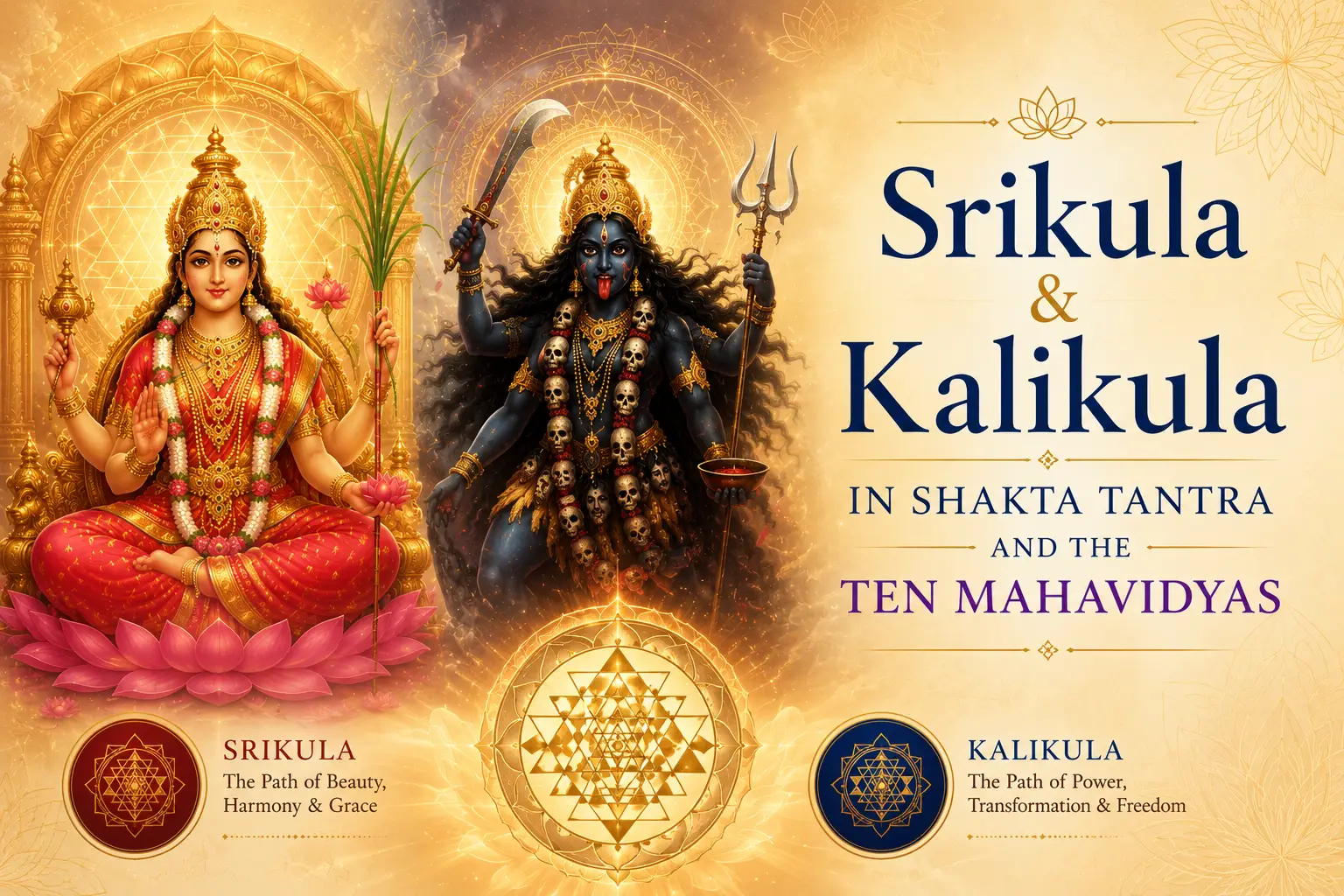
Within the field of Shakta Tantrism and the Dasa Mahavidya tradition, two great kulas stand as the primary streams of Devi worship, each carrying its own depth, its own inner method. The two largest and most visible schools of Shaktism are the Srikula, the family of Sri Kula, strongest in South India, and the Kalikula, the family of Kali, which prevails in northern and eastern India. Srikula holds the gentle radiance of the Divine Mother in her forms of beauty, grace, and auspiciousness. Kalikula holds the fierce and direct power of the Divine Mother in her transformative forms. Both honour Devi as the highest reality while each follows its own style of worship, its mantra, and its own method of sadhana.
What Does Kula Mean in Tantra
In Tantra, the word kula carries the meaning of family, clan, or lineage. It points to a living current of wisdom and practice passed down through generations of seekers. A kula is a stream of teaching connected with a particular form of Devi, carrying its own mantras, rituals, and way of approaching the divine.
When a seeker enters a kula, that seeker joins a long chain of practice held together by devotion to a specific aspect of Shakti. Each kula holds its own presiding deity, its supporting deities, and its specific modes of working through tantra, mantra, and yantra. These ways continue through the guidance of the guru and the sampradaya. In the Shakta tradition, this transmission keeps the path clear and aligned, so the seeker receives practice suited to personal nature, inner readiness, and the living line of initiation.
What Is Srikula: The Family of Sri
The Srikula tradition focuses worship on Devi in the form of the goddess Lalita Tripura Sundari, who is regarded as Mahadevi, the Great Goddess. Śrīkula and Śrīvidyā developed through several Tantric currents with important centres in Kashmir and in South India and is today the prevalent form of Shaktism practised in South Indian regions such as Kerala, Tamil Nadu, Andhra Pradesh, and Karnataka, as well as the Tamil areas of Sri Lanka.
The teaching of Srikula holds that the Divine Mother appears as beauty, grace, and luminous consciousness. Srividya is considered one of Shakta Tantrism’s most influential practices around Lalita Tripura Sundari. Its central symbol, the Sri Chakra, is probably the most famous visual image in all of Hindu Tantric tradition. This geometric form of nine interlocking triangles holds the complete structure of creation and consciousness. Through this yantra, the seeker directs attention toward wholeness, stillness, and inner clarity while keeping devotion fixed on the Divine Mother in her radiant form.
In Srikula practice, every aspect of the goddess, whether gentle or fierce, is ultimately seen as expressions of Lalita. Srikula sadhak worship Lalita using the Sri Chakra yantra, which is regarded as her subtle form.
The Mahavidyas of the Srikula Lineage
Classical Tantric sources describe the Srikula Mahavidya family in both the familiar ten and in extended lists that carry additional wisdom forms. Srikula focuses on auspicious, manifesting energies, with Tripura Sundari, Bhuvaneshvari, Matangi, and Kamala as its primary forms, emphasising order, beauty, harmony, and fullness.
Mahavidyas in Srikula are described with an extended list. The core Srikula Mahavidyas are:
1. Tripura Sundari (Shodashi): The central Srikula Mahavidya and embodiment of blissful, balanced consciousness. Her energy refines the mind and soul, supports Kundalini ascent through harmony, and reveals Shiva as pure and serene awareness.
2. Bhuvaneshvari: The goddess whose body is the entire cosmos. Bhuvaneshvari expands inner awareness into vast space, where the seeker learns to feel as wide and inclusive as the sky itself.
3. Tripura Bhairavi: The fiery, disciplined face of the Srikula. Bhairavi burns impurities and karmic heaviness, yet keeps the seeker aligned with beauty and inner order, preparing deeper states of Shiva-consciousness without collapse into chaos.
4. Bala Tripura Sundari: The youthful expression of Tripura Sundari, representing spiritual innocence and fresh devotion. Her energy supports mantra learning, gentle awakening of inner power, and the early stages of Kundalini rising.
5. Bagalamukhi: The stilling power of the Srikula. In this lineage, Bagalamukhi restrains scattered thoughts and brings luminous inner silence where Shiva as witness consciousness becomes clear and stable. Some Śrīvidyā traditions identify Dandanatha with Bagalamukhi and closely associate them together. She appears in both Srikula and Kalikula traditions, with her function varying according to the lineage and the seeker’s need.
6. Kamala (Kamalatmika): The abundance aspect of the Srikula, the Tantric Lakshmi. Kamala shows how divine energy expresses through prosperity, beauty, and daily life without binding the soul, so that worldly existence itself can serve awakening.
7. Matangi (Rajamatangi): The goddess of refined speech and inner music. Matangi cleanses language, thought, and subtle sound so that mantra, teaching, and creative expression carry truth directly from Shiva-consciousness into the world. In the Srikula system, she is known as the prime minister of Lalita.
8. Svapnavati Vidya: The subtle dream-wisdom Mahavidya, associated with inner guidance through dreams, vision, and liminal states. Her presence guides the seeker through inner worlds where Kundalini resolves hidden patterns.
9. Mahamadhumati: A higher Srikula Mahavidya of sweetness and fullness, where consciousness rests in continuous inner joy. This state reflects integrated Shiva-Shakti realisation, in which life feels like a natural flow of spiritual fulfilment.
The Ten Mahavidyas
The ten Mahavidyas are usually named in the following sequence: Kali, Tara, Tripura Sundari, Bhuvaneshvari, Bhairavi, Chhinnamasta, Dhumavati, Bagalamukhi, Matangi, and Kamalatmika.
The Mahāvidyās are often described according to two complementary perspectives. One is their temperament—whether they predominantly express the Divine Mother’s gentle (saumya) or fierce (ugra/ghora) nature. The other is their lineage affiliation, such as Śrīkula or Kālikula. Śrīkula generally emphasizes the auspicious, harmonious, and manifesting forms of Śakti, while Kālikula emphasizes her transformative, dissolving, and fierce forms. Tantric traditions are diverse, and no single classification is accepted by every scripture or lineage. Many goddesses, including Tārā, Tripura Bhairavī, Bagalāmukhī, and Dhūmāvatī, may be worshipped in both Śrīkula and Kālikula depending on the guru-paramparā, regional tradition, or specific Tantric text.
The classification of the Mahavidyas into Śrīkula and Kālikula varies among Tantric scriptures and living lineages. The table below reflects a commonly taught modern synthesis. Within the familiar ten, their primary lineage affiliation is as follows:
| Number | Goddess | Primary Affiliation |
|---|---|---|
| 1 | Kali | Kalikula |
| 2 | Tara | Both lineages |
| 3 | Tripura Sundari | Srikula |
| 4 | Bhuvaneshvari | Srikula |
| 5 | Chhinnamasta | Kalikula |
| 6 | Tripura Bhairavi | Both lineages |
| 7 | Dhumavati | Kalikula |
| 8 | Bagalamukhi | Srikula |
| 9 | Matangi | Srikula |
| 10 | Kamala | Srikula |
The Tantra holds that one Mahavidya leads its sadhaka to another depending on need and aspiration. Each of the ten Vidyas leads the seeker to the Supreme Reality, and each is great in its own right, equal in all respects to each of the other nine.
What Is Kalikula: The Family of Kali
The Kalikula form of Shaktism is most dominant in north‑eastern India, widely prevalent in West Bengal, Assam, Bihar, and Odisha, as well as parts of Nepal and Kerala. Kalikula lineages focus upon the Kali as the source of wisdom and liberation. The main deities of the Kalikula tradition are Kali, Chandi, and Durga, with Tara and all the other Mahavidyas also receiving deep veneration.
Where Srikula illuminates the inner life through beauty and grace, Kalikula transforms through the fierce, dissolving power of the Divine Mother. The Kalikula seeker approaches the goddess with the understanding that transformation will reach the deepest layers of the self. Kali, the supreme deity of this lineage, is the power of time itself. She represents pure consciousness beyond all form, the destruction of ego and ignorance, and the liberation that comes from confronting what is false without hesitation.
Kalikula focuses on fierce, dissolving energies, with Kali, Tara, Chhinnamasta, and Dhumavati as its dominant forms, emphasising ego dissolution, the void, and transcendence.
The Mahavidyas of the Kalikula Lineage
The core Kalikula Mahavidyas and their spiritual qualities:
1. Kali: The first and foremost Mahavidya, the dark cosmic mother who devours time itself, representing pure consciousness beyond all form and the liberation that comes from confronting death fearlessly. She is the supreme deity of the Kalikula tradition.
2. Tara: The compassionate guide who leads the seeker across the turbulent field of existence. Tara embodies boundless compassion combined with fierce protectiveness. Although classical texts generally associate Tara with Kālikula, she is also deeply revered in several Śrīvidyā and regional Tantric traditions. She is honoured in both Srikula and Kalikula traditions.
3. Chhinnamasta: The goddess of complete self-offering and the dissolution of the ego boundary, representing the direct flow of life from its own source.
4. Dhumavati: The most enigmatic Mahavidya, the Widow Goddess who represents the void, the unmanifest, and the experience of absence. In facing the aspects of life that most avoid, the seeker discovers the truth that lies beyond all forms and identities. Also sometimes worshiped in Śrīkula; often grouped with Kālikula in modern teachings because of her fierce and ascetic nature.
5. Bagalamukhi: The protective power of the Mahavidyas, that removes destructive energy and movement and grants mastery over speech and reactive mental patterns. In her Kalikula aspect, she works through strong protection and the arrest of harmful karmic motion.
6. Bhairavi (Kalikula aspect): The fierce fire of tapas that burns deep karmic structures and prepares the seeker for radical inner transformation. Honoured in both lineages with different emphases depending on the context of practice.
The Spiritual Meaning of the Srikula Path
Srikula presents Shakti as a movement of energy that reveals Shiva as quiet, luminous consciousness. Tripura Sundari offers the central key: the soul discovers that true beauty is the natural radiance of consciousness when it is whole and undivided. Bhuvaneshvari expands this into vast inner spaciousness. Matangi brings that realisation into speech and thought. Kamala demonstrates how abundance supports practice rather than drawing awareness away from its source.
Srividya leads toward the realisation of fullness, where consciousness rests in completeness. The Srikula path is suited to seekers who value refined worship, inner harmony, and gradual transformation, where Kundalini rises through clarity, devotion, and the sustained alignment of awareness with the unity of Shiva- Shakti consciousness over time.
The Spiritual Meaning of the Kalikula Path
Kalikula leads toward the realisation of emptiness, where the seeker discovers that liberation comes through the complete dissolution of false identity. In truth, both Srikula and Kalikula meet at the same point. Fullness and emptiness are two ways of describing the same absolute reality.
The Kalikula path asks for a quality of inner courage that the Srikula path rarely demands at the outset. The seeker must be willing to face what is genuinely present in the inner life without softening or rearranging it. Kali’s grace arrives through radical honesty, through the willingness to surrender every constructed layer of identity until what remains is pure, unobscured awareness.
How the Two Paths Differ in Practice
The Divine Mother is one. Her paths ask for different qualities of inner work, and understanding both makes the whole tradition visible.
The Srikula path works through soft and inner purification (Gentle )
- Grace and beauty as the primary vehicle toward liberation
- Mantra and yantra practice through the Sri Vidya system
- Gradual refinement of inner awareness toward luminous clarity
- Sustained devotion to the benign, auspicious forms of the goddess
The Kalikula path works through her fierce power
- Transformation as the direct vehicle, through dissolution of illusion
- Direct encounter with Kali’s raw, concentrated energy
- Radical inner honesty and the willingness to see clearly
- Complete surrender of constructed identity to the fierce grace of the Mother
Both paths serve the same awakening of consciousness and the same ascent of Kundalini toward unity of Shiva- Shakti consciousness.
Related posts:
Sri Vidya: The Blessing of Abundance: Prosperity, Success and the Fulfillment of Life
Sri Vidya: The blessing of Magnetism, Creativity, and Beauty
Sri Vidya: Pure Devotion as the First Blessing
Kundalini Awakening: The Rising of Shakti Toward Shiva
Sri Vidya, Rahu and Ketu: Integrating Shadow Self with Desire & Detachment

Rohit Ray Sharma is a spiritual awakening coach in India helping conscious professionals and seekers find greater clarity, purpose, and self-awareness. His work draws on the wisdom of India’s Shakta and Shiva traditions, with a focus on Sri Vidya, spiritual awakening, consciousness, self-realisation, and inner transformation. Book a one-to-one spiritual awakening session to begin your journey toward greater clarity and purposeful living.
- Rohit Ray Sharma
- Rohit Ray Sharma
- Rohit Ray Sharma
- Rohit Ray Sharma