
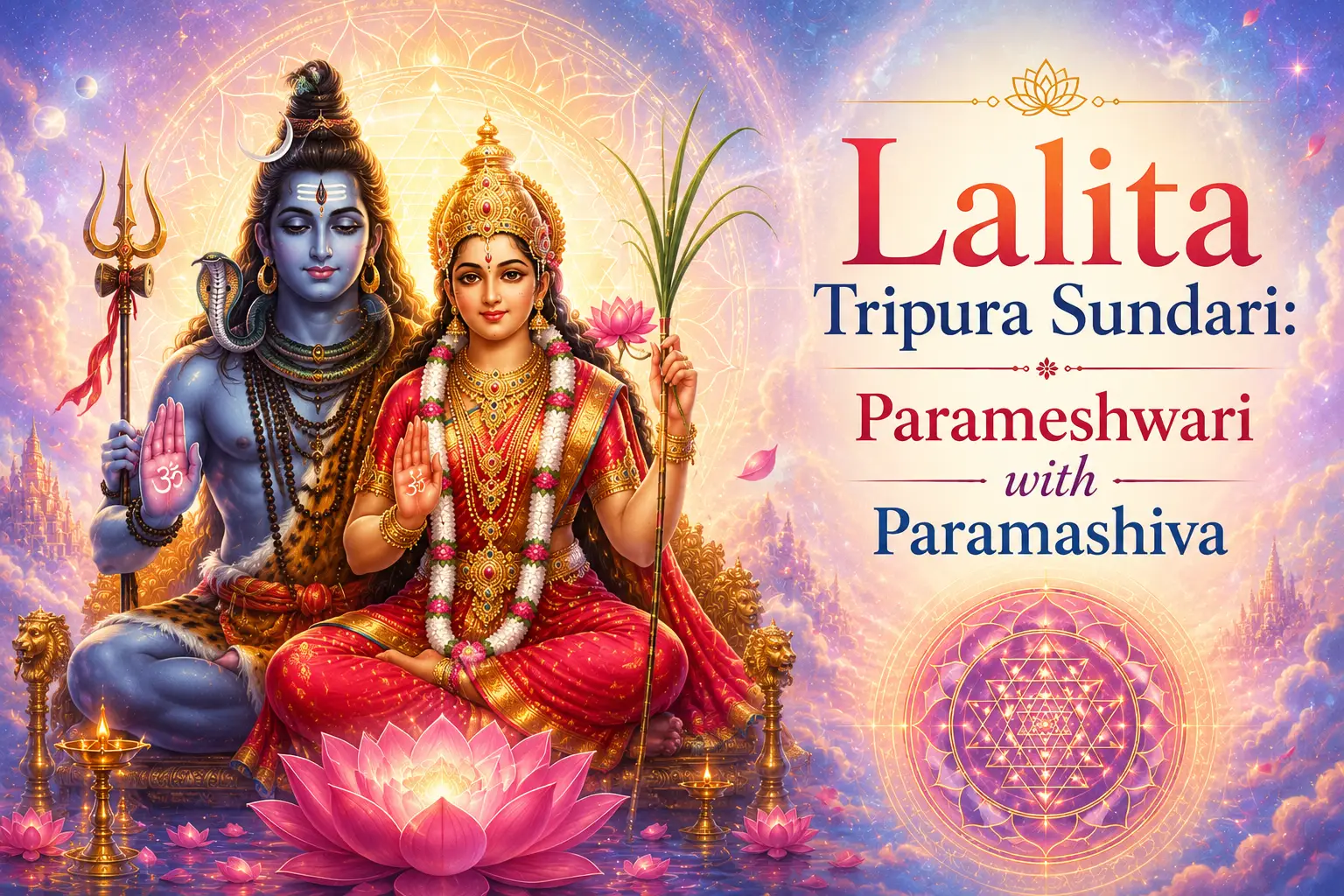
Lalita Tripura Sundari is Parameshwari, the supreme goddess, the absolute power from which all creation, all divine functions, and all cosmic intelligence arise. She is the source from which all other divine forms draw their authority and their capacity to act.
Her consort is Paramashiva, the undivided supreme consciousness that precedes all manifestation. Together, Lalita as Parameshwari and Paramashiva as the absolute awareness constitute the complete Absolute, the total reality before and beyond the universe, and equally present within every particle of it.
Paramashiva: The Ground of All Consciousness
Paramashiva is the consciousness that precedes creation, precedes time, precedes the first movement of anything toward form. He is the ground of all grounds, the awareness beneath all awareness. In the Vedic and Shaiva understanding, he is the absolute in the truest sense of the word.
His essential nature is perfect stillness. Paramashiva is the consciousness element that remains unchanging, undisturbed, and entirely self-contained. He holds infinite potential within himself, and yet that potential remains latent in the absence of the activating power that belongs to Shakti. This is the nature of absolute consciousness. It requires nothing from outside itself. It is complete. And in that completeness, before Shakti moves, no universe stirs, no creation arises, no experience unfolds.
This stillness is the most profound kind of strength. The capacity to hold infinite potential without any movement, without any compulsion toward expression, belongs to Paramashiva alone. The universe becomes possible precisely because Shakti chooses to move through this ground of absolute awareness.
Lalita as Parameshwari: The Supreme Power of the Absolute
Lalita as Parameshwari is the supreme power of that absolute consciousness. She is the living force by which pure awareness, Shiva, expands for creating, sustaining, dissolving universe. She is inseparable from Paramashiva, co-equal, bound with him, and the very energy through which his infinite potential becomes infinite expression.
The tradition describes her as the source of three primary shaktis, the three powers that govern all of creation:
- Iccha Shakti: the power of will and divine intention, the first movement of consciousness toward manifestation
- Jnana Shakti: the power of knowledge and inner intelligence, the awareness by which consciousness knows itself and knows the world it creates
- Kriya Shakti: the power of action, the force by which divine intention and divine knowledge become the actual, living universe
These three shaktis are one power moving through three phases of expression. Together they describe the complete movement from the first arising of divine will through the full unfolding of creation.
Lalita and Paramashiva are also revered together as Kameshwari and Kameshwara, the goddess of supreme desire and the lord of supreme desire. This name carries a precise teaching. At the absolute level, creation arises from the divine desire of consciousness to know itself through experience. Lalita is that desire in its sovereign, living form. Paramashiva is the pure awareness within which that desire arises. Together, they are both the source and the substance of all existence.
One Reality, Two Perspectives
The teaching that Shiva and Shakti are inseparable is the central statement of the Shakta tradition. They are the same single reality perceived from two angles simultaneously. One angle sees pure consciousness, still, undivided, complete. The other angle sees pure energy, living, creating, moving through every form.
Consciousness and energy are two aspects of one indivisible truth. They are the same Absolute, and no genuine division exists between them. At the level of Paramashiva and Parameshwari, this unity is understood in its final and absolute sense. Together, without separation, without one being subordinate to the other, they constitute the complete form of the Absolute. Creation itself is the expression of this union.
Without Parameshwari, Paramashiva remains in his own undisturbed stillness. Without Paramashiva, the energy of Parameshwari has no ground of awareness to move through and no direction toward which it can express. Creation becomes possible when consciousness and energy are understood as one, when awareness and power are recognised as the same reality looking at itself from within.
The Cosmic Hierarchy in a Single Image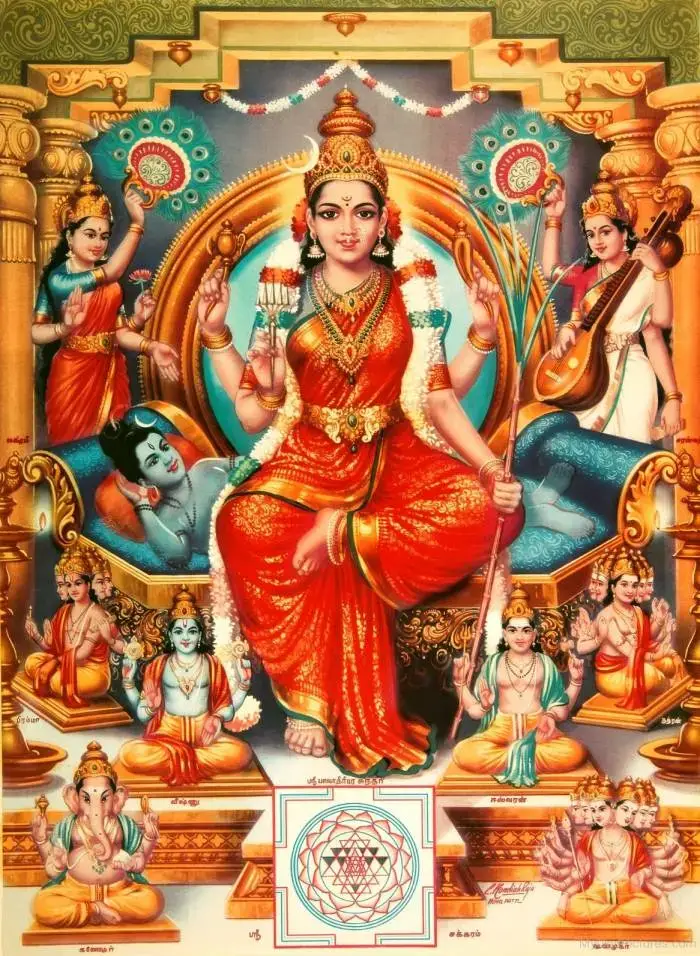
The Shakta tradition communicates the sovereign nature of Lalita Tripura Sundari through one of the most precise and revealing images in all of Vedic cosmology. In classical Sri Vidya paintings of Devi Lalita Tripura Sundari, the other gods and goddesses around her throne show how all cosmic powers function through her Shakti. They represent creation, preservation, dissolution, concealment, grace, protection, strategy, knowledge, and prosperity. Lalita is seated on a throne. Beneath that throne, serving as its very foundation, rest four great cosmic deities:
- Brahma, who holds the power of creation
- Vishnu, who holds the power of preservation
- Rudra, who holds the power of dissolution
- Sadashiva or Ishana, who holds the power of concealment and grace
- Lalita Tripura Sundari (center) with her two sons Ganesha (left) and Kartikeya (right)
This is a teaching of the highest order. Every cosmic function, every power of creation, preservation, dissolution, and grace, receives its authority, its intelligence, and its actual capacity to operate from Lalita Tripura Sundari herself.
Brahma creates because she empowers him to create. Vishnu preserves because she sustains that preserving force within him. Rudra dissolves because she moves through him as the sovereign power of transformation. Sadashiva conceals and reveals because she is the living light that makes both concealment and revelation possible.
The throne image communicates what theological argument approaches only slowly. Lalita is the source from which all cosmic intelligence flows. Every divine function in the universe is an expression of her power, operating through a specific form, directed toward a specific purpose, yet drawing from the same single supreme energy at its root.
Varahi Devi: the general commander of the Divine Mother
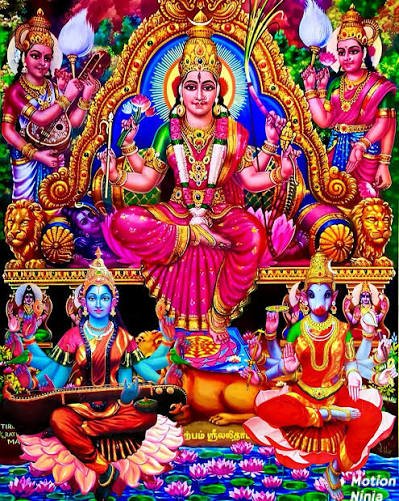
Varahi Devi appears in the image of Lalita Tripura Sundari as one of the strongest powers in the divine army. She is the boar-faced Mother Goddess, honored among the Sapta Matrikas, and her form carries the force of protection, courage, and firm divine action. In the sacred battle of Lalita against Bhandasura, Varahi is known as Dandanatha, the great commander who leads the Mother’s forces and brings down the enemies of dharma.
Raja Shyamala or Matangi: the minister of speech and strategy
Raja Shyamala, also known as Raja Matangi, Mantrini, or Nakuli, serves as the minister of Lalita Tripura Sundari. In the sacred stories, she stands beside the Mother during the great battle, guiding divine strategy and helping destroy the commanders of the opposing forces. Her power is linked with mantra, refined speech, music, learning, and subtle intelligence
Saraswati and Lakshmi with Lalita Tripura Sundari
Saraswati and Lakshmi often appear around the divine court of Lalita Tripura Sundari as attendant goddesses or gracious powers within her sacred composition. Saraswati represents knowledge, learning, arts, and the purity of intellect. Lakshmi represents prosperity, abundance, beauty, and auspicious living. Their presence near the goddess shows that wisdom and prosperity are both expressions of the Mother’s grace.
In Sri Vidya understanding, these two powers do not stand apart from spiritual life. They belong within it. Saraswati gives clarity of mind, and Lakshmi gives fullness of life. When both appear beside Lalita, the image shows a complete vision of divine order, where understanding and abundance flow together under the rule of Shakti.
Related posts:
Lalita Tripura Sundari: The Divine Union of Mahasaraswati, Mahalakshmi and Mahakali
The Stages of Spiritual Awakening Through the Das Mahāvidyās
Das Mahavidya Sadhana: Journey from Awakening to Self-Realization
Srikula & Kalikula in Shakta Tantra and the Ten Mahavidyas
Sri Vidya: The blessing of Magnetism, Creativity, and Beauty

Rohit Ray Sharma is a spiritual awakening coach in India helping conscious professionals and seekers find greater clarity, purpose, and self-awareness. His work draws on the wisdom of India’s Shakta and Shiva traditions, with a focus on Sri Vidya, spiritual awakening, consciousness, self-realisation, and inner transformation. Book a one-to-one spiritual awakening session to begin your journey toward greater clarity and purposeful living.
- Rohit Ray Sharma
- Rohit Ray Sharma
- Rohit Ray Sharma
- Rohit Ray Sharma