
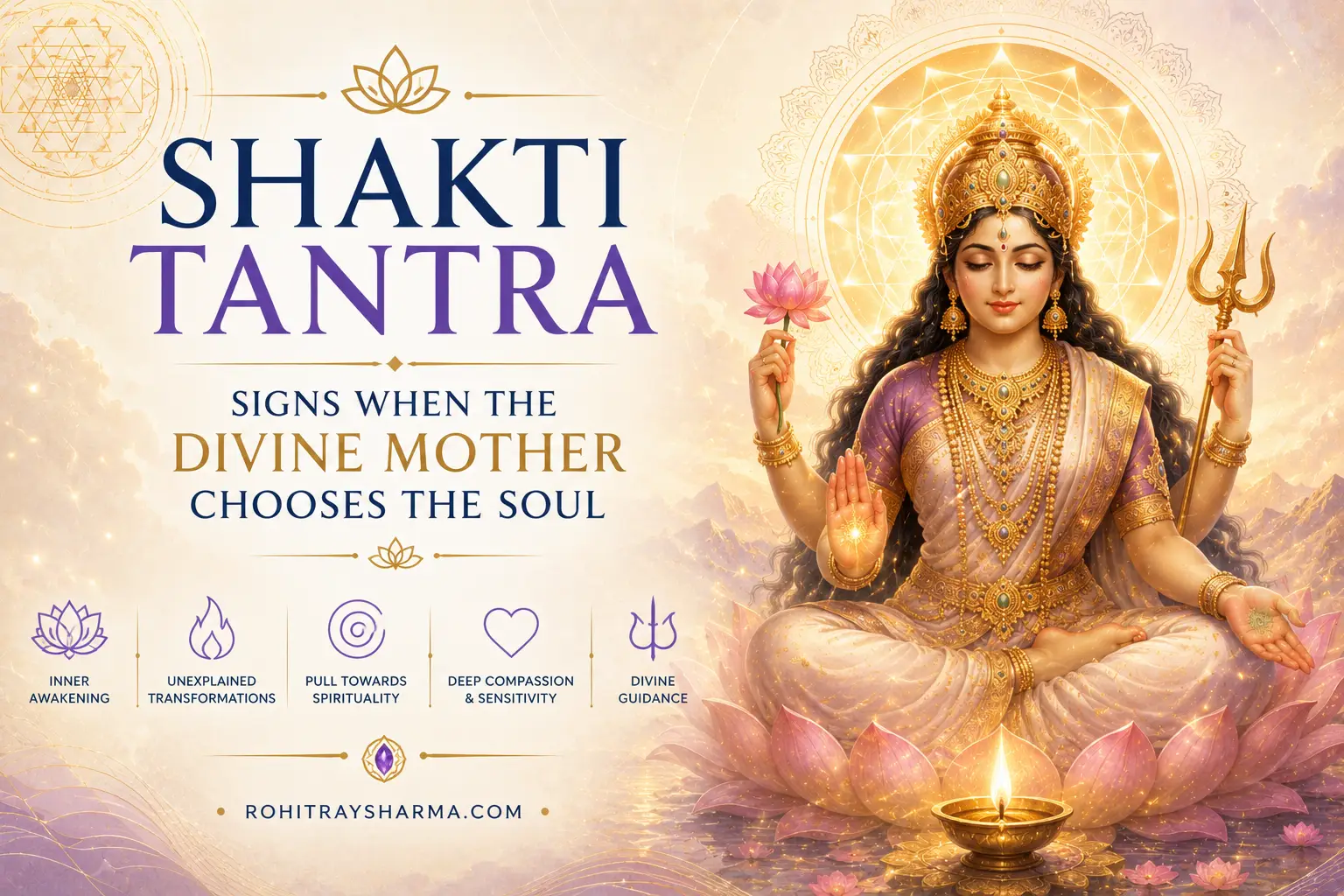
Shakti is the supreme force behind creation. She is the power that shapes the stars, moves the breath, turns the seasons, and awakens the soul within the ordinary course of a life. She appears in many forms, each carrying a distinct teaching, a different quality of grace. In the Shakti Tantra tradition, this same power that moves galaxies also moves inward as feeling, intuition, courage, and the quiet turning of consciousness toward truth.
This path belongs to the oldest living streams of Indian spiritual life. Over long centuries, goddess worship grew from outer ritual into a refined discipline that brings mantra, yantra, meditation, and inner transformation into one integrated practice. In this tradition, the Mother appears as beauty, fierce grace, protection, wisdom, and the hidden force that awakens consciousness itself.
Signs of the Shakti Tantra Path: When the Divine Mother Chooses the Soul
The Shakti Tantra path has a way of finding the seeker before the seeker finds it. A person may feel drawn toward the Divine Mother without being able to explain why. Prayer may bring unexpected tears. A temple visit may leave behind a stillness that lasts for days. Sacred images may speak in a language the mind cannot yet translate, but the heart recognises completely. These signs include a wish for truth and a sense that ordinary life carries a hidden depth.
These signs carry meaning. They signal a soul moving toward a particular kind of encounter with the divine.
Common Signs of Call of the Shakti Tantra Path
- A deep pull toward the Divine Mother.
- A strong attraction to mantra and sacred sound.
- A natural respect for women and the feminine principle.
- A vivid response to goddess images, symbols, and sacred forms.
- Deep comfort in chants, lamps, flowers, and sacred images.
- A desire for inner awakening & transformation over outer display.
- Repeated life events that turn the soul inward.
- Sensitivity to silence, stillness, and sacred spaces.
- A natural wish to know the Goddess more deeply.
- A steady desire to serve the Goddess through worship and discipline.
- A growing sense of being used as an instrument for a higher will.
- A strong pull toward Goddess worship, devotion, and prayer without any outer reason.
- Sudden periods of detachment, sensitivity, and inner restlessness.
- A wish to understand energy, consciousness, and the mystery of life.
- A longing for surrender without weakness.
- A genuine pull toward serving the welfare of others as a blessing from the Goddess.
The Shakti Tantra path tends to ripen people over years before it announces itself clearly. When the recognition comes, it feels less like a new beginning and more like a return.
The Nature of Awakening on This Path
Awakening within Shakti Tantra carries a specific quality. Warm, intimate, and powerful at once. The universe begins to feel like a living presence filled with intelligence and grace. Food, work, relationships, suffering, silence- all of ordinary life begins to look different when seen through this awareness, because the tradition teaches that every part of life can become part of sadhana.
The seeker on this path does come to renounce the world in a conventional sense. They come to see it differently with experience. These experiences become part of the practice, because the Mother lives inside experience, and the discipline of the Shakti path is largely the discipline of learning to recognise her there.
The Practices That Shape the Seeker
Shakti Tantra values practice deeply because wisdom ripens through lived discipline rather than through understanding alone. The path works on the whole person, on body, breath, sound, image, and inner stillness together.
Mantra chanting comes first, because sacred sound is seen as a living bridge between the seeker and the Divine Mother. A mantra held with steadiness over time leaves a trace in the deeper mind. It changes the inner atmosphere gradually, settling what is restless, opening what has been closed.
Puja, the act of worship with flowers, incense, lamps, and water, trains the attention to be fully present in an act of offering. Each element of puja carries meaning. The lamp is not decoration. It is the seeker’s awareness being offered back to the source of awareness. Performed with this understanding, puja becomes a genuine meeting rather than a routine.
Meditation on the Goddess works through image and presence. The seeker sits with the form of the Mother, allows it to become interior, and gradually discovers that what began as an outer image becomes an inner reality. The form guides the attention inward until what was being contemplated begins to contemplate the seeker in return.
Yantra, the sacred geometry associated with each goddess form, gives the mind a visible structure through which to approach the invisible. The lines, triangles, and central point of a yantra train the eye to look inward. In sustained meditation, the outer pattern fades and the inner pattern it corresponds to begins to reveal itself.
Seva, selfless service, holds a central place in this tradition. The Shakti path grows stronger when devotion turns outward into care for others. The seeker who genuinely offers their skill, time, and attention in service of others is practicing the Goddess in the world. The distinction between inner practice and outer life dissolves in this way. All of it becomes one movement.
What the Path Ultimately Reveals
Shakti Tantra remains living because it addresses a need that sits at the centre of human experience: the need to belong to something real, something vast, something that holds both the light and the difficulty of life without renunciation.
The Goddess asks for honesty before she asks for anything else. She meets the seeker where they actually are, in confusion, in longing, in the middle of an ordinary life that has begun to feel like it contains more than it can say. From that meeting, the path unfolds gradually.
Practice deepens. The mind grows quieter. The heart becomes more spacious. What felt separate begins to feel connected. What felt heavy begins to feel purposeful. And somewhere along the path, usually without announcement, the seeker stops searching for the Mother outside and begins to recognise her presence as the awareness through which all of this has always been seen. That recognition is the real beginning.