
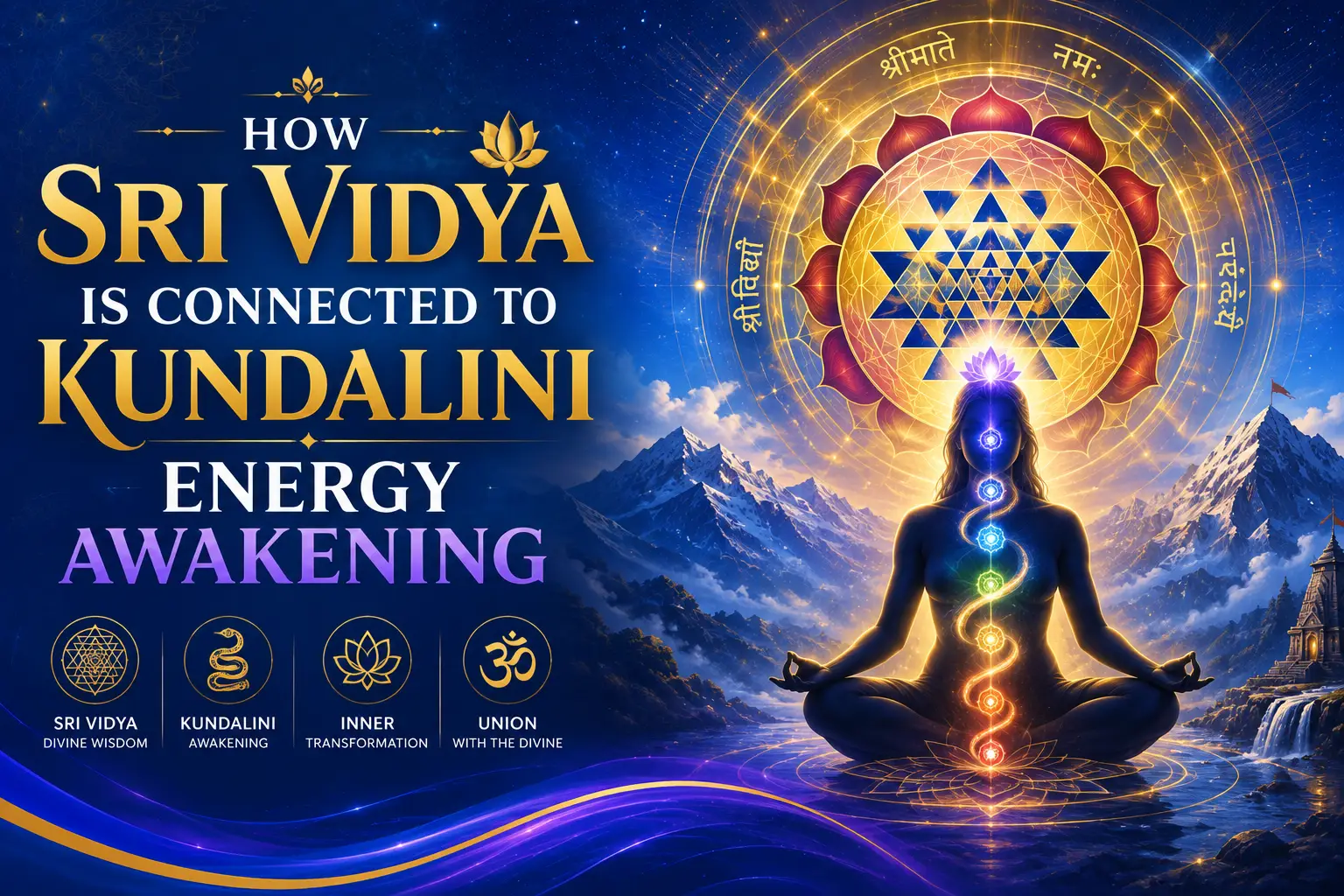
Sri Vidya and Kundalini yoga are similar yet different. Both traditions use the concept of Shakti, although they understand and approach it through different theological and spiritual frameworks. Sri Vidya belongs to the wider Shakta traditions, which regard Devi, or Shakti, as the supreme divine reality, and its method of approaching this power differs from that of Kundalini yoga, even though the two traditions share several concepts concerning Shakti, the subtle body and spiritual awakening.
Sri Vidya centres on worship of the Divine Mother, Lalita Tripura Sundari, and within this tradition, Shakti is worshipped in that form. Kundalini, in tantric and yogic teaching, is the dormant energy said to rest at the base of the spine, where the same Shakti is described within the subtle body rather than through a worshipped form. The two traditions share the concept of Shakti, but their practices and theological frameworks differ.
Some Sri Vidya interpretations relate mantra, Sri Chakra worship, and inner worship to the traditional description of Kundalini rising from the Muladhara toward the crown. Within these interpretations, Sri Vidya’s devotional and mantra practices are considered in relation to Kundalini awakening, though this relationship is not expressed identically across all lineages.
The Meaning and Path of Sri Vidya
Vidya means knowledge. Sri carries meanings associated with auspiciousness, beauty, splendour and prosperity. Within Sri Vidya, the name points to sacred knowledge associated with the Divine Mother, and the tradition belongs among the Shakta traditions, which hold Devi, or Shakti, as the supreme divine reality.
Mantra, yantra and worship are central elements of Sri Vidya practice. Mantra is associated with the sonic form of the Devi, while the yantra provides a geometric representation of her, seen in the Sri Chakra. Worship, or upasana, is how a practitioner sustains devotional attention toward her. Sri Vidya does not generally require renunciation of ordinary household life. Work, wealth and family relationships remain part of the practitioner’s everyday life, and specific approaches to ritual and conduct vary between lineages, ranging from worship kept entirely internal and meditative to worship carried through external ritual forms.
Kundalini in Tantric and Yogic Teaching
Kundalini is described as a coiled power, resting at the base of the spine in a region the tradition calls Muladhara. It stays largely dormant until sustained practice wakes it. Traditional Kundalini descriptions associate its ascent with the subtle channel called Sushumna and with the chakras located along the central axis of the subtle body, rather than with the physical spine as such.
Traditional Kundalini teachings describe both gradual and sudden forms of this awakening, with many accounts emphasising preparation and sustained practice. These traditions place importance on physical and mental preparation. Within the subtle-body framework, Kundalini’s movement is described in terms of Shakti, nadis and chakras, rather than in terms of ordinary physical anatomy.
Why Shakti Connects Sri Vidya and Kundalini
Within Shakta theology, Shakti is understood as the dynamic, active aspect of the supreme reality, inseparable from consciousness and yet responsible for all movement, form and manifestation. This is the principle both traditions are working with, even where they locate it differently. Sri Vidya locates this principle in a worshipped form, the Devi. Kundalini teaching locates it within the physiology of the subtle body.
This shared theological ground is part of why practices from one tradition can be read, in some interpretations, alongside teachings from the other, without treating the two traditions as identical. Sri Chakra worship and the rise of Kundalini through the chakras are both, in this view, engagements with the same underlying principle, approached through different disciplines.
Lalita Tripura Sundari and the Symbolism of Awakened Kundalini
Some Sri Vidya interpretations identify Lalita Tripura Sundari with the fully awakened aspect of Kundalini Shakti. Kundalini in the body is described as coiled and dormant, in this reading. Lalita is described as risen, radiant, seated at the crown. In this interpretation, the two forms represent different states or expressions of Shakti.
The Sri Chakra: Structure and Symbolism
The Sri Chakra consists of interlocking triangles, nine layers deep, arranged around a central point called the bindu. In Sri Vidya, the structure of the Sri Chakra symbolises the union of Shiva as consciousness and Shakti as dynamic power. The yantra therefore represents both a form of the Devi and this union.
Sri Chakra symbolism and Kundalini teaching use different frameworks for the relationship between Shiva, Shakti and spiritual realisation. Some interpretations associate their respective central points with this same union of consciousness and Shakti. Sri Chakra worship is traditionally linked to gradual development rather than the pursuit of immediate experience.
Sri Vidya and the Subtle Body
Worship and mantra remain the most visible part of Sri Vidya. Some Sri Vidya interpretations relate its inner practices to the subtle-body framework described in Kundalini traditions, including the concepts of nadis and chakras.
Some Sri Vidya practices include contemplation of the Devi within the subtle body. Certain interpretations relate this form of contemplation to the chakras described in Kundalini traditions.
Practices Associated with This Tradition
Some traditional interpretations associate japa, the repetition of mantra, with greater concentration and reduced mental distraction. Sri Chakra meditation involves sustained attention to the yantra and its symbolic structure, and some interpretations read this movement of attention, from the outer structure toward the bindu, as symbolic of a shift from differentiated experience toward unity. Puja, or ritual worship, gives devotional practice a structured, regular form. Visualising the Devi within the body is read, in some Sri Vidya practices, as engaging these same chakras, and study of the tradition’s symbolism supplies the philosophical and theological ground beneath its devotional practices.
None of this is described uniformly as producing dramatic or immediate results. Within these traditions, sustained practice is often associated with changes in concentration, emotional steadiness and awareness, arriving gradually rather than all at once.
Mantra as a Central Practice in Both Traditions
Within Sri Vidya, sustained mantra practice is traditionally understood to influence the mind and subtle body. Mantra is treated as a sonic form of the deity.
Principal Sri Vidya mantras are traditionally transmitted through diksha from a qualified guru. Traditional practice places importance on accurate transmission and pronunciation, and guru-parampara names this transmission of teaching from teacher to disciple within a lineage. Kundalini teaching links particular sounds to particular chakras too, and focused chanting is described, in both traditions, as supporting the rise of energy through the subtle body. Traditional practice places greater emphasis on preparation and disciplined repetition than on seeking sudden or forced experiences.
Kundalini Awakening as Understood Within Sri Vidya
Some Sri Vidya readings treat Kundalini awakening as a development that grows out of sustained devotion and sadhana, rather than something produced by deliberate effort toward an energetic experience. Devotional interpretations link it to both sustained sadhana and the grace of the Devi.
Mantra and worship, in this view, are not tools for producing an immediate experience. Their purpose within the tradition is understood through sustained sadhana, discipline and devotional relationship with the Devi, rather than through the pursuit of immediate experiences. Unusual experiences during practice are, in traditional guidance, matters worth raising with an experienced teacher, particularly at more advanced stages.
Preparation and Discipline in These Traditions
Both traditions place importance on preparation and disciplined practice, although their specific methods and ritual frameworks differ. In some lineages, guidance from an experienced teacher is considered important when unusual or intense experiences arise during advanced practice. Traditional teachings also caution against treating unusual sensations as automatic evidence of spiritual progress.
Sri Vidya and Kundalini are distinct traditions, although both place Shakti at the centre of their understanding of spiritual transformation. Sri Vidya approaches Shakti through Lalita Tripura Sundari, mantra, Sri Chakra and worship, while Kundalini traditions describe Shakti through the subtle body, nadis and chakras. Some Sri Vidya interpretations relate Kundalini awakening to the deeper dimensions of its devotional and mantra practices, but this relationship varies across lineages. The connection between the two traditions is best understood through this shared concept of Shakti, while preserving the distinct theology and practices of each.