
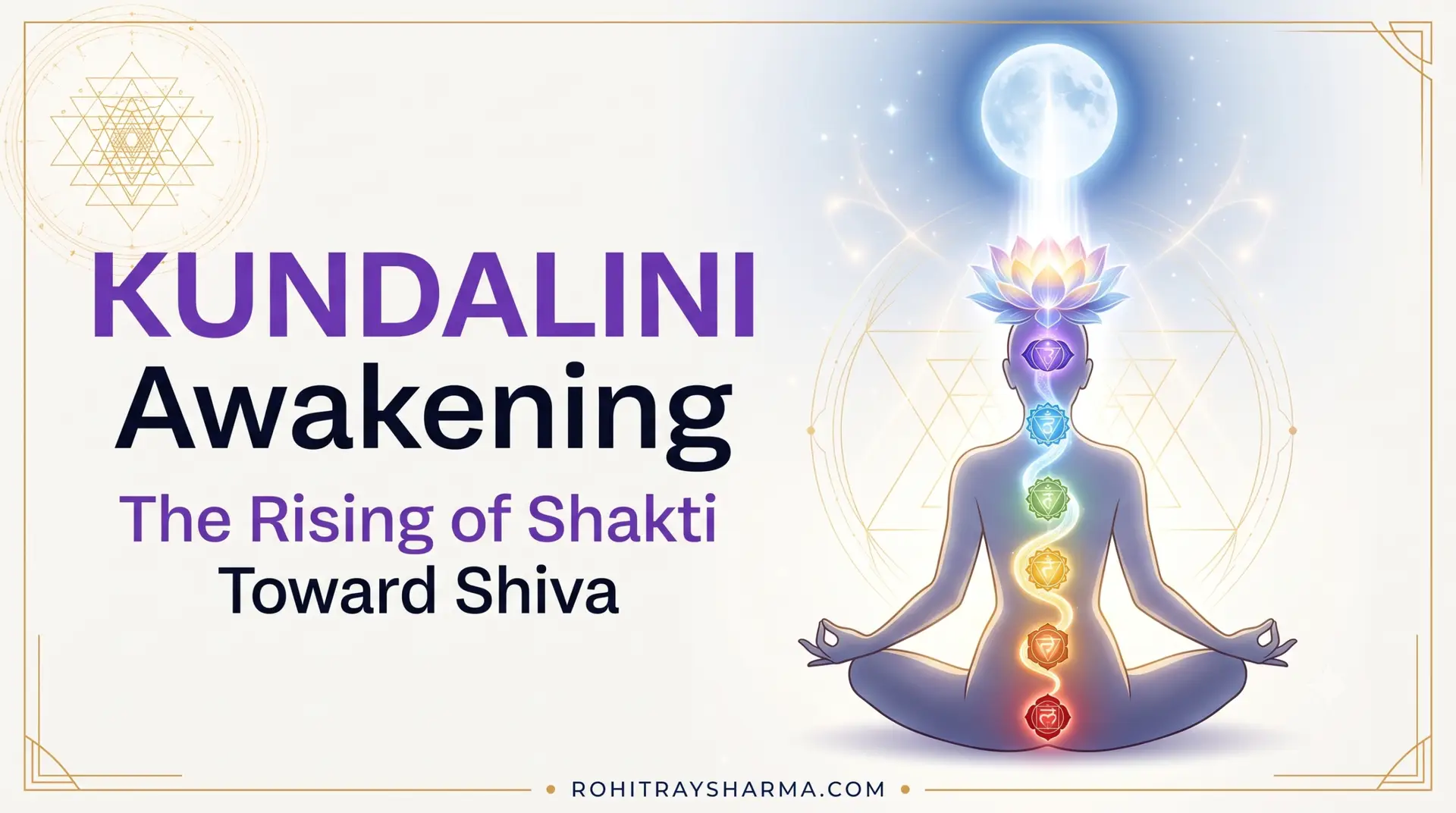
Every human being carries a hidden spiritual power. The ancient yogis called this power Kundalini Shakti. Kundalini awakening is the journey of Shakti returning to Shiva, and of the individual soul remembering its true source. This path speaks of awakening, purification, balance, and freedom from inner confusion. It is not something outside you. It already lives within you.
Many seekers feel drawn to Kundalini because it speaks about real inner change.
What is Kundalini?
Kundalini means the coiled power. Kundalini is the dormant spiritual power in the subtle body, often described as energy resting at the base of the spine, near Mooladhara. In Vedic teaching, it is a living force of consciousness that can lead a seeker toward enlightenment when awakened in the right way. She is resting in seed form, waiting for the right inner condition to rise.
The three nadis in Kundalini yoga are Ida, Pingala, and Sushumna, and together they form the main inner pathways through which prana moves in the subtle body.
- Ida is the left channel and carries a cooling, reflective, moon-like quality, often linked with calmness, feeling, and the feminine side of nature.
- Pingala is the right channel and carries a warming, active, sun-like quality, often linked with vitality, action, and the masculine side of nature.
- Sushumna is the central channel, and it is the most important for spiritual awakening because Kundalini rises through it when the inner system becomes balanced.
Kundalini awakening works by rising through the central channel called Sushumna, after the body, breath, and mind become purified and steady. As it moves upward, it passes through the chakras and gradually opens deeper levels of awareness, until it reaches Sahasrara, the crown center, where Shakti reunites with Shiva consciousness.
This power is present in every soul. It holds the full possibility of spiritual growth. When practice, purity, and maturity come together, this hidden force begins to move upward. The rise of Kundalini is the rise of consciousness itself.
Tantra speaks of Kundalini as Shakti in her latent form, ready to unite with Shiva at the crown. Yoga gives the map of inner centers and the discipline needed for safe ascent. Vedanta points to the final realization that this movement leads toward the discovery of the Self, which was always whole. The journey is spiritual, practical, and deeply personal.
Shiva and Shakti
Shiva is pure consciousness. He is the witness, the still awareness, the silent ground behind all thought and motion. He is the unchanging presence in which all experience appears.
Shakti is energy, creation, mind, prana, nature, and life force. She is the movement that makes form, feeling, thought, and action possible.
Their union is the highest state of yoga. Shiva without Shakti remains still. Shakti without Shiva moves without clear awareness. When both are present together, life becomes complete. The objective of Kundalini awakening is self-realization- the soul becoming aware of its own source.
Why do we forget
Human beings often forget their divine nature because of Maya, ego, karma, and deep habit patterns. The mind begins to think, “This body is me,” or “These emotions are me,” or “This role is me.” Awareness then gets covered by identification.
Vasanas, the old impressions in the mind, keep repeating old patterns. These impressions shape desire, fear, reaction, and confusion. The energy is never truly absent. Only awareness becomes less clear. The soul then lives as if it is separate, even while the deeper truth remains near.
The work is to remove what hides it. When inner veils thin out, the seeker begins to see what has always been present.
Kundalini Awakening Journey
Kundalini rises from Mooladhara to Sahasrara. This is the upward journey of consciousness. It is a movement from survival toward freedom, from limited identity toward direct realization.
The purpose of this rise is Self-realization. It is the return of Shakti to Shiva. It is the meeting of energy with pure awareness. This meeting dissolves the feeling of inner separation.
The journey is gradual. The path prepares the vessel. The seeker grows, and as the seeker matures, the inner power rises in a natural way. The seeker becomes more inwardly clean, more steady, and more aware. The soul starts to live with less confusion and more depth.
Seven Chakras
The seven chakras form a classical inner map of human consciousness in yogic and spiritual thought, moving from the base of life to the crown of realization. Each center reflects a stage of inner growth, and together they describe the journey from survival to self-realization.
1. Muladhara
Muladhara is the root center, the place of stability, safety, and grounded living. It relates to the basic trust needed to stand firmly in life, and many teachings describe it as the foundation for the whole inner journey. When this center is balanced, a person feels settled, supported, and able to face life with greater steadiness.
2. Swadhisthana
Swadhisthana is the center of feeling, desire, and creative movement. It shapes the way emotion flows through the personality and how a person relates to pleasure, expression, and inner fluidity. When this center is clear, emotional life becomes more open, creative energy begins to move well, and the soul feels less rigid.
3. Manipura
Manipura is the center of fire, will, and personal strength. It supports courage, discipline, self-respect, and the power to act with clarity. When balanced, this center helps a seeker move from hesitation into purposeful action, and from confusion into inner command.
4. Anahata
Anahata is the heart center, known for love, compassion, and deeper connection. It opens the human being to care, forgiveness, and a more inclusive way of seeing life. When this center matures, the person begins to feel unity more naturally, and relationships become a field of warmth rather than conflict.
5. Vishuddha
Vishuddha is the throat center, the place of truth, expression, and clear speech. It shapes how a person speaks, listens, and brings inner truth into outer life. When balanced, this center allows words to carry honesty, calm, and spiritual dignity.
6. Ajna
Ajna, the brow center, is linked with insight, intuition, and inner seeing. It helps the seeker move beyond surface thinking into deeper wisdom and direct discernment. When this center becomes clear, life is guided by inner vision rather than confusion, and the mind begins to serve awareness.
7. Sahasrara
Sahasrara is the crown center, the highest point in the chakra journey. It is described as the place where individual consciousness opens to universal awareness and the seeker tastes unity with the source of life. In this realization, the journey of the chakras reaches its fulfillment, and the soul rests in a deeper state of freedom and liberation.
Preparation for Kundalini awakening
Preparation matters more for Kundalini awakening Practices. A pure body, a calm mind, and a compassionate way of living create the right inner field.
Purify the body with satvic food, good sleep, and healthy habits. Purify the mind with meditation, prayer, and self-observation. Purify the soul through forgiveness, compassion, and gratitude. Purify action through truthfulness, dharma, and selfless service.
This is the wise path. When the vessel is ready, Shakti rises with grace.
The Need for a Guru
A true Guru helps the seeker move safely and clearly. Guidance removes confusion, protects the inner path, and teaches in the right order. It also guards the seeker from ego traps and false confidence.
The Guru may appear as a living master, a true lineage, or a sincere spiritual tradition that carries clear wisdom. The outer form may vary, yet the function remains the same. A true guide helps the seeker see more clearly.
A true guru matters in Kundalini practice because the energy is real, the inner channels are subtle, and unbalanced practice can disturb the body and nervous system. The seven chakras form a living inner system from Mooladhara to Sahasrara. Without wise guidance, a seeker may force practice, chase sensation, or move too quickly through inner work, and this can create confusion instead of clarity. A true guide brings order, patience, and trust, so Shakti rises steadily, and the seeker can move through the chakras with balance and safety.
Obstacles on the Path: Kundalini practice and Kundalini Awakening
The first obstacle is ego. Ego wants control, praise, and special status. It can turn spiritual life into personal display.
- Ego is one of the first obstacles. It wants progress, status, and special identity, which can turn inner practice into self-display. In Kundalini work, ego can also make a seeker force results, chase powers, or compare experiences, and this pulls attention away from truth. The remedy is humility, silent practice, and a willingness to be a student.
- Fear is another obstacle. As inner energy begins to move, fear can arise through the body, emotions, or mind. A seeker may fear intense sensations, fear loss of control, or fear change itself. Wise guidance matters here because fear eases when the path is understood, the body is grounded, and practice is slow and respectful.
- Spiritual pride can block growth in a subtle way. A seeker may begin to believe that unusual experiences mean higher realization. Yet true Kundalini growth brings more silence, more kindness, and more clarity, not arrogance. The path asks for sincerity, not performance.
- Attachment is also a strong obstacle. Attachment to comfort, identity, pleasure, or spiritual results keeps energy moving in old patterns. The subtle body opens when the seeker learns to release control and allow life to unfold in truth. Letting go creates space for Shakti to move.
- Desire for powers can distract the seeker from liberation. Some people become fascinated by visions, unusual sensations, or psychic signs, yet these are side matters on the path. The deeper aim is awakening, purification, and self-realization. Powers may appear, but they are never the goal.
- Lack of discipline weakens the vessel. The chakras and the subtle body respond best to steady practice, clean habits, and inner order. When routine is unstable, the rise of energy becomes uneven. Discipline gives Shakti a clear channel.
- Emotional imbalance can make the path difficult. Old pain, stored emotion, and inner knots can surface during awakening. Gentle pacing, grounding, and integration matter so much. The path becomes easier when the whole being is prepared with care.
These obstacles can be met with honesty. The path asks for humility, patience, and steady effort. It asks the seeker to keep returning to sincerity.
Kundalini in Daily Life
Awakening changes ordinary life. Anxiety begins to reduce. Patience increases. Purpose becomes easier to feel. Emotional balance grows. It touches speech, work, family life, service, and daily choices. The inner rise shows itself in outer conduct. A real seeker becomes more useful, more peaceful, and more present. This is the sign that the inner path is working.
Final Union
When Kundalini reaches Sahasrara, Shakti meets Shiva in the highest centre of the subtle body, and the seeker enters a direct recognition of true nature. Kundalini is Divine Shakti. Shiva is Pure Consciousness. Every sincere practice prepares this union. Awakening comes step by step. When Shakti rises through a purified heart and a steady mind, She returns to Shiva, the eternal consciousness that has always been your true Self. This is the sacred journey of Kundalini, and it is the hidden purpose of every sincere spiritual path.
In that moment, the sense of being a separate individual begins to dissolve, and the inner truth appears with great simplicity: the Self was never apart from the whole. This is Self-realization, the clear knowing expressed in the spirit of “I am That,” where awareness rests in its own source and life is seen as one continuous field of consciousness.
From there, the movement toward Moksha begins, which means liberation from ignorance, inner bondage, and the cycle of mistaken identity.
The real goal of Kundalini Yoga is freedom from ignorance. It is the direct knowing of your true nature.
Related posts:
Das Mahavidya Sadhana: Journey from Awakening to Self-Realization
Religion vs Spirituality: 5 Key Differences and Why Both Matter
Lalita Tripura Sundari: Introduction and Meaning of the Name
Spiritual Awakening Coaching: 10 Ways It Can Help Your Awakening Journey
Sri Vidya: The Blessing of Abundance: Prosperity, Success and the Fulfillment of Life

Rohit Ray Sharma is a spiritual awakening coach in India helping conscious professionals and seekers find greater clarity, purpose, and self-awareness. His work draws on the wisdom of India’s Shakta and Shiva traditions, with a focus on Sri Vidya, spiritual awakening, consciousness, self-realisation, and inner transformation. Book a one-to-one spiritual awakening session to begin your journey toward greater clarity and purposeful living.
- Rohit Ray Sharma

- Rohit Ray Sharma
- Rohit Ray Sharma
- Rohit Ray Sharma