
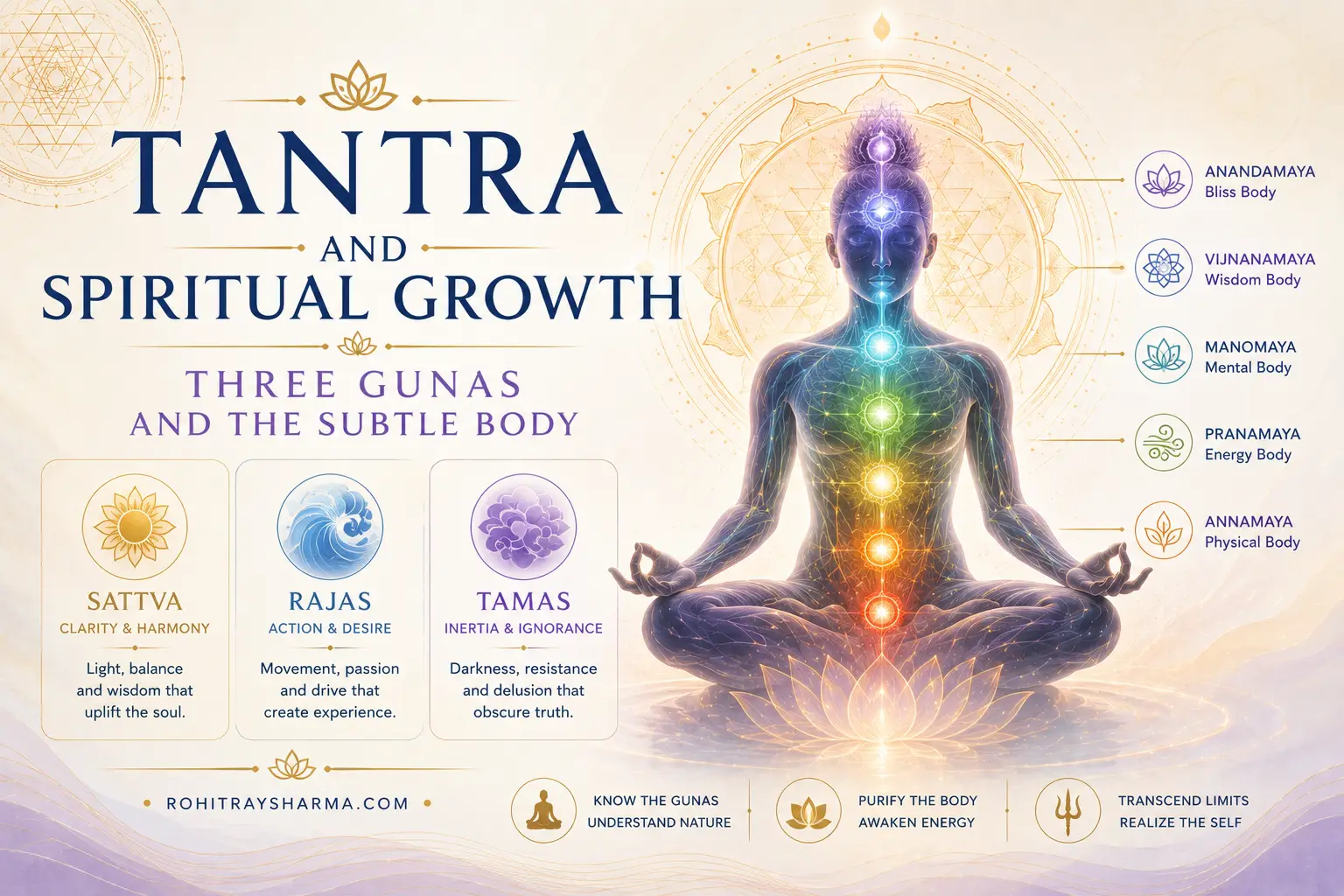
Tantrik sādhana points toward one clear inner aim: spiritual growth through the rise of sattva, the quality of light and clarity, with rajas serving as the force that awakens and strengthens it. In simple terms, all nature works through three gunas, sattva, rajas, and tamas, and every human life carries some mix of these three. Sattva brings understanding, rajas brings movement, and tamas brings heaviness, so the path becomes easier to understand when these three are seen as parts of one inner process rather than separate ideas. The seeker grows by reducing the weight of tamas, guiding rajas into disciplined effort, and letting sattva become steady and bright.
The Three Qualities of Inner Life
The three gunas belong to Prakriti, the field of nature. Every mind, body, and habit shows a mix of these three qualities. Sattva reveals what is true. Rajas drives activity. Tamas hides awareness and creates dullness.
These qualities keep changing in daily life. One moment the mind feels calm, another moment restless, and another moment tired. That changing movement shows the play of the gunas. Spiritual practice brings order to that movement.
The role of Tamas Guna
Tamas is heaviness, inertia, and obscuration. When tamas predominates, the mind is dull, the will is absent, and the soul seems buried under habit and unconsciousness.
Tamas gives heaviness, sleepiness, and confusion. It covers awareness. When tamas rules, energy becomes low, and the mind loses interest in higher things.
Still, tamas has a place in nature. Rest and stillness need some tamas. The problem appears when tamas becomes strong enough to block growth. Then life becomes slow, dull, and unclear.
The role of Rajas Guna
Rajas is activity, passion, and restless movement. Rajas stirs things up. It generates energy, ambition, desire, and effort. On its own, it can scatter a person in every direction. Used wisely, it becomes the fuel that wakes the seeker up and keeps the practice alive.
Rajas gives motion, drive, and effort. Without rajas, no practice can begin. In the spiritual path, rajas becomes useful when it supports discipline, study, worship, and self-control.
Rajas also creates desire and agitation when it grows too strong. Then the mind runs after many things and loses peace. The same force that creates restlessness can also help build steady practice when guided well.
The role of Sattva Guna
Sattva is clarity, harmony, and luminosity. When sattva predominates, the mind becomes transparent, the heart becomes steady, and awareness opens toward higher understanding.
Sattva stands close to clarity, peace, and understanding. When sattva grows, the mind becomes stable and open. Thoughts become cleaner. Choices become wiser. Attention becomes stronger.
A simple line can express this truth: clear mind, clear path. This is the inner value of sattva. The spiritual seeker looks for that clarity in thought, speech, food, habit, and company.
Tantric practice first refines tamas through disciplined rajas, stabilizes sattva, and ultimately points beyond all three guṇas into direct awareness. The path uses the energy of rajas, the fire of effort, discipline, devotion, and sincere practice, to awaken sattva from its latent state. This is a precise understanding of how inner transformation actually works. Sattva cannot simply be willed into existence. The energy of rajas must be redirected toward a higher purpose, and when this happens consistently over time, the inner life begins to clarify.
The five koshas
Panchkoshas or five koshas are the five sheaths of human life, and each sheath shows a deeper layer of existence.
1. Annamaya Kosha is the food body, the physical layer formed and sustained by food, sleep, movement, and the elements.
2. Pranamaya Kosha is the life force layer, the field of prana that supports breathing, vitality, circulation, and energy flow.
3. Manomaya Kosha is the mind layer, where thoughts, emotions, memories, and desires rise and shape experience.
4. Vijnanamaya Kosha is the wisdom layer, where discrimination, understanding, and inner judgment begin to mature.
5. Anandamaya Kosha is the bliss layer, the deepest sheath, where peace, fullness, and inward joy are felt most clearly.
The subtle body
Tantric teaching speaks of a subtle body that carries the deeper pattern of life. This subtle body includes buddhi, ahamkara, manas, and the senses. It shapes the outer body and the next direction of life.
Shakti Tantra recognises that the human being operates simultaneously on gross and subtle levels. The physical body is visible. The subtle body is not visible, yet it is the real operator of experience.
The subtle body comprises:
-
Buddhi: the faculty of discernment, the capacity to distinguish truth from appearance
-
Ahamkara: the sense of individual identity, the feeling of being a separate self
-
Manas: the thinking mind that processes sensation and creates inner images
-
The ten senses: five organs of perception and five organs of action
Many Tantric and yogic methods work with prāṇa, nāḍīs, chakras, and kuṇḍalinī to refine the subtle body and awaken spiritual energy. Prāṇa is the life force, nāḍīs are the channels through which it flows, chakras are the inner centers where that flow gathers and changes, and kuṇḍalinī is the awakened spiritual power described as rising through the central channel toward higher consciousness. Practices such as prāṇāyāma, mantra, meditation, and inner concentration are commonly used to purify these channels, steady the mind, and support the ascent of energy.
The spiritual state of the individual shapes the quality of inner experience through buddhi. When buddhi operates from tamas, perception becomes clouded. When it operates from rajas, it becomes calculating but ultimately restless. When it operates from sattva, it becomes a clear mirror in which reality shows itself as it actually is.
Shakti Tantra offers a complete set of practices designed to refine buddhi toward sattvic clarity. The path works through sound, image, breath, devotion, and disciplined attention until the mind becomes the kind of instrument through which genuine wisdom can move.
Buddhi changes according to prarabdha karma, and buddhi is also shaped by present effort, the predominance of the guṇas, study, association, and sādhana. When buddhi becomes tamasik, life leans toward dull and inert states. When buddhi becomes rajasik, life leans toward active and passionate states. When buddhi becomes sattvik, life moves toward finer and brighter states.
How body and mind connect
The inner state and outer state live together. The subtle body sends its influence into the gross body. The body then carries the results into daily life through action, mood, and choice.
This means inner work matters deeply. If the subtle level becomes clear, the outer life slowly changes too. The path is inward first, outward later.
Human life and growth
The movement from lower states toward higher states is part of the inner journey. Human birth carries special value in spiritual thought because it gives the rare chance to rise, refine, and grow in clarity. In lower forms of life, awareness is limited, but in human life the mind, intellect, and will become active enough to question, choose, and change direction. This turning point matters because spiritual growth begins when a being sees the difference between habit and truth, between impulse and wisdom, between outer movement and inner peace. The higher journey starts when life is used for self-knowledge, discipline, compassion, and steady inner refinement, until the person moves from confusion toward clarity and from restlessness toward the light of the Self.
How sādhana works
Tantrik sādhana uses rajas to raise sattva. This means effort is placed in the service of clarity. Practice, discipline, and steady repetition all support this change.
Simple forms of inner work often help:
-
Clean habits support sattva.
-
Steady effort supports rajas in the right way.
-
Quiet reflection supports clearer buddhi.
-
Good company supports a balanced mind.
The path grows stronger when action becomes clean and calm. The heart becomes lighter, the mind becomes clearer, and the life becomes more inwardly ordered.
Daily life and inner change
The teachings become practical in daily life. Food, sleep, habit, speech, and company all shape the gunas. Calm routines and honest self-observation help sattva grow.
A few simple truths stay useful:
-
A quiet mind supports clear seeing.
-
A disciplined life supports inner strength.
-
A clean heart supports steady progress.
-
A patient attitude supports lasting change.
The shift does not happen in a rush. It grows through repeated effort and clear intention. Awareness becomes clearer step by step. Tantrik sādhana uses movement to bring clarity into power. The subtle body shapes the outer body, and the state of buddhi shapes the next stage of becoming. Tantra does not ask the seeker to reject the forces of nature. It teaches how to understand them, refine them, and finally discover awareness. Inner clarity becomes outer destiny. That is the quiet promise of this path.
Closing reflection – Tantra and Spiritual Growth – Awareness of trigunātīta
Tantra does not ask the seeker to reject nature’s forces; it asks for clear understanding of them, steady refinement of them, and calm awakening beyond them. The three guṇas, sattva, rajas, and tamas, belong to the working of nature, and spiritual growth begins when their play is seen with discrimination rather than confusion. Tantric sādhana thus leads the seeker to the awareness of trigunātīta, where awareness stands beyond sattva, rajas, and tamas and rests in its own higher truth.
Common questions
Why is sattva preferred in spiritual life? Sattva supports clarity, balance, and steady understanding. It allows inner truth to shine more fully.
Is rajas always a problem? Rajas becomes a problem only when it leads to restlessness and attachment. In proper form, rajas supports action, effort, and discipline.
Can tamas serve a purpose? Tamas supports rest, quiet, and stillness in limited measure. In excess, it blocks growth.
What does the subtle body do? The subtle body carries buddhi, ahaṅkāra, manas, and the senses, and it shapes future embodiment. It links inner life with outer life.
Why does prarabdha karma matter here? Prarabdha karma influences the condition of buddhi and the kind of body and life state that appears. It explains why different beings show different levels of clarity and strength.