Religion and Spirituality: Two Paths, One Longing
Are they the same thing or something far more different than most people realise?
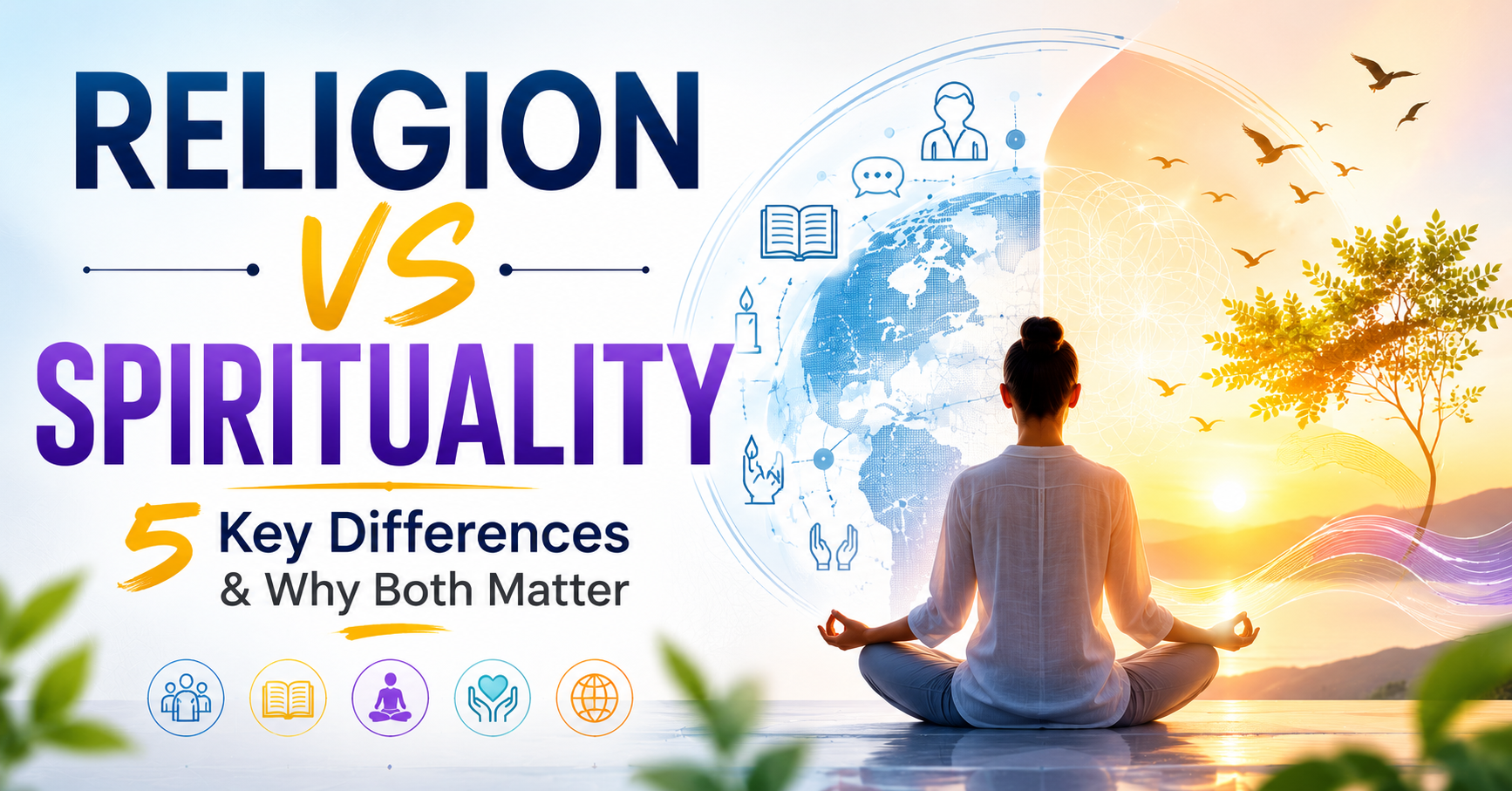
Most of us grow up with one word used in place of the other. Religion and spirituality are spoken of as two distinct movements of the same deep human hunger. This article attempts something more honest: to look clearly at both, understand the difference, and ask which one, or which balance of the two, is actually shaping how you live.
Religion and Spirituality: Are They the Same, or Is There a Difference?
Across the world, this question is becoming increasingly difficult to ignore. People are seeking the sacred more openly than ever before, yet the words religion and spirituality are often used as if they mean the same thing. The first honest step in any search for deeper meaning is understanding what these two terms truly represent and how they differ.
What Religion Actually Is
Religion is the organised, collective expression of humanity’s encounter with the divine. It is built from doctrine, scripture, ritual, community, and lineage. It answers the largest questions of human life, where we come from, how we should live, and what happens when life ends through a shared framework that has been tested, shaped, and preserved across generations.
Religion is a structure, a framework for living that tells a person what is divine, what is worth protecting, what deserves reverence, and how the practice should be followed. It defines what is permitted and what is not, what must be upheld and what must be restrained. At its strongest, it gives a culture its moral architecture and gives an individual a sense of belonging.
What Spirituality Actually Is
Spirituality is the individual, inward search for direct experience of the divine. It does not depend on shared doctrine, community structure, or collective belief. It depends on personal seeking, honest questioning, and the willingness to look beyond form toward what form points to. It is a personal quest that asks deeper questions, one that may begin by doubting a ritual, questioning a pattern, or simply feeling that inherited belief is no longer enough by itself. That search may begin through reading, through a teacher, through silence, or through any sincere method that opens the inner door. What matters is not where it starts but the honesty with which it continues.
1. Source of Authority: External vs Internal
Religion carries something essential. It preserves culture, holds history, builds community, and gives millions of people a shared language for the sacred. The standards it asks of individuals, the structures it maintains across generations, and the belonging. Religion deserves respect for what it protects and what it passes on.
Religion places authority outside the individual in scripture, in tradition, in interpretation passed down through recognised lineages of teachers and institutions. The authority is inherited and preserved across generations. External authority provides a check against that tendency. It holds a standard that asks something of the individual.
Spirituality asks the next question. Once a person has received what tradition offers, something inside may begin to ask whether it can be known more directly, more personally, more honestly. That is not a rejection of religion. It is the natural movement of a sincere seeker going deeper into the same truth that religion has always pointed toward.
2. Community vs Solitude: Belonging vs Becoming
Religion is fundamentally collaborative. It is designed to be practised with others. The community, the gathering, the shared act of worship, these are parts of religious life. They are the structure of it. Religion places the individual inside a lineage, ancestral, cultural, and theological that gives identity, orientation, and shared meaning. This is one of religion’s most profound gifts. It means a person is held by something larger than their personal history.
Spirituality fundamentally is a path of self-discovery, and the search is personal. Even when pursued within a community, a group of sincere seekers, a contemplative environment, a shared commitment to inner work, the essential movement is personal. No one can feel another person’s stillness. No teacher can transfer realisation from one person to another. The inner work is done in private, even when it is supported by a relationship.
Spirituality often creates a connection of unusual depth, where religious community bonds people through shared belief and shared practice. Spiritual connection tends to bond people through shared honesty, shared questioning, and shared recognition of something that cannot easily be named.
3. Ritual and Form vs Direct Experience
Religion works through form. Prayer, ceremony, scripture, pilgrimage, seasonal observance, and daily acts of devotion are its essence. They give a method to reach the divine through practices that can be repeated, remembered, and passed on. Form matters because the human mind needs anchors. Ritual creates a structure for devotion. It works at a level deeper than thought. It speaks in the language of the body, of memory, of breath, and of repetition, reaching the parts of human experience that knowledge and argument alone cannot touch.
Spirituality seeks what lies within form, and often beyond it. It asks whether the act of devotion is genuinely felt or only carried out. Whether the divine is being truly approached or only performed. This is not a rejection of form. It is the natural deepening that happens when a sincere person has held a practice long enough to begin sensing the life behind it and feels called to move closer to that life itself.
The movement from outer practice to inner awareness is one of the most consistent experiences in human history, appearing across every tradition and every century. It arises wherever a person who has been practising sincerely long enough stops asking what to do and begins asking what is actually happening beneath what they are doing. It is the natural next movement of a person who has taken the outer path seriously enough to sense that an inner path exists.
Spirituality at this depth is not about finding a new practice to replace the old one. It is about a fundamental shift in where a person is looking. The seeker stops looking outward at what should be done and begins looking inward at who is doing it. The question is no longer about the ritual. It is about the awareness behind the ritual. The attention behind the prayer. The silence beneath the words. This shift cannot be taught in the ordinary sense. It can only be pointed toward, again and again, until the person sees it for themselves. Spirituality is the courage to stop gesturing and to actually look.
4. Identity vs Inquiry: Who You Are vs Who Is Asking
Religion gives identity. To carry a religious identity is to carry a name, a name that shapes the rhythms of daily life, the marking of time, the understanding of one’s place in a family, a community, and a cosmos. Religious identity can be a profound source of dignity, especially for communities that have faced suppression, displacement, or erasure. It answers the question “who are you?” with something that can be held, declared, and passed on. For hundreds of millions of people, it is the most honest and complete answer they have.
Spirituality tends to examine identity rather than provide it. It asks questions rather than answering them. It enquires into what remains when the names and roles fall away. Who am I truly? What is the divine? How am I separate from it, and how am I connected to it? They are questions that must be lived with, sat with, and returned to honestly over time.
5. Path vs Transformation: What Each One Genuinely Offers
Religion also offers moral structure. It carries the sense that actions have weight, that love has a design, that the dead are remembered, and that life has a purpose worth taking seriously. It organises a life from the inside out. It asks something of the person who holds it, and that asking, over time, builds character in ways that few other forces can match. A person shaped by genuine religious practice tends to carry something steady in them, something that holds even when circumstances do not.
Spirituality offers something that sits alongside this, and in some ways goes further inward. Where religion answers the questions that suffering asks, spirituality asks the person to go deeper than the answers. It invites a direct encounter with what makes those answers true. It moves a person from receiving wisdom to living it, from following a moral structure to understanding, from the inside, why that structure points toward something real.
This inward movement asks a great deal. It requires a willingness to look honestly at oneself, to sit with discomfort rather than escape it, to choose sincerity over performance again and again. It is a slow discipline. It rewards patience and honesty far more than it rewards effort or speed.
When that movement takes hold, the change it brings is quiet but unmistakable. The mind becomes less reactive. The heart becomes less guarded. Life, even in its ordinary moments, begins to feel fuller and more present. The person who has genuinely turned inward may look no different from the outside. But something in how they meet life shifts in a way that those who know them well will sense before it can be put into words.
Bringing It Together: Two Movements of One Longing
Religion is the collective memory of humanity’s encounter with the divine. It preserves what generations have discovered, protects what communities have built, and holds open a space where the sacred can be approached together. Its gift is continuity, belonging, and a moral architecture that has carried civilisations through centuries of change.
Spirituality is the individual’s living encounter with that same divine. It takes what tradition has preserved and asks whether it can be known personally, directly, and honestly. Its gift is depth, inner freedom, and the slow transformation that comes from looking sincerely inward over time. It does not ask a person to abandon what they have inherited. It asks them to go all the way into it, past the surface, past the repetition, into the living truth that the form was always meant to carry.