
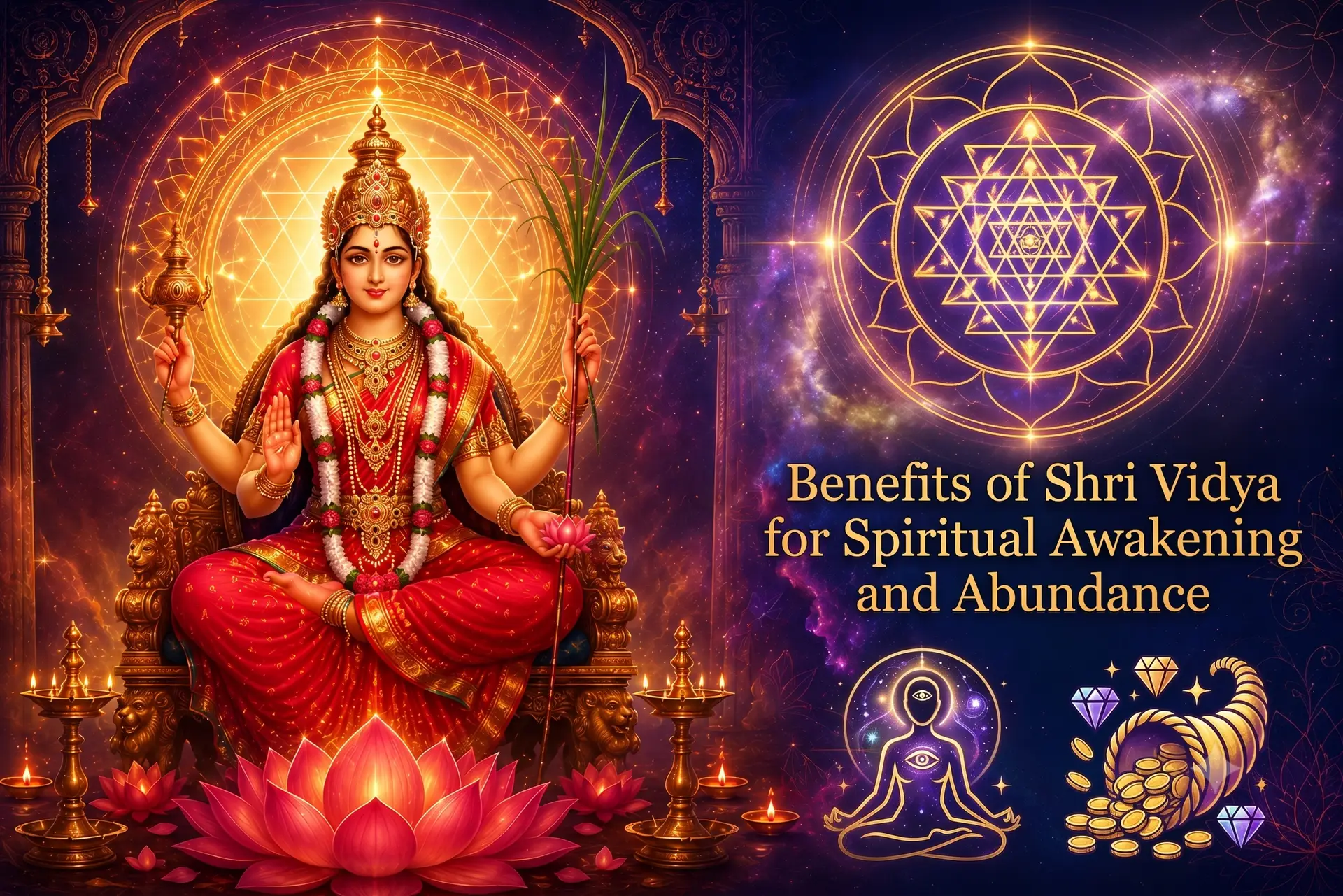
Does devotion change anything beyond a passing sense of comfort? Can worship bring real abundance, real clarity, and real purpose? This question sits at the center of Sri Vidya, the Shakta path devoted to the goddess Lalita Tripura Sundari, one of the most complete expressions of the Divine Mother in Indian spiritual tradition.
Lalita Tripura Sundari blesses you through a gradual movement, from devotion into inner alignment, from alignment into higher awareness, and from higher awareness into abundance, creative expression, and service to others. Her grace moves well beyond ritual, reshaping how you perceive truth, use talent, receive prosperity, and relate to the world around you.
Who Is Lalita Tripura Sundari
Lalita Tripura Sundari is worshipped in the Shakta tradition as the supreme form of Shakti, the divine feminine energy that gives rise to all creation. Her name carries two meanings. Lalita means the one who plays, pointing to creation as her spontaneous expression, a joy carried lightly. Tripura Sundari means the beauty of the three worlds, the physical, the subtle, and the deepest layer beneath both.
In Sri Vidya, the Shakta path built around her worship, she is honored as Rajarajeshwari, the sovereign ruler, and as the source from which every other form of the Divine Mother arises. Her worship stays woven into daily life, touching how a person earns, creates, relates to others, and comes to know the self.
Two goals are held together here instead of being treated as opposites. Bhoga means worldly fulfillment, and moksha means liberation from the sense of being a limited, separate self. Most spiritual paths ask a seeker to choose between the world and the beyond. Lalita Tripura Sundari grants both, seeing the world itself as her radiant expression and a direct path toward the divine.
Pure Devotion as the First Blessing
Devotion is where your relationship with the Divine Mother usually begins. You may turn toward her out of longing, out of grief, out of gratitude, or out of an unexplained pull that grows stronger with time. This early devotion can feel emotional and personal, and it should. Bhakti, devotion carried with genuine feeling, remains a foundation you keep building on for a lifetime, the ground every later blessing grows from.
As devotion steadies, something quietly shifts. Your attention, once scattered across worry and want, starts gathering around a single point of trust. A mind that was pulled in several directions begins to settle. Prayer stops being a request made from lack and starts becoming a form of remembrance, a return to a presence that was always available.
This settling is an active process. It asks for consistency, a small daily offering of attention through mantra, meditation or quiet remembrance, kept up whether the day feels good or difficult. Devotion practiced this way soon grows beyond a private emotional event and begins to align you with something larger than personal preference, carrying you into the next stage of grace.
Raising Awareness Toward Higher Consciousness
Once devotion steadies the mind, perception itself starts to change. Several spiritual traditions describe this shift using different language, from raised vibration to expanded awareness to a subtler frequency of attention. Whatever words are used, the actual change is simple to describe. Ordinary perception stays narrow, noticing mainly threat, comparison and lack. A refined awareness notices connection, sufficiency and meaning in the same circumstances that once felt limiting.
Lalita Tripura Sundari is regarded as the source of this refined awareness, consciousness itself expressing through form. As devotion deepens, attention naturally moves inward, away from constant reaction and toward quiet observation. You begin noticing thought as it arises, gaining distance from it instead of being carried along immediately. For most seekers this builds gradually and quietly, the way clarity returns to water once it is left undisturbed.
This refined perception is often described, in modern spiritual language, as a shift toward a higher vibration. In classical Indian terms, it is closer to viveka, the capacity to discern what is real and lasting from what is temporary. Both descriptions point toward the same inner event, a mind less caught in illusion and more capable of recognizing truth directly. This growing clarity opens into self-realization, the recognition that the awareness watching every experience was never separate from the Divine Mother’s own consciousness.
Abundance and the Fulfillment of Life
Grace expressed through Lalita Tripura Sundari lets you keep material life whole while spiritual depth grows alongside it. Bhoga, worldly wellbeing, is honored as a legitimate outcome of sincere practice, one of the ways her abundance naturally moves through a devotee’s circumstances.
Prosperity still asks for effort, though the effort begins to feel lighter over time. Decisions that once carried anxiety start to carry more clarity, because a mind aligned through devotion and steady awareness chooses from a calmer, more discerning place. Opportunities that once felt scarce start appearing more easily, because a settled, attentive person recognizes and acts on them sooner than a scattered one.
Bhoga and moksha stay held together in this tradition, worldly fulfillment and inner liberation described as two expressions of the same grace. A devotee remains free to build a full life, a career, a family, a creative practice, while that same life becomes the ground where self-realization slowly unfolds.
The Art of Attraction and Creative Expression
Lalita Tripura Sundari is described across Shakta tradition as beauty itself, understood as far more than physical appearance. It refers to a quality of presence that draws others toward warmth, harmony and trust. As inner alignment deepens through devotion, this quality tends to grow more visible in everyday interactions, and people often feel more at ease around a grounded, settled presence, a natural draw closer to what modern language calls magnetism or charisma.
This same energy is also considered the root of creativity. The Divine Mother is regarded as the source from which every act of creation springs, and by extension, the source of every human act of making, whether that takes the form of art, writing, teaching or the way a person shapes daily life with intention. As awareness settles, ideas tend to arrive with less strain, since a quiet mind holds more room for insight than a crowded one. Attraction and creativity, understood this way, stand as natural outcomes of the same inner alignment that devotion and awareness produce.
A New Purpose: From Personal Desire to Seva
Early in a spiritual life, most requests made to the Divine Mother center on personal need. Health, security, success, relief from a difficulty- these are honest and appropriate prayers, and Lalita Tripura Sundari receives them without judgment. Over time, as devotion deepens and perception refines, the nature of the seeking itself tends to change.
As awareness expands, a devotee starts noticing that fulfillment extends well beyond personal gain, meaning growing further when abundance is shared than when it is only accumulated. This is the point where devotion often turns naturally toward seva, selfless service offered without expectation of return, what devotion becomes once the sense of separation between self and others starts to soften.
Instead of asking only what you can receive, attention turns toward what you can offer. Purpose stops being an abstract idea to search for and becomes something lived out through daily choices, how time, skill and attention are given to family, community and the wider world. This is often the deepest and most lasting blessing Lalita Tripura Sundari offers, a life reoriented from acquiring toward giving, without losing any of the abundance built along the way.
Living in Alignment With the Divine Mother
Grace of this kind grows through consistency more than intensity. A few grounded practices can support your alignment over time:
- Keep a daily point of remembrance. A short mantra, a few minutes of quiet sitting, or a simple offering each morning keeps your devotion active and continuous.
- Watch reaction before it becomes action. Noticing a reactive thought as it arises, without immediately acting on it, strengthens the discernment that leads toward higher awareness.
- Let your work become an offering. Approaching daily responsibilities with full attention, instead of resentment, turns ordinary activity into a form of worship.
- Stay honest about desire. Personal wants can be named clearly and held lightly, keeping your devotion genuine.
- Share before scarcity feels resolved. Small acts of seva, offered even while you are still building personal stability, accelerate the shift from acquiring toward giving.
- Return to stillness after effort. A settled mind after action, without constant striving, is what allows insight and creativity to surface naturally.
None of these practices require dramatic change. They ask for steadiness, the same quality devotion to Lalita Tripura Sundari cultivates in you from the start.
The Deeper Blessing
Every stage described here, devotion, alignment, higher awareness, abundance, creativity and seva, eventually points back to a single recognition. The Divine Mother a devotee turns toward in prayer shares the same awareness doing the praying. This stands as the deepest teaching of the tradition: Lalita Tripura Sundari is worshipped outwardly through mantra and remembrance until that same presence is recognized within the seeker’s own consciousness.
This recognition completes devotion, abundance and service rather than replacing them, revealing that every blessing received along the way was always an expression of the same grace, moving through a life until the life itself becomes a form of worship.
Frequently Asked Questions
Frequently Asked Questions
- What does it mean when Lalita Tripura Sundari blesses a devotee?
It means a gradual inner shift, moving from devotion toward clearer perception, greater abundance and a stronger sense of purpose, expressed through daily life rather than a single dramatic event. - Does worshipping Lalita Tripura Sundari conflict with seeking material success?
No. Sri Vidya honors both worldly fulfillment and spiritual liberation, treating prosperity as a legitimate expression of the goddess's grace. - How can a beginner start connecting with Lalita Tripura Sundari?
A steady daily practice works better than an elaborate one, a short mantra, quiet sitting, or simple remembrance each day building the consistency devotion depends on. - What is the connection between devotion and higher awareness in this tradition?
Devotion settles the mind first. Once your attention steadies, perception naturally refines, allowing you to recognize truth and meaning more clearly than before. - Why does devotion often lead toward service to others?
As your awareness expands, the sense of separation between yourself and others softens, and fulfillment starts to include what you offer others as much as what you personally gain. - Is self-realization the final goal of worshipping the Divine Mother?
Self-realization is considered the deepest blessing of this path, the recognition that the awareness within you was never separate from the Divine Mother you worship.

Rohit Ray Sharma is a spiritual awakening coach in India helping conscious professionals and seekers find greater clarity, purpose, and self-awareness. His work draws on the wisdom of India’s Shakta and Shiva traditions, with a focus on Sri Vidya, spiritual awakening, consciousness, self-realisation, and inner transformation. Book a one-to-one spiritual awakening session to begin your journey toward greater clarity and purposeful living.
- Rohit Ray Sharma

- Rohit Ray Sharma
- Rohit Ray Sharma
- Rohit Ray Sharma