
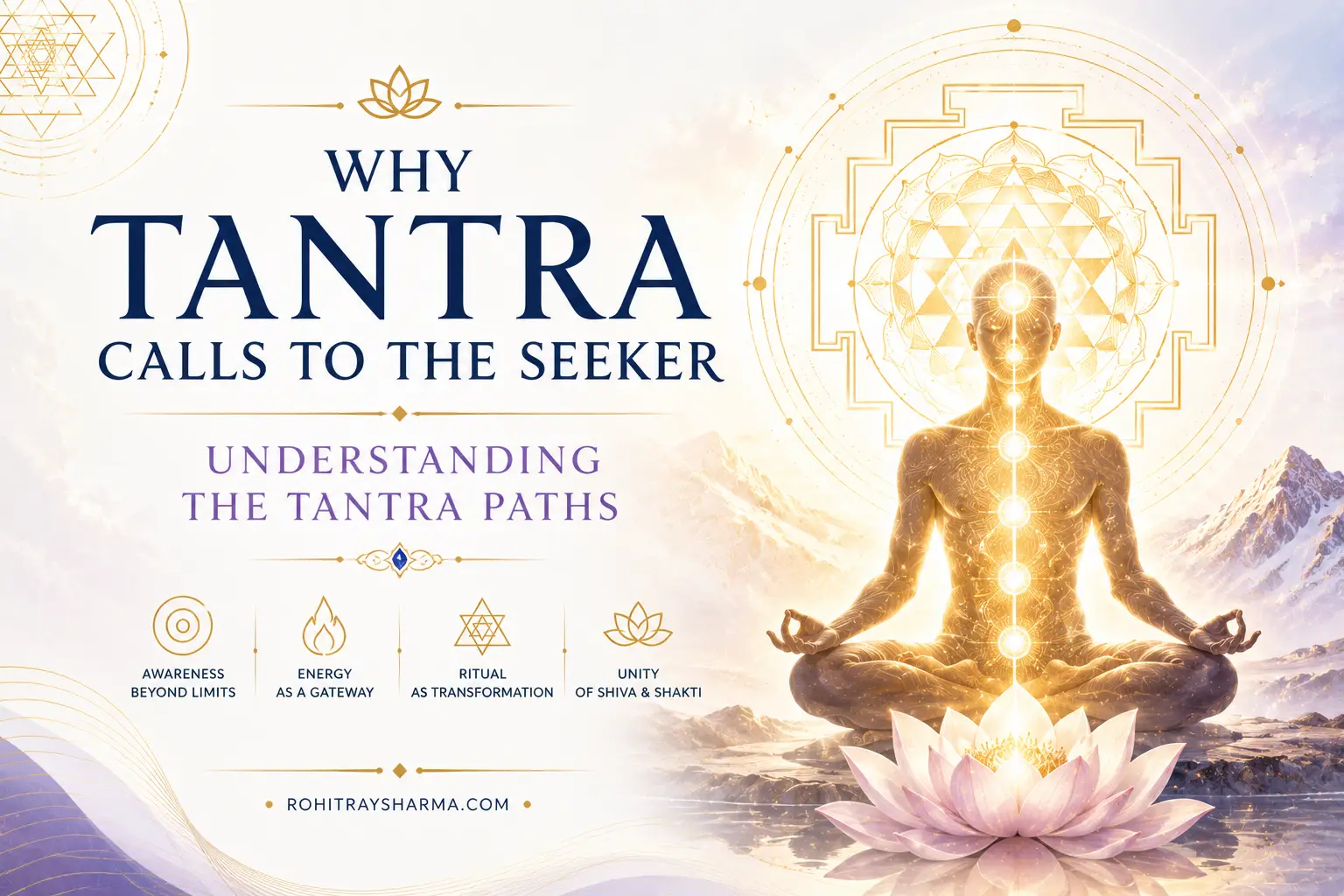
Some souls are drawn to Tantra because it calls those who would live life fully and, at the same time, pursue the inner Way. This path does not demand a dramatic renunciation of the world; rather, it invites wakefulness, patience, and the steady unfolding of practice from the very place where life now stands. For this reason Tantra touches those in whom strong desire, deep feeling, or restlessness dwell. It accepts the human as the human is, and by slow artifice refines that life toward self-realisation.
This is not subtle. The householder rises at dawn, performs daily tasks, meets family duties, bears economic strain and emotional trial, and nevertheless harbours the longing for a spiritual life. Tantra holds such a life itself to be the field of sadhana. It does not say: first be perfect, then practise. It bids only that the seeker enter practice with sincerity, correct the self little by little, and at length grow into profound awareness. Hence many feel about it a calm, natural attraction.
Shakta Tantra And Shiva Tantra
Shākta Tantra is the path where Divine Power, or Shakti, is central, and all worship turns toward the Mother as the source of creation, preservation, and return. Śaiva Tantra is the path where Shiva, the still and luminous Consciousness, is central, and Shakti is understood as His living power.
Shiva without Shakti is silence without movement, and Shakti without Shiva is movement without rest. The full truth shines when both are known together, for the universe itself is born from their sacred union.
Tantra Paths
1. Vedācāra
This is the first and most ordinary path, where Tantra remains close to Vedic discipline, purity, mantra, temple worship, and lawful conduct. It is the foundation of spiritual life, where outer order prepares the heart for inner awakening.
2. Vaiṣṇavācāra
Here devotion becomes stronger, and the worshipper approaches the Divine through love, surrender, name, and remembrance. The mind learns softness, faith, and steady devotion, and the path becomes sweeter and more inward.
3. Śaivācāra
In this path, Shiva is known as the supreme Consciousness, and the seeker develops steadiness, meditation, and inner strength. The emphasis is not merely on ritual, but on silence, awareness, and the power that burns ignorance.
4. Dakṣiṇācāra
This is the right-hand or orthodox tantric mode, where Shakti is worshipped in a pure, disciplined, and symbolic way. It is considered a sattvic path, and many practices that appear fierce are handled in inner or symbolic form rather than crude outer display.
5. Vāmācāra
This is the left-hand path, more secret, more intense, and meant for those with firm discipline and guidance. It works by transforming powerful human energies into spiritual force, yet it is never meant for careless imitation.
6. Miśra or Madhyama
Some traditions speak of a mixed or middle path, where right-hand and left-hand modes blend according to the seeker’s nature. This shows that Tantra is not one rigid method, but a living gradation of inner capacity.
7. Siddhāntācāra
This stage is for refined seekers who move beyond outer forms into deeper tantric truth, where knowledge, mantra, and inner realization become central. It is a bridge between ordinary worship and the highest nondual vision.
8. Kaulācāra
This is the highest and most secret tantric way, where the seeker sees the Divine in all things and the whole life becomes worship. In this state, distinction weakens, inner freedom grows, and the path moves toward direct union with the Supreme.
Tantra is for everyone because it begins from the actual place where a person stands, not from some ideal state assumed for some distant future. The tamasic man comes with inertia and habit, the rajasic with momentum and force, the sattvic with clarity and equipoise; Tantra works with the three gunas, for to it they are not obstacles but the very materials of practice. Each condition is allotted its rightful place in the journey and is gradually transmuted toward Self-knowledge.
The tamasic temperament needs steadiness, routine, and a way out of dullness without guilt. The rajasic needs direction, so that its energy will convert into discipline rather than into turmoil. The sattvic requires depth, so that clarity may cease to be merely intellectual and become living self‑experience. Tantra speaks equally to all three because human life wears many layers and true growth is never forced; it ripens slowly through wise use of what already exists. This is why the tantric path appears whole: it does not counsel flight from life, but the entering of life more awake.
Therefore Tantra also draws those who desire a spirituality that breathes with real life. It views the human being as a living field of change where desire, feeling and awareness may be refined together, until self‑realisation is the simple, steady, and immediate fact of living.
One need not cast all away to walk this road. Practice begins where the mind is full of thought, where the heart is weary, where desires yet live, and where delusion has not wholly ceased. Tantra teaches that the very force which binds may, by practice, be refined and become the means of liberation. Desire that once scattered the mind may be turned toward discipline. Restlessness that once caused suffering may be fuel for spiritual progress. This thought awakens hope in many, for it shows that the Way is not reserved to those already tranquil.
Tantra’s principal virtue is its honouring of gradual unfoldment. It does not praise abrupt flight from life; it esteems the slow, natural maturation that takes place within. Tantra does not blame the human condition but transforms it. Thus the path remains living and timely. It is no road of escape; it is the art of living with greater awareness, dignity, and self-recognition.