
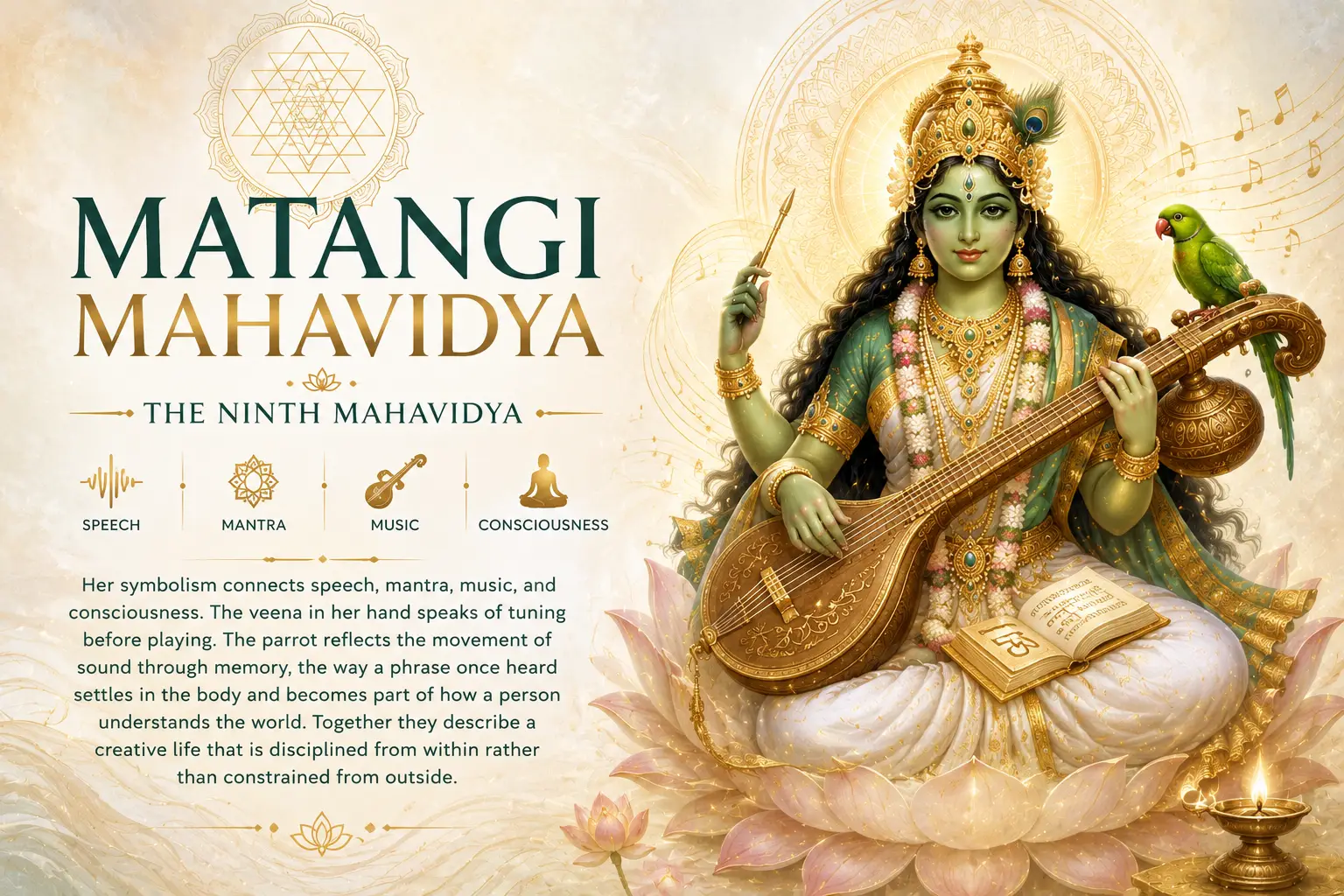
Matangi, the ninth of the ten Mahavidyas, is the goddess who governs the moment when inner truth becomes outer expression, and she is not gentle about how much she asks for. Having passed through that stillness, the seeker meets Matangi. She asks what was heard in the quiet. She asks what arises when the noise finally stops. And then she asks the seeker to speak it.
Matangi is also known as Ucchishta Matangi or Ucchishta Chandalini. She is one of the most revered and unusual forms of Mahavidya, the goddess who rules speech, music, art, and inward wisdom. In the tantric current, she is remembered as the Tantric Saraswati, yet her presence is stronger, wilder, and more intimate with the hidden currents of life. She is also closely linked with Lalita Tripura Sundari, where, as Raja Shyamala, she appears as the minister of divine speech, sacred attraction, and inner counsel, guiding the seeker toward the deeper truth behind words and form. In spiritual life, her teaching is clear: wisdom does not live only in approved spaces. It also lives in the broken places, the awkward places, and the quiet places where a person stops pretending, and in that way Matangi becomes the goddess who leads speech back to its source and devotion back to its living heart.
Her symbolism connects speech, mantra, music, and consciousness. Matangi is most often shown in an emerald green tone, and this colour carries the feeling of living intelligence, fertility, and the deep movement of thought through nature. In her iconography, the veena, the parrot, and the subtle gestures of her hands speak as clearly as any mantra. The veena points to harmony between inner and outer life, the flow of sound through the body, and the disciplined tuning of consciousness, while the parrot reflects speech, memory, and the power of articulated truth. Her hand symbols and overall form remind the seeker that Matangi is not only about refined knowledge, but about sacred expression that rises from the margins, where voice, art, and wisdom become one living expression.
Matangi is called the Tantric Saraswati
Unlike the Vedic Saraswati, who embodies purity and refinement, Matangi resides beyond convention, classification, and control. She is the sovereign of the spoken word, the divine outcaste who blesses those who live authentically and speak their truth.
The Vedic Saraswati belongs to the well-lit, structured teachings. She is the goddess of careful learning, of text memorised with precision, of the student who prepares before speaking. Matangi works differently. Her knowledge arrives through lived experience, through what has been felt rather than only studied, through the kind of understanding that comes after something has actually happened to a person and left its mark. She is, in that sense, the goddess of earned wisdom rather than inherited wisdom.
Her name comes from mata, meaning thought or mind, and angi, meaning embodiment. Matangi is the embodiment of thought, especially when it becomes sacred sound. Matangi is worshipped as the goddess of creative expression because she governs speech, music, art, and the inner power that turns feeling into form. Artists feel drawn to her because she blesses the voice behind the voice, the quiet current where inspiration begins, and she helps words, song, and image come out with clarity, force, and soul. Her worship is especially dear to those who work with language and rhythm, since she is understood as a tantric form of Saraswati who carries both wisdom and artistic energy into lived expression.
Creative thought does not reach its completion until it becomes sound. The idea that remains inside never fully matures. It is the act of giving something a voice, in speech, in song, in writing, in honest conversation, that allows it to become real and transmissible. Matangi governs that transformation.
Devi Matangi is linked to the Vishuddha Chakra, the centre of speech, and resides at the tip of the tongue, where speech takes form. The throat chakra is the crossing point between the inner world and the outer one, so when it opens, what is felt inside can move outward with clarity and integrity. When it is blocked, a person may carry great depth and still struggle to express it. Matangi’s worship is often sought to support creative expression, clear speech, and the release of Vishuddha Chakra blockages.
Ucchishta Matangi or Ucchishta Chandalini
In her worship, offerings of ucchishta, food that has already been tasted, are considered appropriate. She accepts what other deities in formal Vedic practice would not. Matangi lives equally in the already used, in the ordinary, in what has already passed through human contact and human experience.
For the artist, this matters enormously. The creative process is rarely clean. It moves through failure, through the draft that embarrasses. The performer knows this. The musician knows it. Matangi blesses that process, the whole of it, including the versions that were not ready. She asks the seeker to value the experience of learning as much as the eventual result.
Matangi teaches the seeker how to return to the world with greater wisdom and awareness. Speech, creativity, knowledge, and action are the blessings, but they are no longer driven by ego or ignorance. The creativity Matangi provides is quieter, more honest, and less interested in approval. It knows what it wants to say.
Goddess of the Creative and Spiritual Outcaste
Matangi is considered to be the outcaste among the other goddesses within the Mahavidya. For seekers who have always felt slightly outside the approved frame, whether through temperament, background, the unconventional shape of their questioning, or simply because their spiritual experience has never matched the available categories, Matangi’s energy is immediately recognisable.
Matangi is called the goddess of the creative and spiritual outcaste because she belongs to the Mahavidya current that honours what society often leaves outside, and she transforms that very edge into a place of wisdom. She is close to artists, thinkers, and seekers who have never fully fit the expected mould, because her presence does not demand conformity before grace begins; she meets the person in the actual shape of their life, with all its roughness, instinct, and hidden beauty. In that sense, Matangi becomes the patron of truthful expression, unconventional insight, and creative freedom, especially for those who feel their voice has lived at the margins of ordinary acceptance.
Speech, Sound, and the Levels of Vak
Speech unfolds in four levels, and each level reveals a different face of consciousness. A seeker learns to honour all four, because true speech does not begin at the mouth and does not end there either. It begins in stillness, matures in awareness, and becomes complete only when the outer word remains faithful to the inner truth.
The Four Levels of Speech
- Para is the source, the quiet pulse before language. Para Vak is the most subtle level of speech, the silent source from which all words arise, and in spiritual teaching it is understood as speech before speech, pure awareness before language takes shape. At this level, sound is still unborn, yet meaning already exists as living consciousness, so Para Vak is often described as the deepest current of expression, where the self touches the eternal word. A seeker grows close to Para Vak through silence, inward attention, and a mind that becomes still enough to hear the beginning of thought before it becomes thought.
- Pashyanti is the felt meaning, the first clear seeing of an idea. Pashyanti is the stage of speech where meaning first becomes visible inside consciousness, before it turns into full thought or spoken sound. It is often described as “seeing speech,” a subtle awareness where an idea is not yet dressed in words but is already present as a living form in the inner field. Pashyanti is the moment when truth begins to gather shape in the heart, and a seeker who learns to rest there gains a quieter mind, clearer intuition, and a deeper relationship with the source of speech itself.
- Madhyama is the inward sentence, formed but still unspoken. Madhyama is the middle level of speech, the stage where thought has already taken form but has not yet become audible word. It is the quiet inner speech of the mind, the place where ideas are shaped, chosen, tested, and prepared before they are spoken into the world. Madhyama is the bridge between the subtle inner vision of Pashyanti and the clear outer voice of Vaikhari, and mastery of this stage brings greater self-awareness, steadier thinking, and cleaner expression.
- Vaikhari is the audible expression, the speech others hear. Vaikhari is the spoken form of speech, the level where inner thought finally becomes audible word and enters the shared world of human life. In spiritual teaching, it is the outermost and most tangible expression of Vak, where the hidden current of consciousness passes through the tongue, lips, and breath to become clear language. A seeker learns from Vaikhari that speech is sacred action, because every spoken word carries the power to shape relationship, thought, and atmosphere, and therefore the voice must be used with awareness, truth, and care.
When this order is understood, speech becomes a spiritual discipline rather than a habit. The tongue then follows the heart with greater care, and the mind learns that every word carries the trace of the silence from which it came.
Matangi’s grace works on restoring that connection. The practitioner who approaches her is gradually asked to close the gap between the inner and the outer, to speak more truly, to value what arises in stillness over what is shaped by social approval. It is about the quality of inner alignment that makes speech carry actual weight.
What the Path Asks and What It Returns
People are drawn to Matangi at particular moments. The person who has insight but cannot find the words that would make another person actually feel it. They share a common quality: something real exists inside, and the passage outward has narrowed or closed.
Matangi is the force that transforms inner realisation into creative expression and meaningful action. This is the practical heart of her teaching. Realisation that stays inside does not change the world. It is the act of letting the truth out, in whatever form it naturally takes, that completes the work.
What Matangi teaches is the authority that comes from alignment, the quality in a person’s voice when what they are saying and what they know to be true are finally the same thing. It is among the rarest qualities in human expression, and it cannot be performed. It can only be arrived at honestly.
The Unconventional Path
One of the most striking aspects of Matangi Mahavidya is her link with unconventional knowledge. She is not bound to the safe and familiar edges of spiritual life. She carries the beauty of what society often leaves aside. This is why she feels so alive to people who have never fully fit into neat categories.
Matangi represents a sacred freedom from rigid ideas of purity and perfection. Her worship often points toward leftover offerings, unclassified thought, and the ordinary human condition, which is usually far less tidy than public religion likes to show.
This is one reason her path attracts artists, thinkers, and seekers with strong inner lives. Such people often carry a private world that does not always match the outside world. Matangi does not ask them to hide that world. She asks them to refine it, to listen to it, and to let it speak with honesty.
Who Matangi Mahavidya Is For
Matangi Mahavidya speaks most strongly to those whose lives are shaped by expression. That includes singers, writers, teachers, poets, speakers, musicians, and students who rely on clarity of mind and confidence in language. She is also deeply meaningful for people who feel blocked in speech, shy in public, or uncertain of their own voice. Her grace is said to support articulateness, musical strength, memory, and creative flow.
Astrological and tantric traditions also associate her with Sun & Mercury. As the Tantric form of Goddess Saraswati, Matangi governs supreme knowledge, awakened speech, and the 64 creative arts. Through her grace, an afflicted Sun’s aggressive energy is transmuted into radiant wisdom, self-discipline, and deep spiritual insight. For this reason, she is often connected with those experiencing difficulty in study, planning, articulation, or focused thought. Her energy feels especially relevant in modern life, where the mind is constantly pulled in many directions and words often come too quickly or too thinly. Matangi gathers the scattered current and gives it direction.
There is also a deeper reason people feel called to her. She speaks to those who sense they are slightly outside the usual frame. This may come through culture, temperament, gender, ambition, grief, or simply the way life has unfolded. Matangi meets such people with a rare kind of acceptance. She seems to say that the sacred still sees them clearly and still welcomes their voice.
Benefits of Practice
The benefits connected with Matangi Mahavidya are both practical and subtle. Her worship is often described as strengthening speech, improving confidence, sharpening memory, and bringing greater ease in communication. A student may find study easier. A teacher may speak with more calm. A writer may feel words begin to flow again. A performer may feel less divided between inner feeling and outer expression.
Her blessings also extend to creativity. Music, poetry, drawing, acting, and all forms of expressive work often feel more alive under her influence. The creative mind needs both freedom and discipline, and Matangi seems to support both. She helps a person hear the rhythm beneath the noise and return to the pulse of real expression.
There is another benefit that is harder to measure but easier to feel. Matangi brings inner steadiness. The restless mind begins to settle. The voice becomes more honest. The habit of self-criticism softens. What emerges is a quieter kind of authority, one rooted in presence rather than display. This is perhaps her most lasting gift.
Inner Transformation
Matangi’s deeper power lies in the way she changes a person from within. Speech is never only about speaking. It reveals the state of the heart. When speech becomes more truthful, the whole inner life begins to change with it. Her path supports that change gently and steadily.
She is linked with the transformation of thought into awareness. A person who works with Matangi begins to notice which words create confusion and which ones bring light. Some words widen the heart. Some words close it. Matangi teaches the difference through experience. In time, speech becomes more careful, more musical, and more aligned with truth.
Her symbolism around unconventional knowledge carries another layer of transformation. It asks a person to look at the parts of life that were pushed away and to see whether those parts still carry wisdom. Sometimes the self grows strongest by making peace with what it once rejected. Matangi stands in that place of reconciliation. Her teaching feels mature because it includes the whole human being.
Why People Feel Called to Her
People often feel drawn to Matangi Mahavidya during moments of creative tension or emotional honesty. A person carrying grief that has never found language. Something inside seeks a way out, and Matangi offers that passage.
Her call is also felt by those weary of spiritual perfectionism. There is relief in a goddess who does not demand a polished face before devotion begins. She seems to honour the person who arrives as they are. That quality makes her especially dear to seekers who have grown tired of pretending. Under her gaze, truth becomes more valuable than appearance.
Another reason for this calling is her link with freedom. Matangi does not support speech that merely obeys social approval. She supports speech that is awake. For those who want a more authentic way of living, that is a powerful attraction. Her path becomes a way of becoming more real, more articulate, and more inwardly free.
Closing Reflection
Matangi Mahavidya is not only a goddess of language. She is the quiet force that makes language meaningful. She stands where thought becomes speech and where speech becomes a bridge between the inner and outer worlds.
Those drawn to her often discover that their real gift is not only articulateness. It is honesty. It is the courage to let feeling become voice without losing depth. It is the ability to speak with care, listen with attention, and create from an inner place that remains alive. In that way, Matangi Mahavidya becomes more than a figure in the Mahavidya tradition. She becomes a companion in the long, beautiful work of finding one’s true voice.