
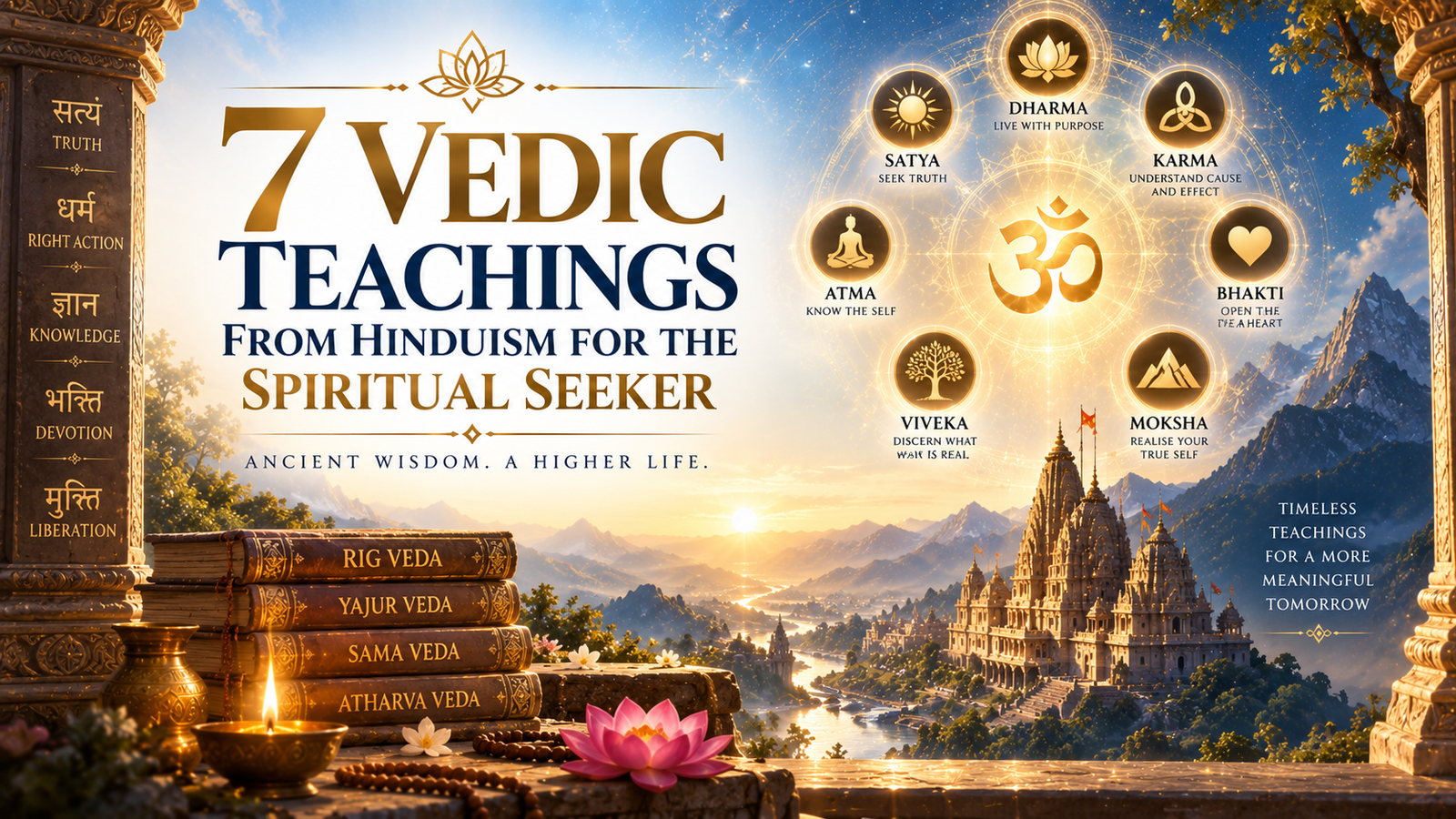
Understanding Purpose, Purification and Liberation in Hindu Philosophy
Hindu philosophy offers a complete account of human life, from its ordinary daily purposes to its final destination. Each of the seven teachings below answers a question the one before it leaves open, moving from why human life exists at all toward what remains once every temporary identity is set aside.
1. Life’s Purpose Is Spiritual Advancement
Hindu philosophy holds that human birth serves a specific function unavailable to other forms of existence: it is the form of life best suited for self-realisation. Across several lives, you become progressively more capable of sustaining spiritual awareness, and this growing capacity is what eventually matures into liberation from the cycle of rebirth altogether.
If human life exists to advance you spiritually, what should the rest of that life, work, relationships, pleasure, ordinary responsibility, be used for? Hindu philosophy organises every part of a life around spiritual growth.
2. The Four Aims of Life Hold Everything Together
Dharma provides the ethical foundation the other three depend on. Artha and kama are legitimate goals in their own right, provided they stay governed by dharma. Moksha stands as the aim the other three ultimately serve.
Hindu philosophy does not ask you to renounce work, wealth or pleasure to take spiritual growth seriously. It asks that these pursuits stay connected to right conduct, so that your material and emotional life feed spiritual growth instead of working against it. Wealth pursued without dharma tends to bind you tighter to want. Wealth pursued within dharma tends to loosen that grip over time.
If dharma, artha and kama are genuine goals and moksha is still described as the highest one, what is being pursued through all four?
3. You Are Already Divine
A central message running through Vedic teaching is that every being already carries the same divine nature that pervades all existence, not as something to be earned or built, but as a present fact currently obscured by ignorance. The four aims of life are pursued by someone who is already, within that pursuit, what the pursuit is quietly aiming toward.
Spiritual practice, understood this way, removes what conceals a nature already present, closer to clearing a window than building something new. This distinction changes what a seeker is working toward: a present recognition that has been available the entire time.
Removing what conceals this recognition is rarely quick. Hindu philosophy names this removal a gradual purification, which is why spiritual growth often feels slow even for someone practising with real sincerity.
4. Spiritual Growth Is a Gradual Purification
The Bhagavad Gita describes the sincere seeker as becoming purified gradually, life after life, reaching the highest goal only after passing through several births. Your own spiritual development, understood this way, is not confined to a single lifetime. Earlier practice prepares the ground later practice builds on, the way any long undertaking depends on the stage that came before it.
This teaching offers you something concrete: patience grounded in structure. If purification extends across more than one life, a single lifetime failing to reach its conclusion is not failure. It is one stage inside a longer process that was never expected to complete in one sitting.
A process unfolding across several lifetimes moves unevenly even within a single one.
5. The Journey Unfolds in Its Own Time
Spiritual progress rarely moves in a straight line. Expansive, clear stretches of practice alternate with heavier, more difficult ones, and both belong to the same movement rather than one representing success and the other failure.
Much of this movement happens at a depth ordinary daily awareness cannot track directly. A shift in tendency or understanding often needs to build for some time before it becomes noticeable at all, which is why a difficult week can sit inside real progress instead of interrupting it.
Once enough of this movement has taken place, what it eventually reveals is the awareness in which every state, comfortable or difficult, has been appearing all along.
6. The Self Stands Beyond Birth and Death
Thought changes. Emotion changes. Desire changes. The body changes across a single lifetime, and identity itself shifts across several lifetimes. Vedantic enquiry asks a direct question about anything that changes in this way: can something that changes be the deepest truth of who you are. Followed fully, this question leads to a recognition of awareness that remains constant while every thought, feeling and identity appears within it and passes.
This recognition is described as something that stands beyond birth and death, having never entered the cycle it appeared to be moving through. Hindu philosophy treats this recognition as the culmination spiritual seeking has been building toward the entire time.
This recognition has a specific name, and it is the destination the rest of this account has been describing all along: moksha.
7. The Ultimate Goal Is Liberation
Everything covered so far, life’s purpose, the four aims, inherent divinity, gradual purification, the uneven shape of the path, and the Self beyond change, moves toward one destination: moksha, liberation from the entire structure of birth and rebirth. Spiritual growth within samsara asks how to create better conditions for the next life, refining one tendency after another. Liberation asks a different question entirely: who is the one being born and dying in the first place.
Answering that question fully is what moksha names. It is reached not by accumulating a better life, but by recognising the Self as something that was never bound to the cycle it seemed to be caught inside. This is the aim toward which dharma, artha and kama were always oriented, the destination the four aims of life name directly as their highest point.
Frequently Asked Questions
- What is the purpose of human birth in Hindu philosophy?
Human birth is treated as uniquely suited for self-realisation. Across several lives, a person becomes progressively more capable of sustaining spiritual awareness, a capacity that eventually matures into liberation. - What are the four aims, purusharthas of life in Hindu philosophy?
The four aims, purusharthas, are Dharma (right conduct), Artha (prosperity and material security), Kama (pleasure and desire pursued within the bounds of Dharma), and Moksha (liberation from the cycle of birth and rebirth). Dharma provides the ethical foundation , and moksha stands as the aim the rest ultimately serve.
Related posts:
Kundalini Awakening: The Rising of Shakti Toward Shiva
5D Consciousness and Spiritual Awakening: A Comprehensive Guide
How Lalita Tripura Sundari Blesses Your Life Through Abundance and Higher Consciousness
Spiritual Awakening: Understanding Why Life Starts Falling Apart
Spiritual Awakening and Detachment: Why Letting Go Matters

Rohit Ray Sharma is a spiritual awakening coach in India helping conscious professionals and seekers find greater clarity, purpose, and self-awareness. His work draws on the wisdom of India’s Shakta and Shiva traditions, with a focus on Sri Vidya, spiritual awakening, consciousness, self-realisation, and inner transformation. Book a one-to-one spiritual awakening session to begin your journey toward greater clarity and purposeful living.
- Rohit Ray Sharma
- Rohit Ray Sharma
- Rohit Ray Sharma
- Rohit Ray Sharma