
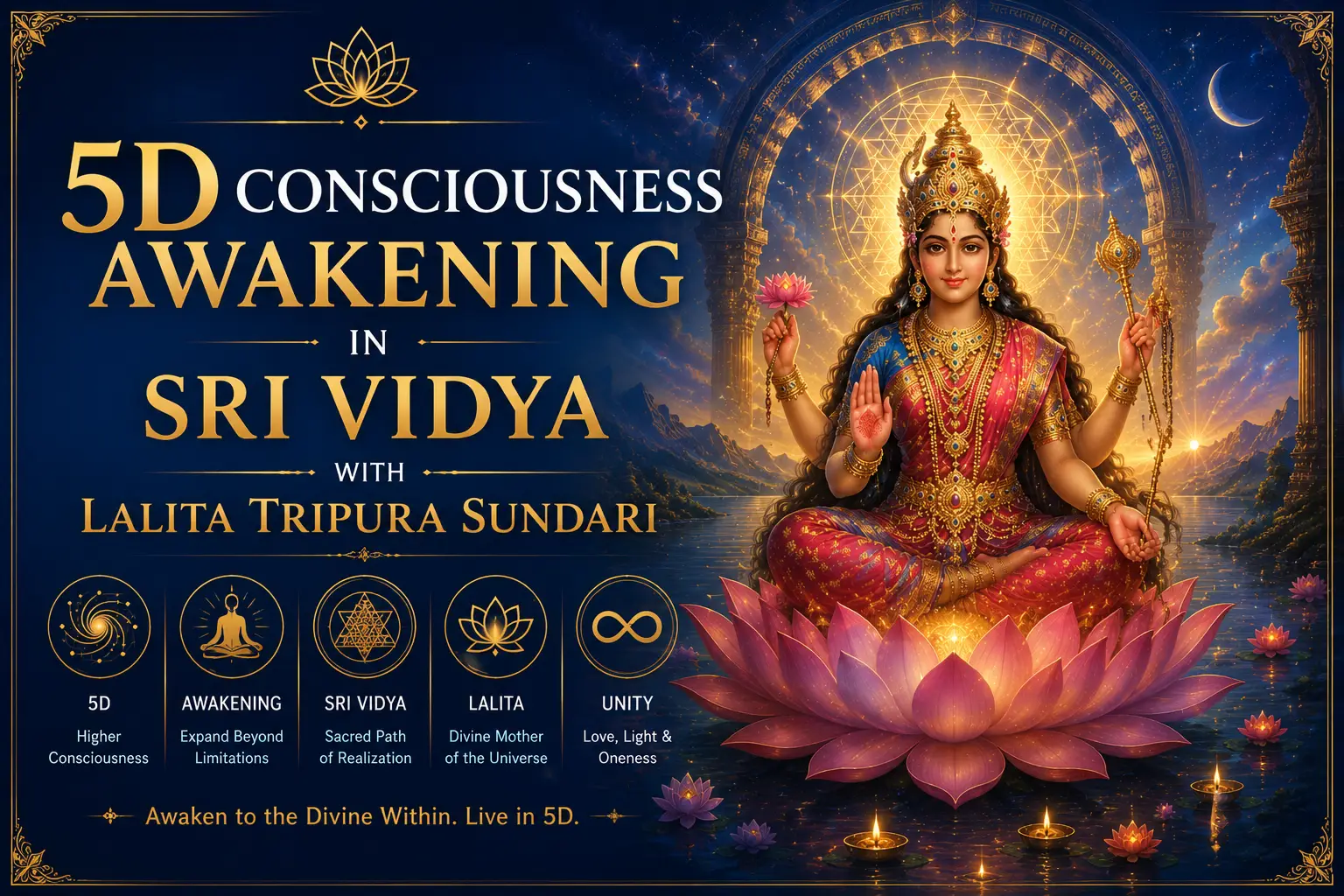
You may have come across the phrase “5D consciousness” and wondered what it means. Does it describe a real shift in how a person lives, or is it modern language dressed up as spirituality? Sri Vidya, a tradition far older than the phrase itself, already holds a precise answer.
5D consciousness is a shift in awareness where compassion, intuition, and inner steadiness matter more than fear and outside approval. Sri Vidya addressed this same theme long before the phrase existed, through the worship and recognition of the goddess Lalita Tripura Sundari as consciousness itself.
What Is 5D Consciousness?
5D consciousness describes a shift in how you relate to yourself and the world around you. Attention moves toward compassion, intuition, and steadiness, while fear plays a smaller role and approval from others matters less. Your sense of identity becomes steadier and depends less on external validation.
The term describes inner states instead of physical ones:
- 3D consciousness centers on survival, material identity, and competition.
- 4D consciousness marks a transitional stage, where old beliefs and patterns start to be questioned.
- 5D consciousness is a state of expanded awareness marked by compassion, intuition, and a felt sense of unity.
Most people move back and forth between these states depending on circumstances. Few remain permanently in one, and the stages are not fixed steps that everyone passes through in the same order. The direction matters more than the labels: fear gradually loosens its grip, and identification with awareness gradually strengthens.
Common Signs People Report During This Shift
- Growing self-awareness
- Reduced attachment to material concerns
- Deeper compassion toward others
- Heightened intuition
- Physical experiences such as tiredness or disrupted sleep during periods of intense change
None of these signs confirm anything by themselves. People report them during a period of inner transformation. Naming them here can help if you notice something similar happening in your own life and wonder what it means.
Who Is Lalita Tripura Sundari?
Lalita Tripura Sundari is the supreme goddess of Sri Vidya, one of ten forms known as the Mahavidyas. Her name has a precise meaning: Tripura points to three cities or three worlds, and Sundari means the beautiful one. Together, the name describes the most beautiful presence across all three realms of existence.
The three cities hold more than one meaning. On one level, they mean the three worlds of heaven, earth, and the world beneath. On another, they mean the three ordinary states of consciousness you pass through daily: waking, dreaming, and deep sleep. She is the consciousness present through all three, observing each one without being changed by any of them.
What Are the Four States of Consciousness?
You move through three ordinary states each day, and a fourth state remains constant beneath them.
| State | Sanskrit name | What it involves |
|---|---|---|
| Waking | Jagrat | Perceiving the world through the senses |
| Dreaming | Svapna | The mind generating its own images during sleep |
| Deep sleep | Sushupti | Complete rest, without perception or dreaming |
| The witness | Turiya | The constant awareness present through all three states above, unaffected by any of them |
Turiya is the constant awareness present through all three ordinary states, unaffected by whichever one happens to be occurring. Waking, dreaming, deep sleep: each one arrives and passes. The awareness watching all three stays exactly where it is.
This witnessing awareness is the true nature of Lalita Tripura Sundari, and recognizing it directly, rather than only understanding it as an idea, is the central aim of the practice. Identification with a single, changing state gives way to recognition of the constant awareness beneath every state. The modern language of 5D consciousness describes something close to this, from a different direction entirely.
What Do Higher Self and Higher Consciousness Mean?
Higher Self is a term common across modern spiritual writing. It names the part of a person that operates from clarity and calm instead of fear and reactive impulse, an internal source of guidance felt as a steady certainty that arrives without pressure or urgency, distinct from the anxious insistence of ordinary thought. Higher consciousness describes the state when this internal guidance becomes the basis of daily awareness instead of an occasional glimpse.
What Does the Sri Yantra Represent?
The Sri Yantra, also called the Sri Chakra, holds a central place in Sri Vidya practice. It is a geometric diagram made of nine interlocking triangles, arranged around a central point called the bindu. The bindu is the goddess in her subtlest form: pure, undivided awareness.
Each of the nine layers corresponds to a particular aspect of consciousness:
- The outer rings correspond to the material world and identification with the physical body.
- The middle layers correspond to emotion, thought, and subtler impressions.
- The bindu at the center represents pure awareness, undivided and complete.
Moving from the outer layers toward the center traces a shift away from identification with the physical body and outer circumstances, toward recognition of the innermost awareness. Follow that movement inward, and it corresponds to what the modern framework describes as 3D awareness giving way to 5D awareness. The Sri Yantra also expresses non-duality through its structure. The interlocking triangles form the union of Shiva and Shakti, the unchanging aspect of consciousness and its dynamic, creative expression, two aspects of one reality rather than two separate things.
What Is Kundalini Awakening?
Kundalini is a dormant energy resting at the base of the spine. When it rises through the subtle centers of the body, it expands perception and loosens the limits of ordinary identification. The same consciousness represented by the goddess is present in your body as this rising energy. As it moves, attention shifts away from purely physical concerns toward a steadier experience of awareness. Identification narrows to a single body and a single set of circumstances, then widens as this energy rises. 5D consciousness names something similar: a gradual expansion from 3D through 4D into 5D, though the pace and the practice involved differ considerably from what a kundalini practice asks of a person.
How Do the Throat, Third Eye, and Crown Relate to 5D Consciousness?
The shift into 5D consciousness moves through three specific energy centers: Vishuddha, Ajna, and Sahasrara.
| Center | Sanskrit name | Location | Association |
|---|---|---|---|
| Throat | Vishuddha | Base of the throat | Expression |
| Third eye | Ajna | Between the eyebrows | Perception |
| Crown | Sahasrara | Top of the head | Union of Shiva Shakti/self-realization |
Vishuddha: The Throat Center
An open throat center marks an early stage of 5D awareness. You speak with less concern about being judged and put your actual thoughts into words more directly. Vishuddha has this same general association with speech and expression, refined here through sustained practice.
Ajna: The Third Eye
This is the center where you start noticing patterns and connections that ordinary attention misses entirely. Ajna has long been linked to subtle perception and steady, one-pointed attention, cultivated over years of consistent practice.
Sahasrara: The Crown Center
Sahasrara marks a point of culmination. Its opening marks full self-realization, a state where your identity stops depending on roles or achievements. Within Sri Vidya, it is the seat where kundalini, having risen through the other centers, reaches its resolution, spoken of in connection with the union of Shiva and Shakti.
One Consciousness, Countless Expressions
There is no true separation between the individual and the universal. Reality is a single awareness expressing itself through countless forms. The physical world, the subtle layers of thought and emotion, and the awareness beneath both are expressions of one underlying reality.
This awareness includes a natural sense of joy. Recognizing it brings a fuller sense of aliveness. A separate, limited self arises from identification with the body and mind, distinct from the awareness beneath them. The sense of who you are narrows to this body and this mind. Loosening that identification is a direct recognition, immediate and unmediated by thought. 5D consciousness describes something close to this: a shift from separation into unity, even where the practice and the pace differ.
How Do Indian Spiritual Traditions Understand Higher Consciousness?
Questions about expanded awareness are far older than the language of 5D consciousness. Different schools answer them in their own specific terms, without full agreement among themselves.
- Vedanta describes the four states already discussed, with turiya as the constant witnessing presence beneath waking, dreaming, and deep sleep.
- Advaita, the non-dual school within Vedanta, holds that consciousness is the only reality.
- The Yoga tradition approaches expanded awareness through the steady refinement of attention. Mental activity quiets gradually, and a more stable awareness becomes recognizable underneath it.
- The Shaiva tradition, particularly within its Kashmiri schools, describes reality itself as consciousness. A person gradually recognizes their own nature as inseparable from that wider awareness.
The connection between them runs deeper than vocabulary: expanded awareness, a loosening of identification with fear-based patterns, recognition of a deeper dimension beneath ordinary experience. Each school names it differently. The direction they describe is similar. Sri Vidya belongs to this same family of teaching, holding its own specific vocabulary already covered here: the goddess, the Sri Yantra, and kundalini.
5D Consciousness and Sri Vidya: Where They Meet
5D consciousness and the awakening described in Sri Vidya point toward a similar theme through different vocabulary. Both describe a shift away from a narrower, fear-shaped sense of self and toward a wider, more connected way of experiencing life. One vocabulary grew out of recent spiritual culture. The other has passed from teacher to student for a long span of time.
Both descriptions point to the same constant: awareness itself is what remains unchanged, beneath any passing state built on top of it. Sri Vidya teaches this recognition through the figure of Lalita Tripura Sundari, the structure of the Sri Yantra, the rise of kundalini, and the centers at the throat, the brow, and the crown. Each element contributes its own part of the teaching. Whichever language you use to describe this recognition, its value appears in how your own daily life changes as a result.
That change appears in daily life itself, in how a person acts, speaks, and responds to what happens around them, as much as in how they think about ideas. Sri Vidya gives this shift a name, a structure, and a goddess through which to recognize it.
Key Takeaways
- 5D consciousness and Sri Vidya are different teachings that point toward a similar theme: awareness itself as the ground of how you live, ahead of fear.
- Within Sri Vidya, Lalita Tripura Sundari is awareness itself, a different claim than a deity who possesses awareness.
- Turiya, the fourth state beneath waking, dreaming, and deep sleep, is the constant awareness that the modern language of 5D consciousness describes from a different direction.
- The Sri Yantra maps this same movement structurally, from the outer rings of material identification to the bindu at the center, pure and undivided awareness.
- Kundalini and the throat, third eye, and crown centers describe the same shift through the body: expression, perception, and finally self-recognition.
- Vedanta, Advaita, the Yoga tradition, and the Shaiva tradition each describe related themes in their own vocabulary, distinct from 5D consciousness and from each other.
- Whichever language you use, the value of this recognition shows in how your own daily life changes.
Frequently Asked Questions
- What does 5D consciousness mean in simple terms?
A state of awareness where compassion, intuition, and inner steadiness take a larger role than fear and outside approval. - Is 5D consciousness the same idea as spiritual awakening?
They overlap without being identical. Spiritual awakening is the wider process; 5D consciousness names one state that can emerge from it. - Who is Lalita Tripura Sundari?
The supreme goddess of Sri Vidya, one of the ten Mahavidyas, recognized as consciousness & supreme energy itself. - What does the Sri Yantra represent?
A geometric diagram of nine interlocking triangles that maps consciousness, moving from outer material layers toward a central point of pure awareness. - How do the throat, third eye, and crown chakras relate to 5D consciousness?
The shift into 5D consciousness moves through these three centers: the throat governing honest expression, the point between the eyebrows governing perception, and the crown marking self-realization, built here through sustained practice over time.
Related posts:
Bala Tripura Sundari: Awakens Inner Transformation and Manifestation
Sri Vidya : The Awakening of Purpose with Desire to Serve
Lalita Tripura Sundari: Introduction and Meaning of the Name
Shakti Tantra: Signs When the Divine Mother Chooses the Soul
How to Connect With Your Higher Self and attain 5D Consciousness

Rohit Ray Sharma is a spiritual awakening coach in India helping conscious professionals and seekers find greater clarity, purpose, and self-awareness. His work draws on the wisdom of India’s Shakta and Shiva traditions, with a focus on Sri Vidya, spiritual awakening, consciousness, self-realisation, and inner transformation. Book a one-to-one spiritual awakening session to begin your journey toward greater clarity and purposeful living.
- Rohit Ray Sharma
- Rohit Ray Sharma
- Rohit Ray Sharma
- Rohit Ray Sharma