
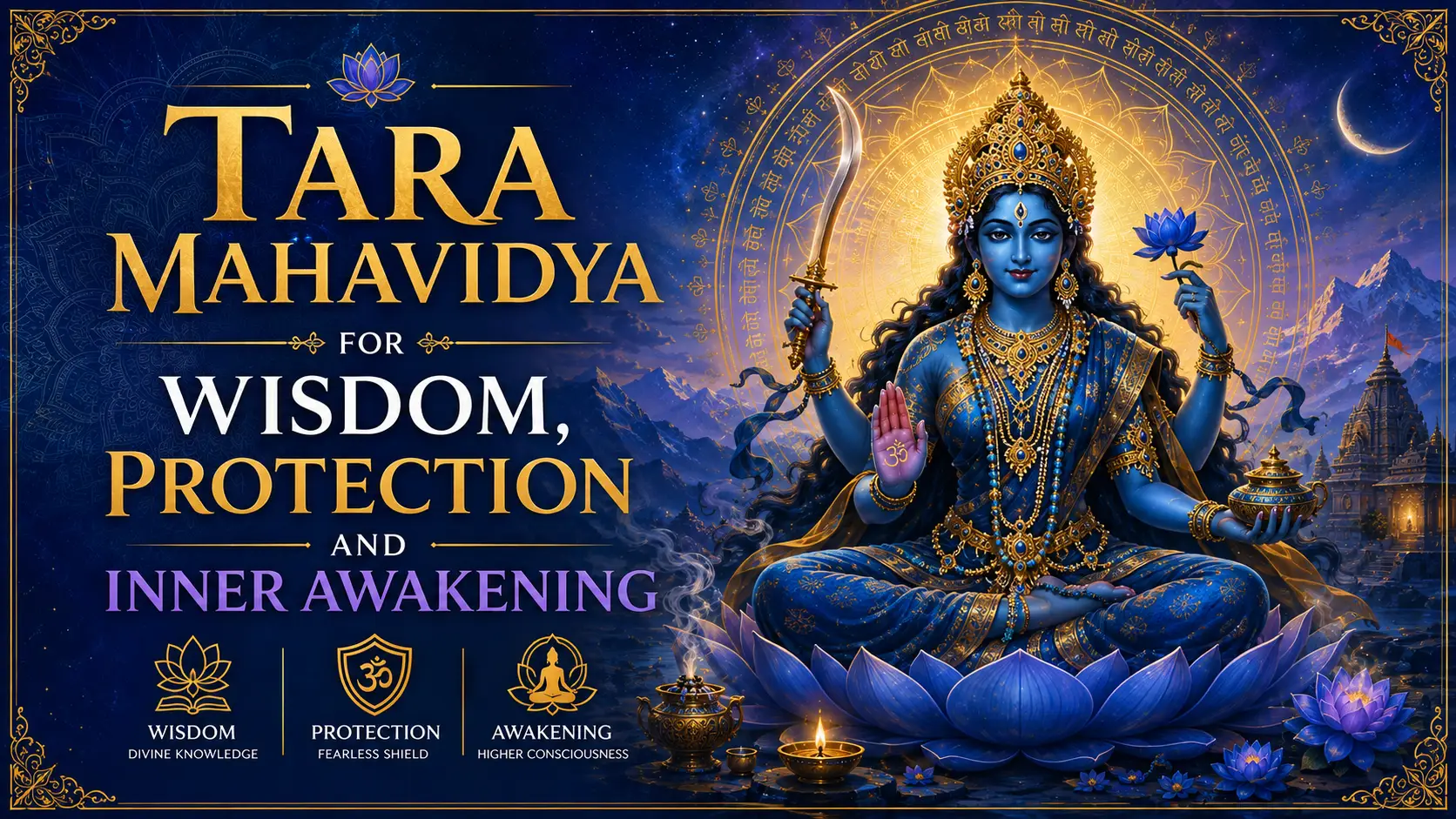
Tara Mahavidya is the second of the ten Mahavidyas, the great wisdom forms of the Divine Mother within Shakta worship. She carries wisdom, protection and the strength needed to move through fear and uncertainty without losing inner clarity. Her worship extends beyond one lineage. Related forms of her appear within Buddhist and Jain devotion too, and this alone shows how widely her symbolism has travelled across Indian spiritual thought.
Tara’s teaching speaks directly to moments of transition: grief, uncertainty, and the passage from one state of life into another. She holds the second position among the Mahavidyas for a specific reason. This placement carries real meaning. It reflects her governing role over the act of crossing, of moving from a difficult condition toward one that is more stable and clear.
The Meaning of Tara’s Name
The name Tara carries two meanings. Both are accepted together, without conflict. One traces the word to a root meaning “to cross.” Tara is the one who helps a devotee cross the ocean of worldly existence, known as samsara. The other meaning connects the name to “star,” a point of light by which a traveller finds direction in darkness.
A star gives light for finding a way through darkness. A guide who helps someone cross a difficult passage offers something close to the same gift: a steady point of reference held within the difficulty itself. This crossing is also described as running in both directions. It carries a seeker toward deeper awareness, and it carries a seeker back into full, grounded living in the world.
Tara’s Place Among the Ten Mahavidyas
The ten Mahavidyas are commonly listed as Kali, Tara, Tripura Sundari, Bhuvaneshwari, Chinnamasta, Bhairavi, Dhumavati, Bagalamukhi, Matangi and Kamala. Ten forms express one Shakti. Each represents a distinct aspect of the Divine Mother, and together they are described as the full range of her creative and transformative power.
Tara follows immediately after Kali in this sequence, and the shift in tone is deliberate. Kali’s symbolism confronts endings and uncompromising truth directly. Tara carries that same fierce intensity in a different direction, turning it toward guidance and steadiness instead of confrontation, even while her form closely resembles Kali’s own. Her worship is also linked, in some astrological correspondences, with the planet Jupiter, long associated in Indian astrology with wisdom and teaching.
Tara and the Story of Shiva’s Steadiness
Tara is associated with the episode of the churning of the cosmic ocean, during which a deadly poison rises to the surface along with the nectar. Fear spreads quickly among the gods present. Shiva alone remains unshaken, and he swallows the poison himself. This unshaken steadiness, called akshobha, is described as coming from the power of Tara working through him.
Danger is not the point of the story. The story is about something else: the steadiness that lets a difficult passage be met directly, so fear does not become a larger crisis. Tara’s symbolism connects protection to exactly this steadiness, the ability to hold clarity and calm inside a hard moment.
The Symbolism of Tara’s Blue Form
Depictions of Tara describe a blue-complexioned goddess holding a cleaver, a lotus, a dagger and a skull cup. Her hair is gathered into a single top-knot instead of left loose, and this single knot is a sign of one-pointed focus, discipline held steady rather than scattered. In her fierce form, known as Ugra Tara, the goddess is depicted with serpents associated with her matted hair and standing upon a corpse, imagery that closely parallels the fierce iconography of Kali.
Blue, across most of these depictions, represents depth and vastness, comparable to the sky or to the ocean. Other names carry related but distinct forms. Nila Sarasvati is associated with blue-toned wisdom, and Ekajata is named for that same single knot of hair. The image of standing above a corpse belongs to a wider pattern found across the Mahavidyas. It points toward what lies beyond the fear of death, not toward death as an end in itself.
Tara Mahavidya and her principal forms
| Form of Tara | Meaning / Character | Consort / Bhairava |
|---|---|---|
| Tara | The second Mahavidya; saviouress, guide and giver of liberating knowledge | Akshobhya Bhairava |
| Ugra Tara | Fierce Tara; associated with protection, destruction of obstacles and intense Tantric symbolism | Akshobhya Bhairava |
| Ekajaṭā (Ekajata) | “One-matted-lock” Tara; an intense, primordial form | Akshobhya Bhairava |
| Nīla Sarasvatī | “Blue Sarasvati”; particularly associated with knowledge, speech and wisdom | Akshobhya Bhairava |
Tara as a Guide Through Fear and Uncertainty
Fear is treated as a natural stage, not a flaw needing correction. This stage follows a recognisable pattern. It surfaces when an old sense of identity can no longer hold the situation in front of a person. Confusion, resistance, and a tight grip on familiar roles all tend to appear together, and this is exactly where Tara’s presence is felt most keenly.
Her symbolism gives protection a specific meaning. It offers steadiness that keeps clarity available even while a difficulty is still present. It does not promise that the difficulty will disappear. Grace carries more weight here than force. Grace takes the form of guidance, offering the courage to continue the crossing instead of a shortcut that skips it altogether.
Tara, the Subtle Body and the Knowledge of Truth
Some readings connect Tara’s worship to the Swadhisthana chakra, the second of the body’s primary energy centres, alongside Kali’s association with Muladhara, the first. Together with her name and her steadying presence in crisis, this placement suggests a movement: from the raw grounding Kali represents, toward the beginning of discernment and clearer feeling. Tara is also spiritually linked with Vishuddha, the throat chakra, connected to her association with true speech and clear expression.
Tara is also closely linked with sattva guna, the quality of clarity and lightness within the mind, and with tattva vidya, direct knowledge of ultimate reality. This is a specific claim, not a loose one. Her symbolism includes more than protection. It extends into the giving of the knowledge by which liberation, or kaivalya, becomes possible. Fear and confusion work as doorways into deeper understanding, not as obstacles blocking it. The crossing itself, approached with steadiness, becomes part of how that clarity is reached.
Tara and the Principle of Guidance
Formal worship of the Mahavidyas, including Tara, calls for the guidance of a qualified guru. Solitary practice alone is not considered enough. This reflects a wider pattern across Shakta worship, where the transmission of mantra and method depends on a living relationship between teacher and student, known as guru-parampara. Her own connection with Jupiter, the planet of wisdom and teaching, aligns with this same emphasis.
A person’s own reading of a symbol carries real value, and it works alongside guidance. Guidance may come through a human teacher, or through the grace her symbolism describes. Either way, it forms part of how a difficult passage gets crossed safely.
What Tara’s Symbolism Offers the Modern Seeker
A person moving through fear, grief or an uncertain transition may recognise something of Tara’s symbolism in their own situation, with or without any formal connection to her worship. Sometimes an old identity or an old certainty no longer feels enough for what a situation now demands. This is exactly the territory her symbolism addresses. At its simplest, it relates directly to that ordinary experience.
Steadiness during uncertainty differs from resistance to change. The two are often confused. Steadiness looks closer to staying discerning and conscious while a change is still underway, trusting that guidance exists even before the outcome of the crossing becomes visible.
Tara as the Inner Light of Wisdom
Across her names and forms, Tara represents protection, steadiness, and the giving of true knowledge together in one figure. Her name points toward light and toward the act of crossing. Her place as the second Mahavidya connects her to the passage from one state into another, and her connection to the Swadhisthana and Vishuddha chakras places that passage within the subtle body itself. Her iconography, from the blue complexion to the single top-knot to the fierce form of Ugra Tara, reflects depth, discipline, and what lies beyond the fear of death. Her link with Triguna (Sattva, Rajas, and Tamas) and tattva vidya carries her protective role directly into the pursuit of ultimate knowledge, and her connection to the guru principle reflects a wider emphasis on receiving guidance instead of proceeding alone.
Tara is worshipped as a Tantric goddess and counted among the ten Mahavidyas, the great wisdom forms of Shakti within Shakta worship. Her worship is described as removing fear and giving tattva vidya, direct knowledge of ultimate reality, which leads toward self-realisation, or moksha. Alongside this, her worship is described as fulfilling genuine worldly desire and offering protection. Worldly benefit and spiritual liberation are held together in her worship, not treated as separate goals a devotee must choose between.