
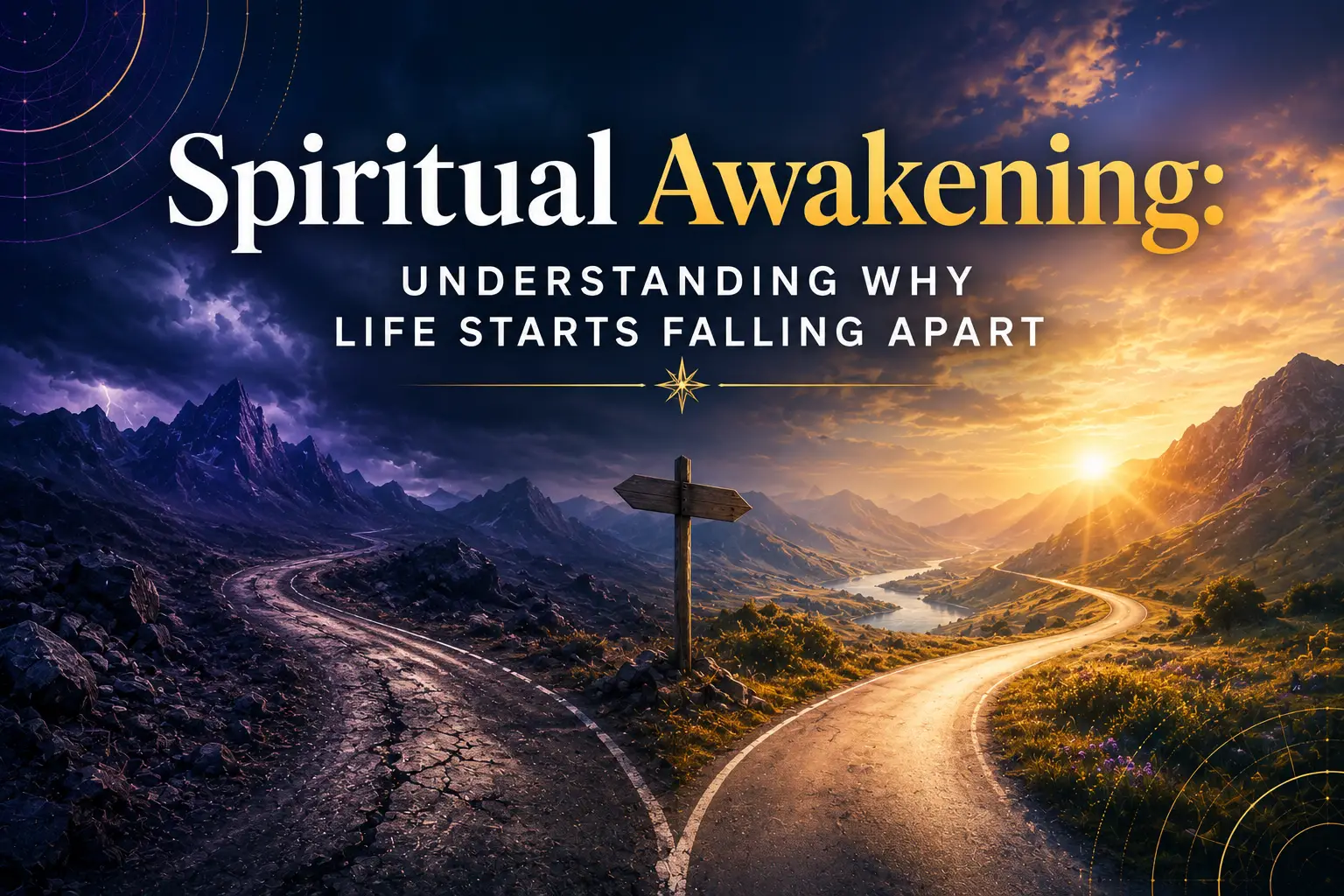
Many people entering spiritual awakening notice their relationships, careers, and sense of stability shifting or dissolving without warning. This experience is common and consistently described as a period where the old structures of identity begin to crumble. What feels like collapse is actually the disruption of the status quo, as long-held beliefs and roles that once felt secure start to lose their meaning.
People start asking questions like –
- Why am I losing friends?
- Why do I feel disconnected?
- Why don’t I enjoy my old life?
- Why do I feel lonely?
At its core, Spiritual awakening involves the purging of the old self, where accumulated emotions, patterns, and attachments surface and release, often through emotional turmoil or unexpected life changes.
This phase is often called the dark night of the soul, marked by despair, meaninglessness, and confusion, yet it is not punishment but necessary purification. What appears as falling apart is, underneath, a clearing that makes space for a more authentic and awakened way of living.
Spiritual awakening is the process by which consciousness begins to recognise itself beneath the layers of identity accumulated over a lifetime.
| Stage | What You May Experience | What It Means |
|---|---|---|
| Awakening Begins | Restlessness, questioning life | Old identity is weakening |
| Emotional Purification | Crying, anger, sadness | Suppressed emotions are releasing |
| Identity Crisis | Confusion, loneliness | Ego is restructuring |
| Integration | Greater peace, acceptance | Awareness is stabilising |
| Mature Awakening | Compassion, clarity | Inner life becomes natural |
The Dissolution of the Ego: The First Movement of Spiritual Awakening
The ego as ordinarily understood is a structure of identification. Through the body, through the mind, through memory and social role and the accumulated story of a personal history, consciousness has identified with a particular and limited version of itself. This identification is so complete that the very idea of questioning it produces anxiety.
The old identity is thinning, and the recognition of the true Self has yet to fully stabilise. The individual lives in the gap between the two, and that gap can feel disorienting.
When awakening begins, that distinction starts to reappear. This is the beginning of genuine spiritual movement, and it is uncomfortable in a very specific way, because the old self does not release its position quietly. It was built to survive. Every belief it holds, every identity it maintains, every relationship it has organised itself around served a purpose at some point. The loosening of these structures feels like loss before it feels like freedom.
The ego, or ahamkara, is the faculty that creates and maintains the sense of individual identity. It is the vehicle through which consciousness entered the world of experience. Ahamkara mistakes itself for the totality of the self, and this mistake is the root of all suffering. Awakening is the gradual correction of this mistake, and that correction, in its early stages, feels like falling apart because what is falling apart is what the person believed themselves to be.
Suppressed Emotions and the Inner Cleansing
As the layers of identity begin to release, what was held underneath them rises to the surface. Every human being carries unprocessed emotional content: grief that was never fully felt, fear that was managed through constant activity, anger that was redirected into more socially acceptable forms, sorrow that was buried under the momentum of daily life.
Spiritual practice stops the constant outward movement of attention. The mind, which was previously too busy to feel what was actually present, slows down. In that slowing, what was always there begins to be felt. This can be genuinely intense. A person who begins meditation or deepens their practice may find that the early months bring more emotional turbulence, alongside greater clarity and sensitivity.
The emotions that arise during this period are completing their cycle. They were suppressed before they could be processed. Spiritual awakening gives them the space to finally move through and release.
The individual who understands this recognises the rising of these emotions as progress. The practice is working. The inner life is becoming honest. What was hidden is becoming visible, and visibility is the beginning of release.
The Falling Away of Relationships
One of the aspects of spiritual awakening that individuals find most challenging is the shift in relationships. As the inner life changes, connections built around the old identity begin to feel misaligned. Conversations that once felt satisfying begin to feel hollow. Friendships organised around shared patterns that the person is now releasing begin to require effort they previously required none. Family dynamics that were once simply accepted begin to be seen clearly.
Spiritual growth asks for honesty, and honesty changes how a person shows up in every relationship. The individual is being invited to bring more genuine presence rather than performed identity into all connections.
Signs that relationships are being affected by awakening include:
- A growing need for depth and authenticity in conversation
- Reduced tolerance for habitual patterns of complaint, gossip, or distraction
- suddenly leaving toxic friendships
- losing interest in social media
- questioning career success
- feeling emotional after meditation
- crying for no obvious reason
- wanting more silence
- becoming sensitive to noise
- A feeling of distance from people who were previously close, without any clear conflict
- New connections forming with people encountered on a similar inner journey
As old connections shift, new connections begin to form. These are connections built on genuine recognition rather than shared habit. They tend to be fewer, deeper, and more sustaining. The person who holds this understanding approaches the transition with patience rather than panic.
The Dark Night of the Soul: When the Path Asks the Most
Every sincere practitioner eventually encounters a season on the spiritual path where the grace that was previously felt seems to withdraw, practice feels dry, the sense of progress disappears, and the individual is left sitting with a depth of inner darkness that feels unlike anything previously experienced.
The night of the soul is a season where meaning fades, and the inner world turns quiet and heavy. Common signs include sadness, exhaustion, emotional swings, loss of inspiration, and a deep feeling that old identity no longer fits. This arises when the soul loosens from borrowed roles and begins clearing what was hidden, so awakening can take root in truth. This darkness is a passage of purification, where surrender becomes the doorway, and silence becomes the teacher.
This passage, known as the dark night of the soul, is among the most productive passages on the entire path even when it feels most desolate. it as a period of deep purification where the gross layers of false identity have already been worked through and the deeper layers are being addressed.
The individual in this stage may experience:
- A complete absence of felt spiritual experience despite continued practice
- A sense that the divine has withdrawn its presence
- Profound questioning of the purpose and direction of the spiritual path
- A feeling of inner emptiness that standard remedies cannot address
- Deep fatigue alongside an inability to return to surface-level life
This is the stage that precedes the deepest openings, and it is a sign of genuine advancement rather than failure.
Physical Symptoms & Signs During Spiritual Awakening
Spiritual awakening happens throughout the whole system, including the physical body. Common physical symptoms experienced during awakening include:
- Unusual fatigue or the need for significantly more rest
- Disturbances in sleep patterns, including vivid dreaming
- Sensations of warmth or energy moving through the body, particularly along the spine
- Heightened sensitivity to sound, food, and environment
- Periods of low physical energy alternating with periods of unusual clarity and vitality
- Increased need for sleep
- Vivid dreams
- Heightened intuition
- Digestive changes
- Needing more time in nature
- Feeling overwhelmed in crowds
These are signs that the subtle body, the field of energy underlying the physical body, is reorganising itself in response to expanding awareness. Caring for the body during this period is itself a form of spiritual practice. Spiritual Awakening is a mind-body-soul process, and the body deserves the same quality of attention as the mind.
Integration: The Work After the Opening
When awakening grows, the old self begins to feel exhausted because its roles, beliefs, and habits no longer fit the deeper truth rising inside you. What once gave safety now feels limited, and the mind may resist because it wants to keep control through familiar patterns. This is why the person feels split between what has been lived for years and what the soul now wants to know.
This stage is often seen as identity collapse, yet it is really a clearing process. The old personality shaped by approval, fear, and repeated conditioning begins to loosen because awareness is growing beyond it. As this happens, there can be confusion, emptiness, and the feeling that life does not work in the old way anymore. Identity conflict during spiritual awakening is the quiet war between the old self that kept life intact and the emerging self that recognises a deeper truth. Old roles, habits, and stories begin to feel hollow as awareness grows, producing confusion, loss of interest, and shifting relationships. This inner conflict appears because the ego defends survival through familiarity while consciousness invites surrender and reorientation toward meaning beyond past conditioning.
The new self does not arrive by force. It grows through patience, self-inquiry, and honest presence, where you allow awareness to watch the old patterns without feeding them. In simple Indian English, this means you stop fighting the change and begin to listen to the quiet truth inside. The shift can feel uncomfortable because the old self is still holding the door, while the true self is waiting for space to come forward.
With steady spiritual practice, the conflict slowly becomes integration. The new self becomes more real in daily life through clear choices, inner calm, and less dependence on fear-based identity. This is how awakening matures, when the person no longer lives from borrowed life, but from direct knowing.
Integration is the gentle art of bringing the new self into daily life. It asks for honest practice, steady routine, and compassionate attention to the body and emotions so insights translate into behaviour rather than remaining ideas. Integration also needs a safe community or wise guidance to mirror the changes and prevent isolation.
As self-awareness deepens, a new identity forms that is less reactive and more centred in inner clarity. This new identity reconfigures choices, relationships, and work, reflecting waking values rather than old survival needs. The process is gradual, requiring patience, compassion, and consistent practice to stabilise the awakened self in ordinary life.
Spiritual Awakening deepens through many openings and many periods of integration. Each opening reveals a layer of the true Self more clearly. Each period of integration is the work of bringing that clarity into the actual fabric of daily life, into relationships, into work, into the quality of attention brought to ordinary experience.
Integration is the stage where insights received during practice begin to change behaviour, speech, and the quality of presence a person carries. The individual who understands integration approaches it as the second half of the spiritual work rather than as a conclusion.
Signs of genuine integration include:
- Growing steadiness in the face of difficulty and provocation
- A reduction in reactive behaviour, particularly in close relationships
- A quality of genuine listening and presence that others begin to notice
- A decreased grip of fear and ego-driven desire on daily choices
- A deepening ability to meet what arises in life with equanimity rather than resistance
- Increased compassion toward others and toward oneself
Integration takes time. There is no shortcut through this phase. The person who continues their practice during integration, rather than relaxing it once a significant opening has occurred, tends to stabilise at each level more completely before the next deepening begins.
Spiritual Awakening Signs You Are Moving Forward
- You react less and observe more.
- You stop needing everyone’s approval.
- Silence feels comfortable.
- You forgive more easily.
- You spend less energy proving yourself.
- You become more compassionate.
- Fear loses its control over decisions.
- Life feels simpler.
- Gratitude appears naturally.
- You trust life more than before.
What all of these descriptions share is the understanding that the discomfort of awakening is the discomfort of release: the body, mind, and ego completing the long work of releasing what was always a temporary covering of the true Self. The pain is real. The confusion is real. The sense of loss is real.
The path of spiritual awakening is not about forcing transformation; it is about allowing it to unfold with balance, patience, and wisdom. Every authentic spiritual tradition reminds us that awakening is supported by regular spiritual practice. During this period, the mind, emotions, and subtle energies begin to reorganise themselves. If these changes are not supported with the right spiritual disciplines, the journey can feel overwhelming. Practices such as meditation, self-inquiry, mantra, selfless service, and the study of sacred wisdom help calm the mind, purify the heart, and gradually prepare a person for spiritual growth.
Related posts:
The Stages of Spiritual Awakening Through the Das Mahāvidyās
Sri Vidya: Raising Your Inner Vibration: From Ordinary Perception to Higher Awareness
Tantra and Spiritual Growth: Three Gunas and the Subtle Body
Sri Vidya: Pure Devotion as the First Blessing
Kundalini Awakening: The Rising of Shakti Toward Shiva

Rohit Ray Sharma is a spiritual awakening coach in India helping conscious professionals and seekers find greater clarity, purpose, and self-awareness. His work draws on the wisdom of India’s Shakta and Shiva traditions, with a focus on Sri Vidya, spiritual awakening, consciousness, self-realisation, and inner transformation. Book a one-to-one spiritual awakening session to begin your journey toward greater clarity and purposeful living.
- Rohit Ray Sharma
- Rohit Ray Sharma
- Rohit Ray Sharma
- Rohit Ray Sharma