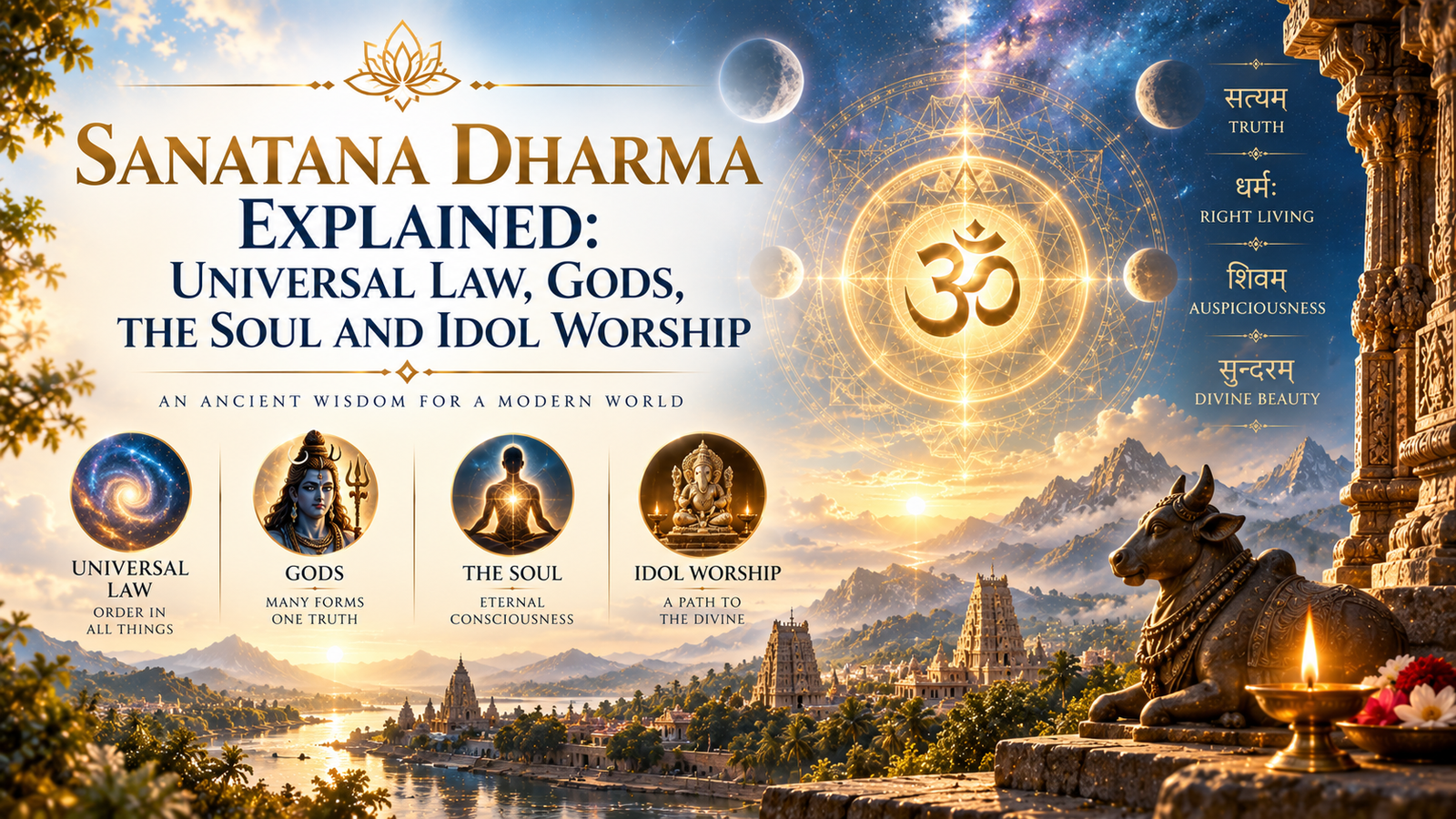
What is Sanatana Dharma, and how does it explain the way we understand God, the soul, and the world around us? For someone encountering Hinduism for the first time, the tradition can seem filled with seemingly separate ideas: an eternal universal order called dharma, many Hindu gods and goddesses, the soul or Atman, and the worship of sacred images. Why are there so many gods if Hinduism also speaks of one ultimate reality? Why worship a physical image if the divine is believed to be present everywhere? And what does Sanatana Dharma actually mean? These questions lead into a connected Hindu understanding of reality, consciousness, divine forms, and spiritual life. This article explores what Sanatana Dharma means, why Hinduism recognises many divine forms, what Atman means as the inner Self, and why murtis or sacred images are used as a focus for worship.
What Is Sanatana Dharma?
Sanatana Dharma is usually translated as the eternal law or the eternal order. The term describes Hindu tradition from within, applied to a way of life understood as timeless. Vedic thought grounds this idea in Rta, the cosmic order that governs the movement of the stars, the rhythm of the seasons, and the ethical structure of human conduct, treating all three as expressions of the same underlying pattern.
Dharma, according to this teaching, is the practice of living in alignment with that order. It covers your ethical conduct, your social duty, and the harmony you maintain between yourself, your community, and the natural world. Living in accordance with dharma is described as producing balance and steady growth. Departing from it, called adharma, is described as producing disorder, both within you and around you.
Vedic thought treats Rta as operating at every scale, from the movement of celestial bodies to the workings of an individual conscience. A universal order operating at every scale raises an immediate question about how something so vast could be approached by any one person, and this is where Hindu tradition’s numerous deities become relevant.
Why Does Hinduism Have So Many Gods?
Hindu philosophy treats its numerous deities as different forms through which one supreme reality, Brahman, becomes approachable. A widely cited Vedic teaching states this directly: truth is one, and the wise call it by countless names. This unity is named Advaita, non-duality, the teaching within Vedanta that ultimate reality is a single, undivided consciousness appearing through countless forms, the oneness underlying every one of Hinduism’s many deities. Shiva, Vishnu, Devi, Ganesha and the others, according to this teaching, as different faces of that same single reality and also separate gods ruling separate domains.
Each deity is also associated with a distinct personality, a particular state of consciousness, and a set of lessons that state makes available. Ganesha carries intellect and the ability to move past obstacles. Knowledge, learning and creative expression belong to Saraswati. Durga’s particular domain is courage and protection, while Krishna represents love, joy and playful wisdom. This connects to a broader teaching about three underlying qualities, called gunas, that shape all experience: sattva, clarity and balance, rajas, activity and drive, and tamas, rest and dissolution. Different deities are read as expressing these qualities in concentrated form, so relating to a particular deity is also a way of relating to the state of consciousness that deity embodies. A person drawn to one of these figures is, according to this teaching, drawn to the specific quality and state that figure represents, and that pull is treated as meaningful.
Ishta Devata is the practice built on this idea: choosing a personal deity suited to your own temperament and stage of spiritual development. If you are drawn toward discipline and renunciation, Shiva may be the natural fit. Devotion, beauty and surrender point more toward Krishna or a Mother Goddess. The choice is not treated as a rejection of the other forms. It is treated as selecting the specific doorway best suited to your own nature, with the understanding that every doorway opens onto the same single reality. Devotion offered this way is understood as a path for completing a specific inner lesson, as a soul lesson, one deity’s particular quality meeting the specific growth you need.
Your relationship with a chosen deity is also understood to change as your own spiritual understanding deepens. Devotion often begins with approaching a chosen deity for something specific, clarity, protection, relief from a difficulty. As the relationship continues, that seeking can mature into trust and love held for their own sake, apart from what is received in return. Your connection to a personal god is expected to deepen along the same path your own spiritual progress is already moving through.
If one supreme reality expresses itself through numerous forms and a seeker relates to those forms through personal devotion, who is doing the relating? Hindu philosophy’s answer to this is Atman.
What Is Atman? Understanding the Hindu Idea of the Self
Atman refers to your true self, distinct from the body, the mind and every role or identity built around them. Hindu philosophy describes the ordinary sense of self as constructed from five layers, called the Pancha Kosha, the five sheaths, that surround Atman without being identical to it.
- Annamaya Kosha, the outermost layer, is the physical body built from food and matter.
- Pranamaya Kosha comes next: the vital energy and breath that animates the body and separates a living being from a dead one.
- Manomaya Kosha, the mental layer, includes ordinary thought, the senses, and emotional reaction.
- Intellect, discernment and deeper understanding belong to Vijnanamaya Kosha, the faculty that can reflect on experience instead of only reacting to it.
- Closest to Atman itself is Anandamaya Kosha, associated with a quiet sense of peace that appears in deep, dreamless sleep and in moments of genuine stillness.
Hindu philosophy also describes this true self through the term Jivatma, the individual soul or individual consciousness, connected to Paramatma, the supreme, universal consciousness. The Bhagavad Gita describes this individual consciousness as unborn and undying, never subject to birth or death even while the body it inhabits is born, ages and eventually dies. What looks like a beginning and an end from the outside, a body coming into existence and later ceasing to exist, is treated as a change belonging only to the body, leaving the consciousness inhabiting it untouched. Different schools within Hindu philosophy describe what this individual consciousness ultimately is in relation to Paramatma differently. Advaita Vedanta holds that the two are, at the deepest level, the same undivided consciousness.
Your body ages and eventually dies. Your vital energy fluctuates throughout a single day. Your mind changes constantly, and even your intellect and its accumulated understanding shift over a lifetime. Atman or Soul is described as the constant awareness in which all five layers are experienced, present without itself being any one of the things it experiences.
If your true self is this subtle, distinct from the body and even from ordinary thought, an ordinary mind needs some way to reach toward it, or toward the divine reality. Hindu tradition’s use of physical images addresses exactly this difficulty.
Why Do Hindus Worship Idols?
Your mind relates to reality most easily through form, pattern, and repetition, more easily than through pure abstraction. A completely formless concept is difficult for you to hold attention on for long, while a specific image, name or story gives your mind something concrete to return to consistently. Murti puja, the worship of consecrated images, is built on this observation about how attention and memory work.
An idol, called a murti, functions instead as a point of focus, a specific form your mind can return to again and again until a personal connection with the quality that form represents grows stable. The material gives your mind a consistent, repeatable object to direct attention and devotion toward.
The specific form a murti takes follows this same reasoning. Hindu sculptural tradition, called Shilpa Shastra, sets out precise proportions for constructing temple images, a system historically measured in units derived from the human hand. Every feature carries deliberate meaning within this system: the number of arms, the posture, the objects held, and the ornaments worn are all specified in advance, encoding a deity’s particular qualities directly into the geometry of the form. Each detail on a four-armed figure holding specific objects corresponds to a quality the tradition associates with that deity, a deliberate encoding rather than decorative variation. The visual pattern itself, its geometry, its consistent persona, and the memory built through repeated viewing become something the mind learns to recognise without deliberate, conscious analysis.
Hindu philosophy holds that Brahman is not confined to a particular place or scale. It is present in the vastness of the universe and equally present at the quantum level, the smallest constituent of matter, present in a mountain, a river, a stone, and in you. This correspondence between the smallest scale and the largest is described through the idea of microcosm and macrocosm, the individual as a compressed reflection of the same pattern that structures the cosmos as a whole. An idol gives your ordinary attention a specific place to notice a presence already there, in the object, in your surroundings, and in yourself.
Frequently Asked Questions
- What does Sanatana Dharma mean?
Sanatana Dharma means the eternal law or the eternal order. It describes Hindu tradition as a way of living aligned with Rta, the cosmic order Vedic thought identifies as governing nature, ethics and society together. - Are the many Hindu gods considered separate beings?
Hindu philosophy generally treats them as different forms through which one supreme reality, Brahman, becomes approachable. - What is Ishta Devata?
Ishta Devata is a devotee's chosen personal deity, selected based on temperament and spiritual stage. The choice is treated as selecting the doorway suited to that person. - What is Jivatma?
Jivatma is the individual soul or individual consciousness, described by the Bhagavad Gita as unborn and undying even as the body it inhabits is born, ages and dies. Schools differ on its ultimate relationship to Paramatma, the supreme consciousness, some holding the two are the same reality, others holding the individual consciousness remains eternally distinct. - What are the five koshas of the Pancha Kosha?
The Pancha Kosha are Annamaya, the physical body, Pranamaya, vital energy, Manomaya, the mind and senses, Vijnanamaya, intellect and discernment, and Anandamaya, the subtle layer of peace closest to Atman.

Rohit Ray Sharma is a spiritual awakening coach in India helping conscious professionals and seekers find greater clarity, purpose, and self-awareness. His work draws on the wisdom of India’s Shakta and Shiva traditions, with a focus on Sri Vidya, spiritual awakening, consciousness, self-realisation, and inner transformation. Book a one-to-one spiritual awakening session to begin your journey toward greater clarity and purposeful living.
- Rohit Ray Sharma
- Rohit Ray Sharma
- Rohit Ray Sharma
- Rohit Ray Sharma