
How Conditioning, Suffering and Self-Knowledge Connect Into One Movement
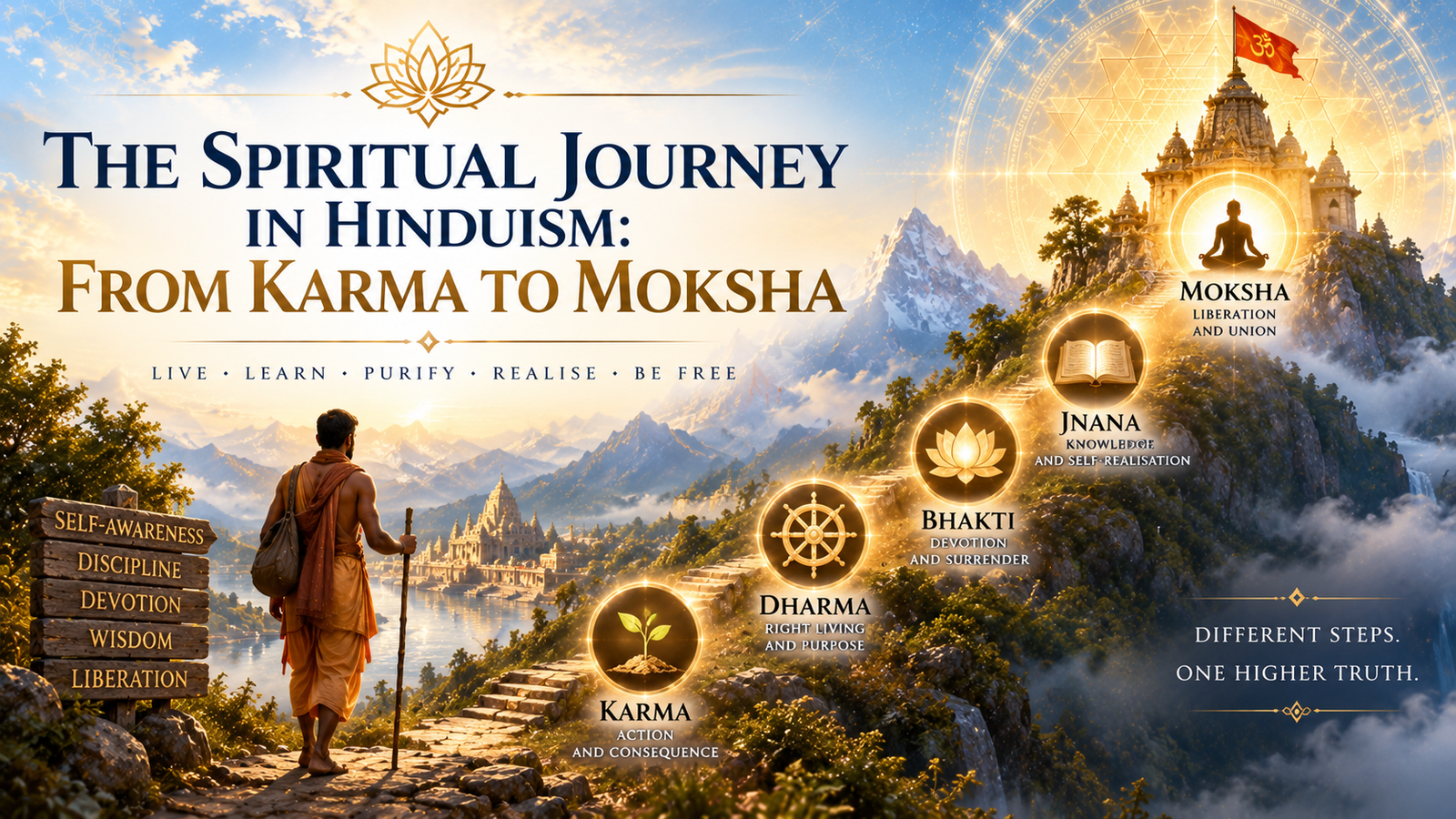
Hindu philosophy explains spiritual life as one continuous movement, not a set of separate ideas to learn one at a time. A pull toward spirituality has a cause. That cause shapes tendencies, tendencies shape desire, desire shapes suffering, and a specific sequence of teachings explains how that suffering loosens and eventually gives way to knowledge of the Self.
1: Why the Spiritual Search Begins
Some people find themselves pulled toward meditation, mantra, temples or the search for deeper meaning with no clear cause in their present circumstances. If this describes something you have felt, Hindu philosophy calls the underlying reason purva-abhyasa, previous practice. The Bhagavad Gita describes a seeker who leaves spiritual practice unfinished in one life as regaining connection with that understanding in a later one, carried forward by the sheer force of the earlier effort. If something can be carried forward across an entire lifetime, what exactly is doing the carrying? The answer is not a memory. It is a tendency, and understanding how a tendency forms is where the real teaching begins.
2: What Shapes the Person You Become
Samskara is the starting point. Every experience and action leaves an impression on the deeper structure of the mind, a kind of imprint that stays even after the experience itself is forgotten. A single samskara has little effect on its own. The real shift happens when the same kind of impression repeats enough times to start influencing how the mind responds as a recurring pattern.
That repeated pattern is vasana, a tendency or leaning that has taken root. Vasana is what turns a scattered set of past impressions into something that behaves like a leaning: a pull toward certain experiences, an aversion to others, a felt sense of what feels natural before any conscious decision has been made. A tendency, once formed, moves toward expression.
That expression is desire. A vasana becomes a want, the want shapes an intention, and the intention moves you toward action. The relevant question is also what you deeply wanted while doing it, since desire is what gives an action its actual direction rather than its outward appearance.
Action completes the cycle. This is where karma applies. Karma is more than what happens to you because of what you did. Action produces a consequence, and it also leaves a fresh impression that strengthens a tendency going forward. Past action shapes present circumstances. Present action shapes future tendency, and together they explain why two people can meet the same circumstance and respond in completely different ways.
3: Why Conditioning Becomes Suffering
The mind does more than register a want. It builds a felt sense of ownership around it: a sense of wanting something, of having achieved it, of something having happened to oneself, of something being one’s own. Hindu psychology names this function ahamkara, the ego, sometimes translated as the I-maker. Ahamkara plays a useful function in this account, part of the mind’s own instrument, alongside intellect and memory. Without an ordinary sense of individuality, everyday functioning would be difficult. The difficulty appears only when this limited, constructed identity gets mistaken for the whole truth of who you are.
Once a separate self is in place, a predictable pattern follows on its own. A self that exists wants things that support it and resists things that threaten it. Hindu philosophy names these two motions raga and dvesha, attraction and aversion. When circumstances agree with what your ego prefers, there is pleasure. When circumstances contradict those preferences, there is resistance. You can feel lifted by praise and deeply wounded by criticism that changes nothing real about your life. The event is often small. The attachment behind it is what determines how strongly your mind reacts.
This is the point where the whole chain turns into suffering. Samskara built a tendency. Vasana turned it into a leaning. Desire gave it direction. Ahamkara claimed it as personal. Raga and dvesha turned every outcome into either a win or a threat.
4: How Spiritual Growth Loosens This Pattern
Vairagya is the classical answer. Vairagya means something more specific than becoming indifferent to life or withdrawing from relationships, work and responsibility. It is the gradual loosening of an inner compulsion that insists a particular outcome must happen for you to feel whole. You can remain fully engaged in family, career and daily duty while holding all of it with a far lighter grip, no longer pulled by attraction or pushed by aversion the way you once were. This kind of freedom is available in the middle of an active life just as much as in retreat from it.
Detachment of this depth is rarely reached by deciding it intellectually. Your mind has accumulated real tendencies over real time, and those tendencies need their own kind of purification. Hindu tradition offers several routes toward this. Karma yoga addresses the habit of turning action into the ego’s search for security and recognition. The action itself continues exactly as before. What changes is the psychological ownership behind it, so that acting well no longer depends on being seen, praised or proven right. Devotion, bhakti, works in a different way entirely: it introduces reverence, trust and surrender, letting a person recognise that life was never fully controllable through individual effort alone, and offering that recognition somewhere instead of carrying it alone.
Both of these prepare the ground for a more direct movement, though a seeker can reach that movement without completing either one first. Someone drawn to devotion and someone drawn to inward questioning are working through the same loosening in two different ways, one through action and love, the other through enquiry.
That inward turn is jnana. At a certain depth, the question you are asking changes shape. It stops being what practice will bring peace, or which teaching holds the answer, and becomes something more direct: who is the one who has been asking all of this the entire time. This is knowledge understood as recognition rather than accumulated information, and it is the natural place the earlier loosening was always leading you toward.
5: Where the Journey Leads
Everything examined so far, thought, emotion, desire, identity, all of it changes. Hindu philosophy asks a pointed question about anything that changes: can something that changes be the deepest truth of who a person is. Vedantic enquiry follows this question directly to the awareness that remains constant while every thought, feeling and identity appears and passes. This recognition is atma jnana, direct knowledge of the Self, and it reveals something that stands beyond birth and death.
Spiritual growth within samsara focuses on creating better circumstances for the next life, gradually refining tendency after tendency. At this point, the question changes from how to improve experience within samsara to whether liberation from samsara is possible at all. That deeper question is a different one: who is the one being born and dying in the first place. Moksha is the answer this question leads to, liberation from the entire structure of birth and rebirth itself.
Summary
A pull toward spirituality pointed toward previous practice. Previous practice pointed toward samskara. Samskara matured into vasana, vasana into desire, desire into karma. Karma needed a self to claim it, which is ahamkara, and that self split experience into wanted and unwanted through raga and dvesha, which is where suffering begins. Vairagya loosened the grip. Bhakti and jnana carried the loosening further, toward atma jnana, and atma jnana revealed exactly what moksha had been pointing toward the entire time: liberation from the structure of birth and rebirth itself.
Frequently Asked Questions
- What is the difference between samskara and vasana?
Samskara is the impression left by a single experience or action. Vasana is the tendency that forms once similar impressions repeat enough times to shape what a person naturally wants and how they behave. - What does ahamkara mean?
Ahamkara is the mind's function of claiming ownership over experience, the sense of wanting something, achieving it, or having it happen to oneself. It is a natural part of ordinary functioning. The difficulty appears only when this constructed identity is mistaken for your whole and deepest Self. - Does vairagya mean giving up worldly life?
No. Vairagya is the loosening of an inner compulsion that insists a particular outcome must happen for someone to feel complete. A person can hold a career, relationships and daily responsibility fully while this compulsion loosens. - Are bhakti and jnana competing paths?
No. Devotion and knowledge are treated as two valid routes toward the same recognition, suited to different temperaments, moving through love and surrender on one path, and enquiry on the other.
Related posts:
Sri Vidya: The Blessing of Abundance: Prosperity, Success and the Fulfillment of Life
Sri Vidya: The blessing of Magnetism, Creativity, and Beauty
Ten Mahavidyas for Trauma & Healing: Path of Inner Transformation
Shakti Tantra: Signs When the Divine Mother Chooses the Soul
Sri Vidya: Raising Your Inner Vibration: From Ordinary Perception to Higher Awareness

Rohit Ray Sharma is a spiritual awakening coach in India helping conscious professionals and seekers find greater clarity, purpose, and self-awareness. His work draws on the wisdom of India’s Shakta and Shiva traditions, with a focus on Sri Vidya, spiritual awakening, consciousness, self-realisation, and inner transformation. Book a one-to-one spiritual awakening session to begin your journey toward greater clarity and purposeful living.
- Rohit Ray Sharma
- Rohit Ray Sharma
- Rohit Ray Sharma
- Rohit Ray Sharma