
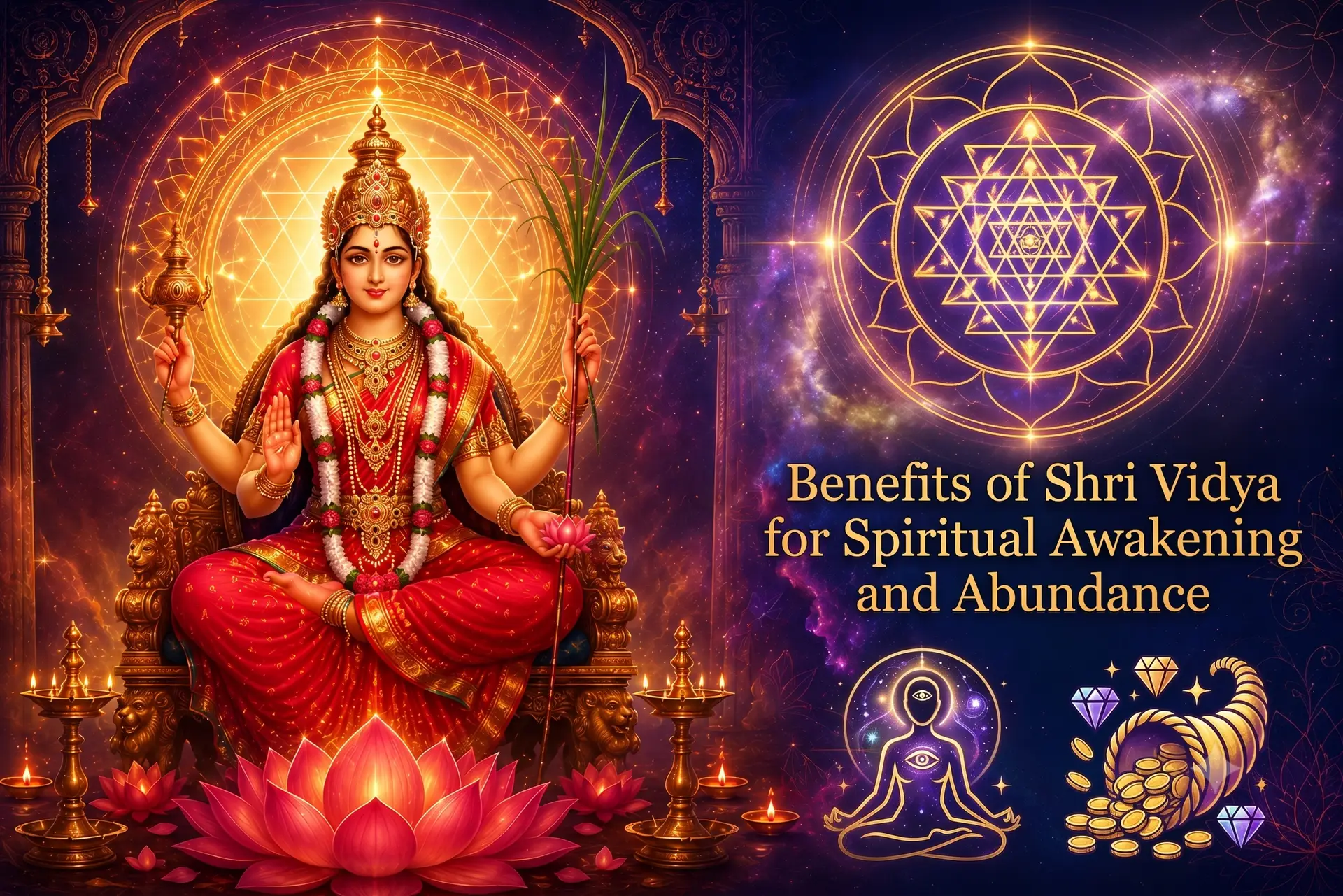
Lalita Tripura Sundari is the supreme mother goddess of Sri Vidya, representing both spiritual grace and material abundance. Her blessings allow a person to maintain material stability while progressing on the spiritual path. This point deserves attention because many people beginning a spiritual journey carry the assumption, absorbed from certain traditions or popular stereotypes, that spiritual seriousness demands giving up ambition, comfort, or success. Sri Vidya sets that assumption aside directly. Prosperity, success, stable relationships, and a comfortable life are considered legitimate and welcome outcomes of sincere practice. They are understood as one of the concrete ways her abundance appears in a person’s life circumstances.
Prosperity still requires ordinary effort, practical work, planning, and skill. What changes is the quality of that effort. Decisions that once involved heavy anxiety begin to reflect more clarity, made from a calmer, more discerning place rather than from fear or urgency. Opportunities that once felt scarce often start appearing more easily as well. This happens through the simple fact that a settled, attentive person recognises and acts on genuine openings sooner than a scattered, anxious one. The same external effort, when applied from a steady inner state, yields different results.
What the tradition describes is a shift in the inner conditions from which a person approaches work, money, and relationships. These conditions support better outcomes over time. The shift does not promise magic or effortlessness. It promises that when inner stillness grows, outer actions become more effective. When fear lessens, clarity increases. When attachment loosens, discernment sharpens. The same life continues, but the person living it has changed. That change is what allows material life and spiritual depth to grow together, without one needing to diminish the other.
Bhoga and Moksha: Why Sri Vidya Embraces Both Prosperity and Liberation
The relationship between bhoga and moksha deserves closer attention, since it sets Sri Vidya apart from several other approaches within Indian spirituality, and it often becomes the point beginners find most reassuring once understood clearly.
Bhoga means worldly enjoyment and fulfillment, comfort, relationship, achievement, sensory and emotional satisfaction. Moksha means liberation, the freeing of awareness from the sense of being small, separate, and bound by fear and craving.
It holds that bhoga and moksha stand as two expressions of the same underlying grace, available together, since the tradition regards the entire visible world, including ordinary desires, relationships and ambitions, as a direct expression of the Divine Mother. A career pursued with integrity, a family cared for with attention, a creative project pursued with dedication- each of these can stay whole and can become the actual setting where self-realization unfolds.
This is a significant reason the path has stayed appealing across generations of practitioners managing full worldly responsibilities. You remain free to build a full life, a career, a family, a creative practice, while that same life becomes the setting where devotion, awareness, and eventually self-realization keep deepening.
Related posts:

Rohit Ray Sharma is a spiritual awakening coach in India helping conscious professionals and seekers find greater clarity, purpose, and self-awareness. His work draws on the wisdom of India’s Shakta and Shiva traditions, with a focus on Sri Vidya, spiritual awakening, consciousness, self-realisation, and inner transformation. Book a one-to-one spiritual awakening session to begin your journey toward greater clarity and purposeful living.
- Rohit Ray Sharma
- Rohit Ray Sharma
- Rohit Ray Sharma
- Rohit Ray Sharma