
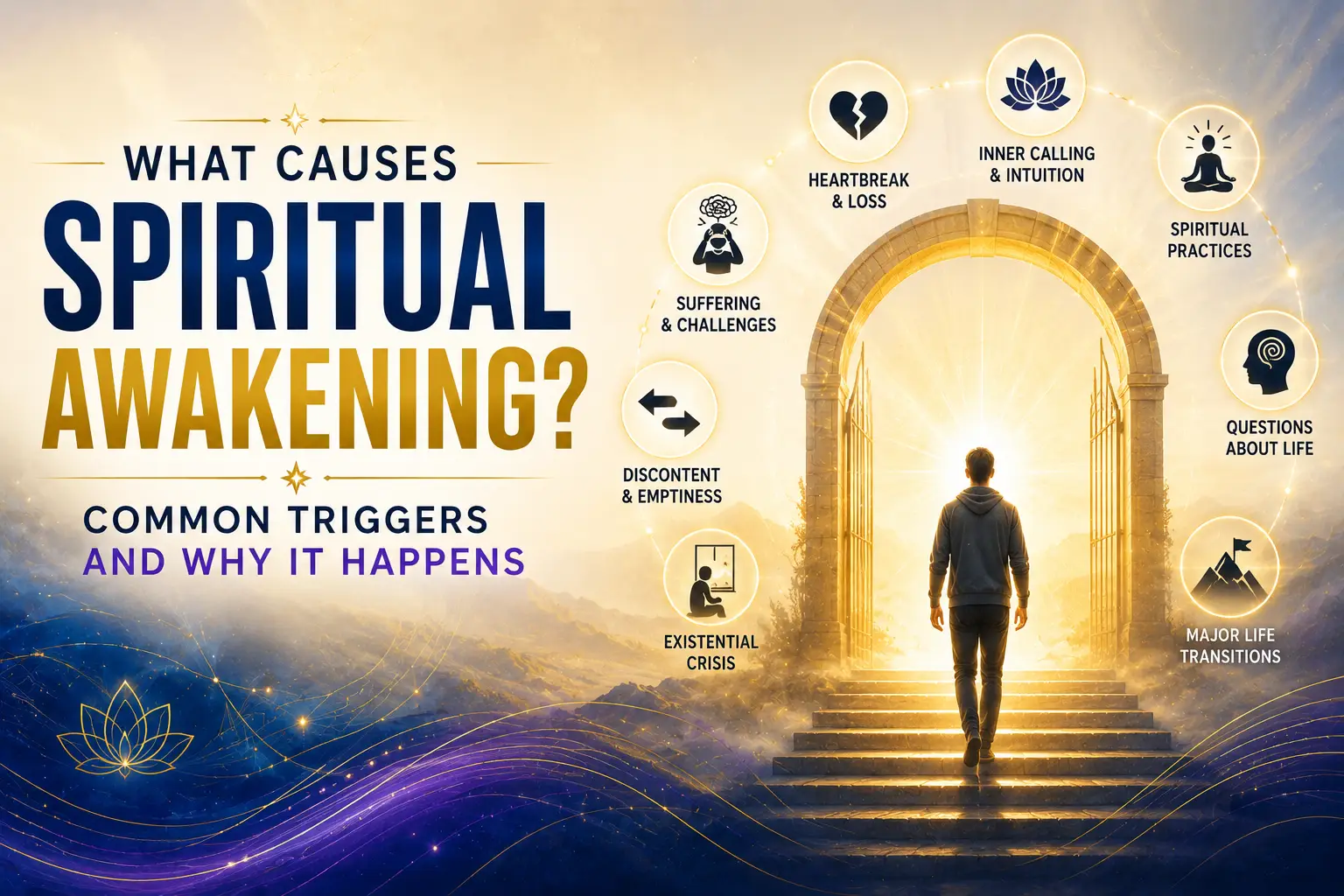
People often describe their spiritual awakening as something that arrived without warning. A loss, an illness, or the end of a relationship. This includes grief, loss, depression, relationship breakdown, and other forms of intense inner pressure. The mind tends to point to that outer event and say: that is where it started. Understanding what those causes are changes the relationship a person has with their own inner life, and with every experience that arrives in it.
What Spiritual Awakening Actually Is
Spiritual awakening is the process by which consciousness begins to recognise its own true nature. It is the gradual or sudden shift from identifying entirely with the body, mind, and personality to recognising that something far deeper and more permanent underlies all of these.
It is a profound shift in consciousness that changes how reality is experienced. The familiar identity built from memories, roles, achievements, and conditioning begins to soften, revealing a deeper awareness that feels timeless, peaceful, and deeply connected to all life. This awakening often brings an expanded sense of presence, heightened intuition, greater compassion, meaningful synchronicities, and the recognition that life is guided by a deeper intelligence. Awakening is an unfolding process of healing, self-discovery, and raising consciousness, where each layer of fear, limitation, and conditioning gives way to greater love, freedom, and inner truth.
Here are 20 of the most frequent signs of spiritual awakening:
-
You begin questioning the purpose and meaning of life.
-
Old beliefs and assumptions no longer feel true.
-
You feel drawn to discover your authentic self.
-
Your intuition becomes stronger and easier to trust.
-
You notice meaningful synchronicities appearing more often.
-
You develop greater compassion and empathy for others.
-
Solitude becomes nourishing instead of lonely.
-
Superficial conversations and distractions lose their appeal.
-
You become more aware of your thoughts, emotions, and habits.
-
A deep desire for truth and authenticity replaces the need for approval.
-
You experience a stronger connection with nature and all living beings.
-
Your priorities shift from external success to inner peace.
-
You become more emotionally sensitive while also growing more resilient.
-
Relationships that no longer support your growth begin to change.
-
You feel called to heal old emotional wounds and limiting patterns.
-
Your dreams become more vivid, symbolic, or memorable.
-
You feel an increasing sense of unity with life rather than separation.
-
Material achievements alone no longer bring lasting fulfilment.
-
You become more present, mindful, and aware of each moment.
-
You feel guided toward living with greater purpose, love, and service.
Common Triggers and What They Actually Do
Spiritual awakening triggers are the outer conditions or inner experiences that bring the threshold to the surface. Certain categories of experience appear most often as the circumstances surrounding an awakening.
1. Loss and grief
The death of someone loved, the end of a significant relationship, or the collapse of a life structure that was providing identity and meaning. Loss removes the outer scaffolding that the constructed self relies upon. When that scaffolding falls away, what remains is more visible. The soul beneath the structure becomes harder to ignore.
2. Physical illness or a near-death experience
The body becoming seriously ill, or the direct encounter with the possibility of death, breaks the ordinary assumption that consciousness and physical continuity are the same thing. What many people discover during serious illness is that something in them remains present and aware even as the body weakens. This recognition can begin a sustained inner inquiry.
3. A period of profound inner emptiness
Sometimes called the dark night of the soul, this is a season in which the soul finds itself stripped of meaning, direction, and the sense of progress. Nothing provides satisfaction. Everything that once worked to create a sense of purpose stops working. This emptiness is when the outer covering of identity becomes thin enough that the truth beneath it is almost visible, and the gap between the two feels unbearable.
4. A spontaneous inner experience
A moment of complete inner stillness in which the ordinary boundaries of the individual self seem to dissolve. A sudden recognition that consciousness extends beyond the body. An experience of profound peace or love without any apparent external cause. These experiences arrive with no prior warning and no outer trigger, and they tend to be among the most disorienting of all awakening circumstances because they have no context in ordinary experience.
5. Sustained spiritual practice
Regular meditation, mantra, devotion, and sincere inner inquiry work precisely and gradually on the subtle body. Over time, this practice thins the veils that keep the true Self concealed. For those who have been practising sincerely over years, awakening often arrives without any single dramatic trigger, through the slow accumulation of clarity that practice produces.
What Causes Spiritual Awakening: The Inner Readiness
Purvajanma Samskara, the accumulated impressions of previous lives, and sincere seeking carried forward through multiple lifetimes. A person who feels drawn to spiritual understanding from an early age, who finds ordinary answers insufficient, who carries a persistent hunger for truth that ordinary success cannot satisfy, is carrying the momentum of inner work already done.
This is the primary cause of spiritual awakening. The outer triggers that appear so significant are secondary. They are the circumstances through which an already ripening inner readiness finally breaks the surface.
The causes that are identified as preparing a soul for awakening include:
- Accumulated sincere seeking across the current lifetime and previous ones, building inner readiness
- The ripening of prarabdha karma, the specific portion of accumulated experience that has come into active expression in the current life
- A deep and genuine longing for truth held consistently over time, even when that longing had no formal spiritual direction
- Encounters with genuine spiritual teaching or a qualified teacher whose presence or words land at a moment of inner readiness
- Creative and artistic experiences that open the soul to states beyond ordinary thought
- Prolonged periods of solitude and silence in which the surface mind finally quietens enough to sense what lies beneath it
- Body-based practices such as breathwork, somatic movement, or sustained physical stillness that release stored tension from the nervous system
When these conditions have gathered sufficiently, something in the inner life reaches a threshold. The outer event that appears at this moment is the form through which the threshold becomes visible. It is real, and it matters. And the deeper cause was building long before it arrived.
The trigger is the event. The awakening is the inner process that the event makes visible. A person who has genuinely understood this begins to engage with life differently. Every experience, pleasant or difficult, is received as potentially relevant to the inner process.
According to the Shakta tradition, the Divine Mother arranges the circumstances of a soul’s life precisely according to what that soul requires for its inner development. The loss arrives when it is needed. The emptiness appears when the soul is ready to discover what lies beneath the constructions of the conditioned mind. The stillness opens when the inner ground has been prepared sufficiently to receive it.
It is an invitation to recognise the spiritual awakening process.
Related posts:

Rohit Ray Sharma is a spiritual awakening coach in India helping conscious professionals and seekers find greater clarity, purpose, and self-awareness. His work draws on the wisdom of India’s Shakta and Shiva traditions, with a focus on Sri Vidya, spiritual awakening, consciousness, self-realisation, and inner transformation. Book a one-to-one spiritual awakening session to begin your journey toward greater clarity and purposeful living.
- Rohit Ray Sharma